Broadleaf weed control in new and established pasture.
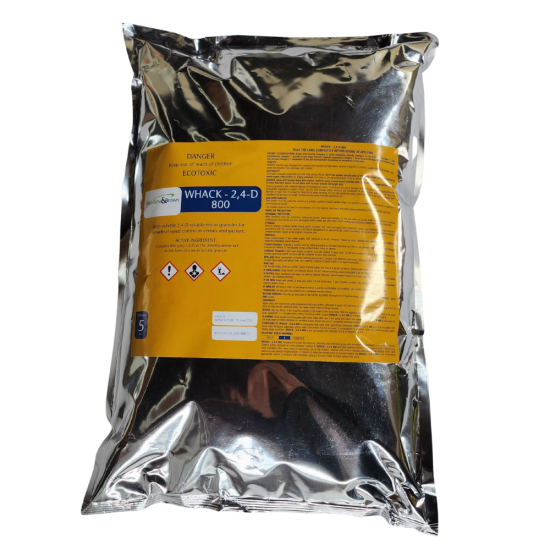
Contains: 800g/kg 2,4-D as the dimethylamine salt in the form of a water soluble granule.
WHACK - 2,4-D 800 is a non-volatile, micro granule herbicide for controlling broadleaf weeds in pasture and cereals. This easy-to-dissolve formulation provides effective weed control with minimal handling concerns and reduced odour compared to traditional 2,4-D products (particularly esters!). It’s also a concentrated 800g/kg amine formulation, so has a bit more grunt than the older style products around.
Similar or Equivalent to:
- Baton 800wsg (1)
Key Product Features
2,4-D herbicides are widely used in controlling broadleaf weeds in new and established pastures, in various agricultural, turf and non-crop settings. It is relatively kind to clover when sprayed after hard grazing.
On pasture, we recommend a dosage rate of between 1-3kg/ha. The lower rate for seedling weeds and small plants and the higher rate for more mature plants. The best time to use WHACK – 2,4-D 800 is late autumn or early winter.
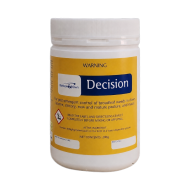
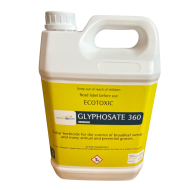
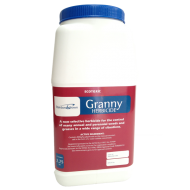
WHACK – 2,4-D 800 is also compatible with most commonly used herbicides including our Glyphosates (Rainbow & Brown Glyphosate 360, Rainbow & Brown Glyphosate 540, Granny Herbicide), Decision and Dicamba 500 SL.
What’s Controlled by WHACK – 2,4-D 800?
WHACK – 2,4-D controls or severely checks the following weeds:
Allseed, apple of Peru, Bathurst bur, bitter cress, black nightshade, burdock, bur medick, buttercups, Canadian fleabane, Californian thistle, catsear, charlock, chicory, cornbind, cresses, dandelion, dove's foot, fathen, field bindweed, foxglove, groundsel, hawkbit, hawksbeard, hawkweed, hedge mustard, mouse-ear chickweed, nettles, nodding thistle, oxtongue, parsley dropwort, penny cress, pennyroyal, piripiri, plantains, ragwort, red dead nettle, redroot, scotch thistle, selfheal, shepherd's purse, storksbill, twin cress, variegated thistle, vetch, wart cress, wild mustard, wild carrot, wild parsnip, wild radish, wild turnip, willow weed, winged thistle.
Controlled as Seedlings Only:
Cape weed, creeping mallow, cut-leaved geranium, daisies, docks, fennel, spurrey, thornapple, willow weed.
WHACK – 2,4-D 800 can be tank mixed with flumetsulam (Decision) and clopyralid (Ralid) for control of mature, multi-crown and hard-to-kill weeds in one application.
Ragwort Control with Rainbow & Brown WHACK – 2,4-D 800
WHACK 2,4-D 800 is the ideal product for spraying ragwort in the May to July period, when the plant is at its most susceptible, and when clover damage will be minimised due to less clover leaf being present in pastures.
Thistle Control with Rainbow & Brown WHACK 2,4-D 800
Boom spraying in late autumn and early winter with WHACK – 2,4-D 800 will control autumn-germinating thistles at their most vulnerable seedling stage. Early spring is also effective if the thistles are still seedlings or small rosettes.
Control Spring Germinating Weeds with Rainbow & Brown WHACK – 2,4-D 800
WHACK – 2,4-D 800 sprayed in spring gives excellent control of those broadleaf weed species that can’t be dealt with by the autumn/winter boom spraying because they germinate too late. That is dandelion, storksbill, pennyroyal, and many other spring germinating weeds.
What Weeds are not Controlled with WHACK 2,4-D 800?
Chickweed, cleavers, grasses, hydrocotyle, stinking mayweed, oxalis, prostrate amaranth, parley piert, pearlwort, sorrel, staggerweed. There are also some instances of herbicide resistance to 2,4-D in some parts of the country including nodding thistle, slender winged thistle and buttercup.
General Information
Best results are achieved when weeds are small seedlings and actively growing. Use lower rates on seedlings and higher rates on larger weeds or during periods of hardened growth. Note that larger plants and established biennials are often not well controlled, and perennial plants are not well controlled.
APPLICATION OF WHACK – 2,4-D 800
WHACK – 2,4-D 800 can be applied with conventional ground and aerial equipment. Use the higher rates for difficult-to-control perennial weeds.
Aerial Application
Use 30 – 100 L of water per hectare. To minimise damage to susceptible vegetation within 500m, use low drift nozzles which minimise the production of small droplets (less than 100 microns).
Boom Spray Application
Use 100 – 300 L of water per hectare in most situations. For hard-to-kill weeds use 200 – 500 L of water per hectare.
High Volume Spot Treatment / Handgun Rate
500g/100L water with 600 – 800 kPa pressure and No. 4 tip.
Knapsack
50g/10L water
DIRECTION FOR USE OF WHACK – 2,4-D 800
Apply only once per season.
| Crop | Rate | Critical Comments |
|---|---|---|
|
Wheat Barley Millet Ryecorn |
1 – 1.5 kg/ha |
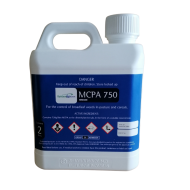
Apply from 6 leaf stage to jointing (when nodes are visible at the base of the stem). Do not apply to wheat or barley between jointing and flowering. Rapidly growing spring-sown cereals should be treated with MCPA (Rainbow & Brown MCPA750). Critical comment: Application to crops outside recommended growth stages or crops stressed due to insect damage or moisture stress may cause serious injury including yield loss. Inspect crops before application to check condition arid growth stage. |
|
Oats |
1 kg/ha | Use only on autumn sown oats and treat in the following spring when plants are fully tillered. Use MCPA on spring sown oats. |
|
Pasture (grass) |
1-3 kg/ha | Refer to Weeds Controlled Table for guidance (refer to the product label). Graze area to be treated to expose weeds and reduce clover leaf. Then leave one week to freshen up before spraying. As treated weeds are more palatable to stock, avoid grazing for 7 days after spraying. |
PASTURE MANAGEMENT
- WHACK – 2,4-D 800 is damaging to all clovers, especially red, suckling and subterranean clover. Additional it damages plantain and chicory. To minimise pasture damage, graze pasture to reduce clover leaf and expose target weeds, and leave for one week to allow weeds to recover before spraying.
- Do NOT spray hay or silage paddocks.
- After spraying, poisonous plants e.g. Ragwort may become more palatable.
- WHACK – 2,4-D 800 may be used for weed control in newly established pastures where weeds are too large for, or not well controlled by MCPB. Do not exceed 1.5kg/ha. If red clover was sown do not exceed 1kg/ha. Clover growth will be suppressed for 3-4 months. Application to ungrazed seedling clovers may result in some plant mortality.
- For improved control of large thistles or phenoxy resistant thistles, add clopyralid (Ralid) at the approved label rate. Note: Clopyralid (Ralid) will severly supress clover growth and clovers may take 6-12 months to recover.
- Buttercup is better controlled with Rainbow & Brown MCPA750.
- Note that some weeds e.g. Bindweeds and Californian thistle will require repeat treatments.
Plant Back Periods
2,4-D has soil activity which may be increased in dry conditions so do not plant susceptible species, (e.g. brassicas, grasses, clovers) for 4 weeks after application.
WITHHOLDING PERIOD
Poisonous plants such as ragwort and others may become more palatable after spraying and livestock should be kept out until plants have died off. For animal safety reasons do not graze treated pasture for 2 weeks after application. This will also allow WHACK – 2,4-D 800 to penetrate through the plant for maximum efficacy
WHACK – 2,4-D 800 is registered pursuant to the ACVM Act 1997. Registration number P10296. Approved under the HSNO Act 1996, HSR100573.
(1) Registered tradename of Nufarm Limited.