VARIEGATED THISTLE
Variegated Thistle – Silybum marianum

DESCRIPTION
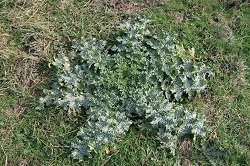
This is a large annual thistle, with flower stalks extending to over 2 metres tall, rising from a massive rosette that can reach 2 metres in diameter.
The leaves are large, lance-shaped, shiny and variegated with prominent white veins and blotches. The edges are tipped with sharp yellow 1 cm spines.
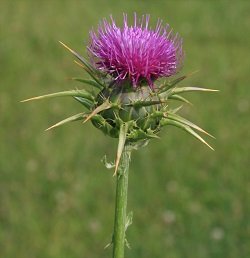
The flowers are large and purple, growing singly on tall and bare stems, and are surrounded by large and sharp yellow-tipped spines.
Each flower can produce 200 brown seeds of 6mm x 3mm carried by a thistle down ‘parachute’ of about 15mm length. The seed is spread by wind, hay, water, mud on vehicles and by animals.
Seeds mainly germinate in autumn producing small rosettes by early winter; these grow rapidly over late winter and early spring, reaching a metre in size by mid-spring. Flowering then occurs between November and January. However some plants may remain as rosettes until the next spring.
The flowering plants go to seed, and then die off in late summer. Seed remains viable for nearly 10 years.
HABITAT
Pasture land, waste areas, mainly in coastal North Island, occasionally in eastern South Island. Appears in greater numbers after summer droughts and wet winters.
In most regions of NZ the species is subject to Pest Plant Management Strategies.
TOXICITY
The plant is toxic to stock due to nitrate poisoning and becomes palatable as it dies off, so it’s important to keep stock out of treated paddocks for at least two weeks after treatment.
PASTURE MANAGEMENT
Maintaining a dense pasture cover without bare patches will prevent the majority of seeds from germinating, and those that do are not tolerant of pasture competition. Avoid overgrazing pasture especially in summer.
PHYSICAL CONTROL
Individual and isolated plants can be chipped or grubbed out.
HERBICIDES TO CONTROL THISTLES
Seedlings are best treated in late autumn to early winter, and rosettes up to early spring while still small. This will allow use of pasture-friendly spot treatment, or of pasture-friendly herbicides for area spraying.
Spot Treatment Herbicides to Kill Variegated Thistles (all growth stages)
- BuckShot (about half a teaspoon) applied direct to the crushed centre of the rosette. Use more for mature plants.
- GrassMate – 6ml/L by knapsack or 250ml/100L by handgun.
- MSF600 – 1g/10L by knapsack or 5g/100L by handgun. Very effective but will damage ryegrass and clover. Kills the seed if applied while plants are still flowering.
- WHACK – 2,4-D 800 at 45grams/10L will control seedlings.
- Cut'n'Paste MetGel applied as a paste on the cut stems is a simple and effective spot treatment control of variegated thistles.
- GrassMate XTRA – 6ml/L by knapsack (Rosette and multi-crowned plants)
Boom Spraying Weedkillers to Kill Thistles (seedlings/rosettes – variegated thistles)
Graze before spraying to reduce clover leaf and expose thistle seedlings. Leave for one week to freshen before spraying.
- WHACK – 2,4-D 800 – 1.5-2kg/ha for seedlings with root crowns less than 2cm and 2-3kg/ha on rosettes with root crowns between 2-4cm, before flower stalk develops.
- Rainbow & Brown MCPA 750 – 1.5L/Ha for seedlings and 2L/Ha for rosettes to 15cm diameter.
- PastureMate – 4L/ha for good control in seedling stage (2-3 leaves). Useful suppression at later growth stages. Pasture (grass/clover) friendly.
Boom Spraying Herbicides to Kill Large Variegated Thistles
- WHACK – 2,4-D 800 and Rainbow & Brown MCPA 750 will not control mature thistles when used alone.
- Ralid Herbicide used at 100-200ml/ha in conjunction with either WHACK – 2,4-D 800 or Rainbow & Brown MCPA 750 as above, will control large and resistant thistles. Expect some pasture damage, especially to clovers. Ralid used alone at 1L/Ha is also effective, but clover damage will be severe.
Weed Wiping Herbicides to Kill Variegated Thistles
- MSF600 – 2-3g/L of water is inexpensive and very effective against erect thistles where pasture is low enough to permit reasonable thistle contact with the roller/wiper.