
26 Oct


0
464
Every NZ farm that uses hazardous substances needs an up-to-date chemical inventory and a current safety data sheet (SDS) for each product, kept where workers and emergency services can get to them. When WorkSafe checked 680 sheep, beef and dairy farms in late 2025, missing SDSs and inventories were behind 94% of the improvement notices issued. B..
08 Oct

0
2128
A wetter helps spray droplets spread across a leaf and stay there, instead of beading up and rolling off before the herbicide gets in. Use a non-ionic wetter for everyday spraying, and step up to an organosilicone wetter for waxy, hairy, dusty or stressed weeds. Always check the herbicide label first, because it tells you whether a wetter is need..
30 Sep

0
3404
Spring is the only time of year a wasp queen is on her own. She's out of hibernation, building a small nest by herself and feeding her first larvae with no workers to back her up. Catch her now and that nest never forms, which means no colony of thousands and no new queens next autumn.
✓Queens are active from early spring, roughly September to..
20 Sep

0
14172
Carrot weed is the common name for parsley dropwort (Oenanthe pimpinelloides), a perennial broadleaf weed that regrows each year from small black tubers on its roots. Stock won't eat it, so it takes over paddocks quietly and then flowers from October through April once it's too late to do much about it. The window that actually works is autumn th..
13 Sep

0
343
Biochar is a highly porous form of charcoal made by heating wood with very little oxygen, and it works by giving soil (and gut) microbes somewhere to live while holding onto water and nutrients that would otherwise wash straight through. Southland Carbon makes it from New Zealand wood biomass at Pukerau, and the same process that produces the bioc..
17 Aug

0
551
Buttercup survives in pasture because cattle find it genuinely unpalatable, so it's left standing while everything around it gets grazed down. Flumetsulam-based herbicides such as Decision control both annual and giant (perennial) buttercup while leaving clover largely untouched, unlike older broadleaf sprays that knock clover around too. Spring, ..
05 Aug
0
448
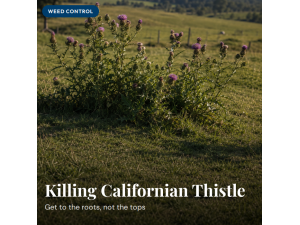
Californian thistle is hard to kill because the plant you see is only the top of a deep, spreading root system that keeps throwing up fresh shoots from root buds. Knocking back the top growth won't get on top of it. The reliable approach is a herbicide that moves through the whole plant down to the root buds, applied while the thistle is actively..
05 Aug
0
418
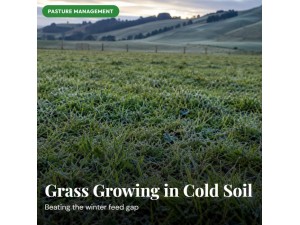
Grass growth stalls once soil temperatures drop below about 10 degrees, which is the winter feed gap every farmer knows. Gibberellic acid, a natural plant hormone sold as Gibb-Gro and Gibber900, can get pasture moving again once soils sit in the 6 to 13 degree range, with a lift in dry matter over about three weeks. It works as a top-up on green,..
15 Jun

0
945
Healthy horse paddocks in NZ need a three-pronged seasonal approach: weed control for persistent species like docks and buttercups, residual fly and tick management through summer, and trace mineral support to fill gaps that good pasture alone can miss.
✓Docks and buttercups reduce pasture quality and can irritate horses; treat in early spring..
28 May

0
971
Foliar fertilisation means spraying dissolved nutrients directly onto plant leaves, where they're absorbed through the leaf surface and bypass the soil entirely. It's most useful for correcting mid-season deficiencies quickly, delivering micronutrients that soil chemistry is locking up, and supporting plants at critical growth stages when you can..
10 Mar

0
13965
Note: This article was last updated March 2026
What Can We Use Instead of Banvine(1)?
Quick answer: Banvine(1) contained 200g/L 2,4-D and 100g/L dicamba. The closest ready-mixed alternative from Rainbow & Brown is LawnMate. A lower-cost option is to use individual herbicides such as WHACK – 2,4-D 800 and Rainbow & Brown Dicamba 500 SL, but any ..
09 Mar

0
3068
Fulvic Acid Explained: How Fulvex 9500 Unlocks Nutrients Plants Can Actually Use
Category: Soil Health
Quick answer: Fulvic acid helps plants access nutrients that may already exist in the soil but are chemically locked up and unavailable. Fulvex 9500 is a highly concentrated 95% pure fulvic acid that works as a natural chelator, binding minera..