
This Blog section is for news about Rainbow & Brown products and their application but especially new products.
26 Oct


0
1654
Every NZ farm that uses hazardous substances needs an up-to-date chemical inventory and a current safety data sheet (SDS) for each product, kept where workers and emergency services can get to them. When WorkSafe checked 680 sheep, beef and dairy farms in late 2025, missing SDSs and inventories were behind 94% of the improvement notices issued. B..
08 Oct

0
2228
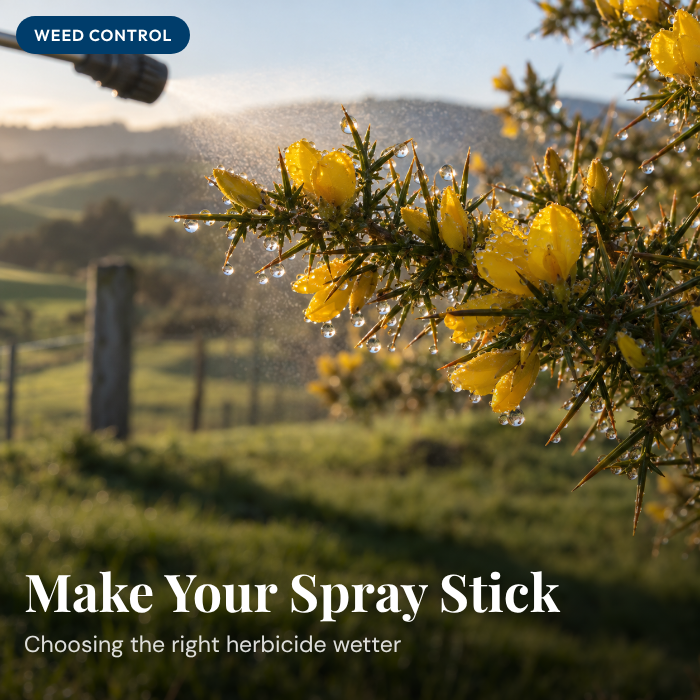
A wetter helps spray droplets spread across a leaf and stay there, instead of beading up and rolling off before the herbicide gets in. Use a non-ionic wetter for everyday spraying, and step up to an organosilicone wetter for waxy, hairy, dusty or stressed weeds. Always check the herbicide label first, because it tells you whether a wetter is need..
20 Sep
0
14314
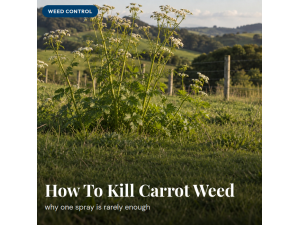
Carrot weed is the common name for parsley dropwort (Oenanthe pimpinelloides), a perennial broadleaf weed that regrows each year from small black tubers on its roots. Stock won't eat it, so it takes over paddocks quietly and then flowers from October through April once it's too late to do much about it. The window that actually works is autumn th..
15 Dec

0
2595
Herbicide Resistance: A Growing Challenge
Herbicide resistance is becoming an increasing challenge across New Zealand, affecting pasture, cropping, vineyards, forestry, and lifestyle blocks alike. It occurs when a weed population adapts to survive a herbicide that once provided reliable control - often after the same mode of action has been used ..
12 Jan
0
14713
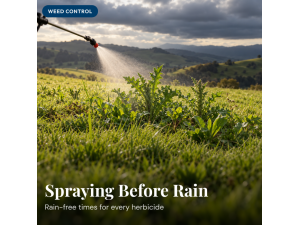
Most herbicides need between 1 and 6 hours without rain after spraying to soak into the leaf and start working. The exact time depends on the product, so check the table below and the label for the one you're using. If the forecast is tight, give yourself an extra hour or two, or wait for a better day.
✓Most herbicides need 1 to 6 hours rain-f..
13 Oct

0
8254
Most liquid herbicides handle NZ winters without issue, but some formulations will separate, crystallise, or coagulate if they get too cold. The safe default is to keep liquid products above 4°C. Dry formulations like granules and WDGs have no temperature restriction but need to stay dry.
Vegetable oil-based crop oils: keep above 4°C
Most liq..
Showing 1 to 6 of 6 (1 Pages)
26 Oct


0
1654
Every NZ farm that uses hazardous substances needs an up-to-date chemical inventory and a current safety data sheet (SDS) for each product, kept where workers and emergency services can get to them. When WorkSafe checked 680 sheep, beef and dairy farms in late 2025, missing SDSs and inventories were behind 94% of the improvement notices issued. B..
08 Oct
0
2228
A wetter helps spray droplets spread across a leaf and stay there, instead of beading up and rolling off before the herbicide gets in. Use a non-ionic wetter for everyday spraying, and step up to an organosilicone wetter for waxy, hairy, dusty or stressed weeds. Always check the herbicide label first, because it tells you whether a wetter is need..
30 Sep

0
3561
Spring is the only time of year a wasp queen is on her own. She's out of hibernation, building a small nest by herself and feeding her first larvae with no workers to back her up. Catch her now and that nest never forms, which means no colony of thousands and no new queens next autumn.
✓Queens are active from early spring, roughly September to..