
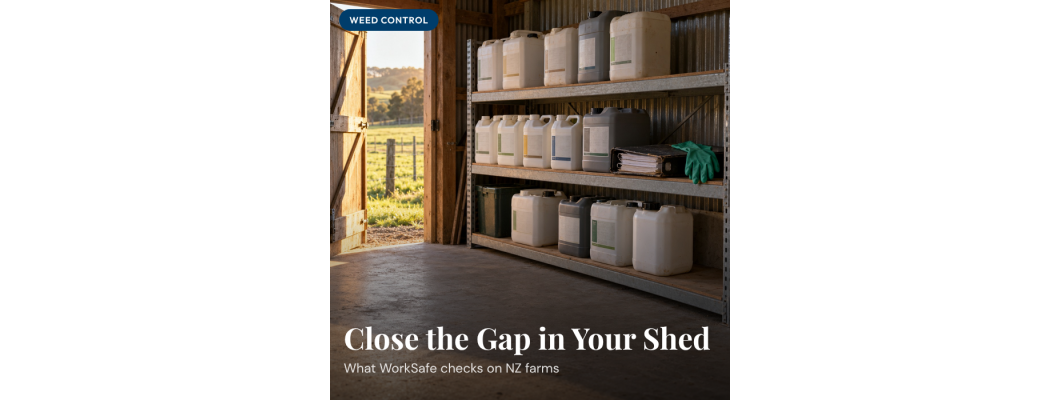
Every NZ farm that uses hazardous substances needs an up-to-date chemical inventory and a current safety data sheet (SDS) for each product, kept where workers and emergency services can get to them. When WorkSafe checked 680 sheep, beef and dairy farms in late 2025, missing SDSs and inventories were behind 94% of the improvement notices issued. Both gaps can be fixed in an afternoon.
- ✓Hazardous substances were the highest-risk area WorkSafe found on farms
- ✓You need a current SDS for every hazardous substance, whatever the quantity
- ✓Your inventory lists what you hold, the most you're likely to have, and where it's kept
- ✓Keep chemicals in their original labelled containers, stored the way the label says
On this page
Most farm chemical sheds aren't dangerous. They're just a bit behind on paperwork. That's exactly what WorkSafe is now looking for. This guide covers farm chemical compliance in NZ: what inspectors found on hundreds of farms, what the rules actually ask of you, and the handful of jobs that get your shed up to scratch.
What did WorkSafe find on NZ farms?
Between October and December 2025, WorkSafe inspectors completed 680 assessments on sheep, beef and dairy farms across New Zealand. Hazardous substances came out as the highest-risk area, with 39% of assessments needing improvement.
The problems weren't exotic. According to WorkSafe, 94% of the improvement notices issued related to missing safety data sheets or chemical inventories. Machinery and vehicles turned up too (unguarded PTO shafts and farm vehicles that needed attention), but chemicals topped the list.
These were mostly small operations. 81% of the businesses assessed had fewer than five employees, which is a fair picture of how most NZ farms run.
WorkSafe's project lead, Carl Baker, summed up why the paperwork matters: "Without them, we don't know the risks." If there's a spill, a fire or someone gets sick, the inventory and SDS are what tell the fire service and medical staff what they're dealing with.
Why do NZ farms keep slipping on chemical compliance?
Mostly because of who handles the chemicals, and how farms are run day to day. The rules haven't changed much since the Health and Safety at Work (Hazardous Substances) Regulations came in during 2017, but plenty of sheds haven't caught up.
- Casual and seasonal labour. A lot of farm work runs on casual staff, contractors and family helping out. Not everyone arrives with chemical training, or the habit of grabbing gloves and a respirator before they're needed. That's not a dig at anyone, it's how farms staff up.
- Small teams, big job lists. On a farm with two or three people, the chemical inventory competes with calving, lambing and everything else. It's easy to put off.
- Stock that changes all season. Products come and go through spring and autumn spraying. An inventory written three years ago probably doesn't match what's on the shelf now.
- The household-use myth. Some people assume small amounts don't count. The exemption for consumer products only covers products used in quantities and ways consistent with household use. A 20 L drum of herbicide on a farm doesn't qualify.
How to close the compliance gap in your shed
Start with the two things that caused nearly all the notices: the inventory and the safety data sheets. Then check labels and storage.
-
Build your inventory. List every hazardous substance on the farm, including waste chemicals waiting to go. For each one, WorkSafe expects the product name (and UN number if it has one), the maximum amount you're likely to hold, where it's stored, any specific storage or segregation requirements, and a current SDS or a condensed version of its key information. The free Hazardous Substances Calculator at hazardoussubstances.govt.nz will build it for you.
-
Get a current SDS for every product. You need one for each hazardous substance, whatever quantity you hold. If you don't have one, or yours is more than five years old, get a new copy from your supplier. Keep them with the inventory, in hard copy or electronic form, where workers and emergency services can get to them without hunting. Looking it up online when something goes wrong doesn't count.
-
Check every container is labelled. Keep products in their original packaging with the label intact. If you decant into a smaller container, that container needs its own label in English with the product name and the hazard pictogram and statement. The only exception is a substance used so quickly after decanting that labelling isn't practical, and the container must then be cleaned straight away.
-
Store each product the way its label and SDS say. Storage and segregation rules depend on the type and amount of each substance. Section 7 of the SDS covers storage. Keep quantities to what you actually need, and keep incompatible products apart.
Always follow product label and local regulations.
Where to find your paperwork. Every product on the Rainbow & Brown website has its SDS and label on the product page, along with the leaflet and haznote where a product has one. Download or print them, file them with your inventory, and most of the job's done.
Practical tips for farm chemical compliance
A few habits keep the shed compliant without making it a project every year.
- Tip: Update the inventory when a new product arrives. The inventory records the maximum you're likely to hold, not daily stock, so it only needs changing when products or quantities change.
- Tip: Keep a printed folder in the shed and a copy in the house. Emergency services need to reach it during an emergency and after an evacuation, so one copy away from the store makes sense.
- Tip: Show new staff the folder on day one. Workers need to know what's in their work area and what the dangers are, and you need a record of the training and instruction each person has had.
- Tip: Check the competency rules for your products. Some products and quantities need a certified handler or other qualification. The Hazardous Substances Toolbox will tell you what applies to the products you hold.
- Tip: Clear out old chemicals. Unused or unlabelled products are a liability on the shelf. Schemes like Agrecovery take farm chemicals and containers in most areas.
Common farm chemical compliance mistakes
Most of what inspectors find comes down to good intentions that never got finished.
Mistake: An inventory that's years out of date. A list that doesn't match the shelf won't help anyone in an emergency. Check it against what's actually there, and update it whenever stock changes.
Mistake: SDSs filed somewhere nobody can find them. An SDS in someone's email inbox isn't readily accessible. Print them or keep them on a shared device, stored with the inventory.
Mistake: Unlabelled decanted bottles. A bottle with no label becomes a real problem the moment something goes wrong, because nobody knows what's in it. Keep products in the original container, or label the new one properly. Never use food or drink containers.
Mistake: Storing chemicals wherever there's a gap. Products that react with each other shouldn't sit side by side. Check the storage section of each SDS and the label, and group products accordingly.
Quick farm chemical compliance checklist
Run through this in the shed this week.
- Inventory lists every hazardous substance on the farm, including waste
- Inventory shows maximum quantity and storage location for each product
- A current SDS (less than five years old) for every product
- Inventory and SDSs kept together where workers and emergency services can reach them
- Every container in its original packaging, or a decanted container labelled properly
- Products stored as the label and SDS say, with incompatible products kept apart
- Training and instruction recorded for everyone who handles chemicals
- Competency requirements checked for the products you hold
Next step: walk into the shed with a notepad, write down every product on the shelf, and enter it into the Hazardous Substances Calculator.
Farm chemical compliance FAQs
Do I need a chemical inventory on a small farm or lifestyle block?
If it's a workplace, yes. The inventory rules apply to any business that uses, handles or stores hazardous substances, regardless of size. The only exemption is for consumer products used in quantities and ways consistent with household use. If you're running a farming business, including a small one, assume you need one.
Where do I get a safety data sheet?
Your supplier should give you one when you first buy a hazardous substance, and an updated version if it changes. If you've lost it or it's more than five years old, ask for a new copy. For products bought from us, the SDS is on the product page of our website.
Can I keep my SDSs on my phone?
Electronic copies are fine, as long as they're readily accessible to anyone who handles the product and to emergency services. A phone that leaves the farm with you doesn't meet that. A printed folder in the shed, or a shared tablet that stays on site, is the safer option.
What happens if WorkSafe finds a gap?
In the 2025 farm assessments, gaps like missing SDSs and inventories were dealt with through improvement notices, which set out what needs fixing. WorkSafe described the visits as honest conversations aimed at helping farmers lift their game. The simplest way through is to have the paperwork sorted before anyone asks.
Further reading
- Storing herbicides over winter: what cold does to herbicides in an uninsulated shed
- Spray safe the smarter way: protective gear and safe habits for spraying
- Rainbow & Brown join Agrecovery: how to recycle containers and get rid of unwanted chemicals
Want a proper walkthrough of what compliance looks like on a working farm? The Hazardous Substances Toolbox at hazardoussubstances.govt.nz is built for exactly this. If you can't find the SDS or label for something you bought from us, contact us and we'll send it through.

Leave a Comment