
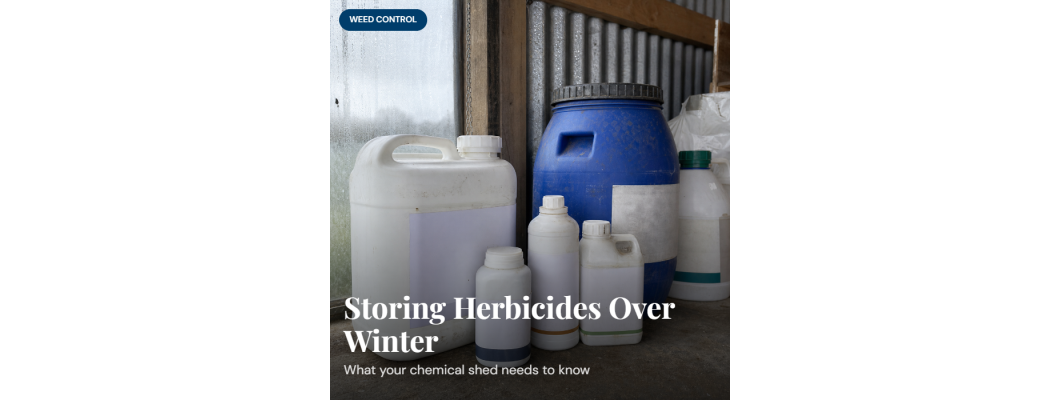
Most liquid herbicides handle NZ winters without issue, but some formulations will separate, crystallise, or coagulate if they get too cold. The safe default is to keep liquid products above 4°C. Dry formulations like granules and WDGs have no temperature restriction but need to stay dry.
- Vegetable oil-based crop oils: keep above 4°C
- Most liquid herbicides (glyphosate, MCPA, triclopyr and others): minimum temperatures vary by product, but 0°C is a common threshold
- Some suspension concentrates (TerbGuard, Doubleshot): keep above -8°C
- Granules, WDGs, and wettable powders: no temperature restriction, but protect from moisture
On this page
You've got a couple of litres of herbicide sitting in an uninsulated shed through a Central Otago winter. Is it still good come spring? The answer depends on which product it is, how cold your shed actually gets, and whether you know what to look for when you pick it up again. This guide covers what you need to know before the cold sets in.
What Happens to Herbicides in the Cold?
When liquid herbicides drop below their storage threshold, the active ingredients and carrier solvents can start to separate. Depending on the formulation, you might see crystals forming, the liquid going cloudy, layers sitting on top of each other, or in more severe cases the product turning into a gel or slush. This isn't just a cosmetic issue: a herbicide that's physically changed may not perform predictably even after it warms back up.
The temperature at which this happens depends on the formulation, not just the active ingredient. The same active (glyphosate, say) formulated at different concentrations or with different carrier ingredients will behave differently in the cold. That's why it's not enough to go by the active ingredient alone. You need to know the specific product.
Why NZ Chemical Sheds Are a Particular Concern
New Zealand's climate is more varied than a lot of people account for when it comes to chemical storage. Temperatures across the country can drop well below freezing in many regions during winter:
- Inland Canterbury and Otago regularly see overnight lows of -5°C to -10°C, and some frost hollows go lower.
- Hawke's Bay, Wairarapa, and Manawatu can hit -3°C to -5°C on cold nights.
- The North Island high country (Central Plateau, Volcanic Zone) sees frosts most winters.
- Even many coastal areas experience temperatures that will stress the more temperature-sensitive formulations.
The bigger issue is that most farm chemical sheds are uninsulated. A metal or timber shed doesn't buffer overnight temperature drops; in frost hollows or sheltered valleys it can actually be colder inside the shed than outside. The air temperature recorded at the nearest weather station may give you little idea of what your shed actually hit overnight.
Liquid vs Dry: How They Behave Differently
The broad rule: liquid formulations are sensitive to temperature, and dry formulations are sensitive to moisture. Understanding this split is the foundation of good chemical shed management over winter.
| Liquid Formulations | Dry Formulations |
|---|---|
| Sensitive to cold. Separation, crystallisation, or coagulation can occur below product-specific thresholds. Always check after a cold period. | Forgiving on temperature. Granules, WDGs, and wettable powders are generally unaffected by NZ winter temperatures. |
| Safe default: above 4°C. If you don't know the specific minimum for a product, keep it above 4°C and you'll cover the vast majority of situations. | Vulnerable to moisture. Clumping, caking, or degraded dispersibility can occur if packaging is compromised or condensation works its way in. |
| Often recoverable. Products that have been mildly cold-affected can sometimes be restored by warming and agitating. See the steps below. | Keep sealed and off the ground. Moisture wicks up from concrete floors. Original packaging with intact seals, stored on a pallet or shelf, is the best defence. |
| Check before use. Look for visual changes after any cold period before the product goes near a spray tank. | Watch for condensation. Temperature swings in a shed can cause moisture inside packaging, especially after cold nights followed by warm sunny days. |
What to Do If a Product Has Been in the Cold
If you suspect a liquid herbicide has been exposed to temperatures below its threshold, don't discard it straight away. Work through this process first before making a call.
-
Check for visual changes. Look for separation (liquid and solids sitting in distinct layers), crystals or ice, cloudiness, or a gel-like texture. Note what you see before touching anything.
-
Move the container somewhere warm. Around 20°C is ideal. Inside a heated building works well. Don't apply direct heat or try to warm it quickly; a gradual return to ambient temperature is what you want.
-
Give it time. Allow two to three days for the product to return to normal temperature. There's no shortcut here.
-
Invert or shake periodically. As the product warms, gently agitate it every 12 hours or so. This helps any separated components remix properly.
-
Assess the result. If the product returns to normal appearance and consistency, it can most likely be used as directed. If separation, cloudiness, or residue persists after a full warming period, don't use it. Contact the supplier or check the SDS for guidance on disposal.
Always refer to the product label and SDS for specific storage and handling requirements.
The Rainbow & Brown Storage Temperature Guide
Rainbow & Brown have put together the following storage reference for their product range. This is a practical starting point when you're deciding what needs to move to a warmer location before winter.
Note: This table is indicative only. Active ingredients are formulated at different strengths with different carrier ingredients, so storage behaviour can vary between products. Always check the product label or SDS for full guidance, or get in touch with the team if you're unsure.
| Minimum Storage Temp | Products |
|---|---|
| No restriction (dry) | WHACK‑2,4‑D 800, Buckshot, Decision, Granny, MSF600, Ranger |
| Above 4°C | BioWet and other vegetable oil-based crop oils |
| Above 0°C | LawnMate, GA200, Halox 100 EC, Ralid, PastureMate, MCPA 750, Dicamba 500 SL, Cut'n'Paste range*, SprayWetter, SuperWetter, Foam Crusher |
| Above -8°C | TerbGuard, Doubleshot |
| Above -12°C | Glyphosate 360, Glyphosate 540, GrassMate, Triclo |
*Cut'n'Paste gels: 5-25°C is the ideal storage range. 0°C is the practical lower limit. Do not freeze.
A few things worth noting here. The glyphosate and triclopyr products are among the most cold-tolerant in the range, which makes sense given how widely they're used across southern NZ where winters are serious. The crop oils and vegetable oil-based adjuvants need the most care. Most of the liquid selective herbicides sit in the middle, needing to stay above 0°C but generally handling NZ conditions without drama if they're not sitting in a frost hollow.
Practical Tips That Actually Help
- Tip: Do a shed audit before the cold arrives, not during it. Identifying what needs moving in early June is easy. Discovering a 20-litre drum of PastureMate has been sitting on a concrete floor through July is less fun. A quick walkthrough now takes ten minutes.
- Tip: Raise containers off the floor. Concrete floors are thermal sinks. They stay cold well after the air in a shed has warmed up. Simple timber pallets or a shelf make a real difference for products with a 0°C threshold on a hard-frost night.
- Tip: Move sensitive products inside if you're in a cold region. Crop oils and anything with a 4°C threshold don't need to live in the main shed over winter. A corner of the garage or utility room is perfectly adequate and means you're not relying on the weather.
- Tip: Don't rely solely on the forecast temperature. Sheds in frost hollows, sheltered valleys, or under trees can be significantly colder than the recorded ambient temperature. If you've seen frost on your shed roof when the paddock is clear, your shed is running cold.
- Tip: Keep dry formulation packaging sealed between uses. A half-used bag of MSF600 or Decision with a compromised seal will absorb moisture over a winter. Decant into a sealable container or tape the bag tightly closed and store it off the ground.
Common Mistakes
Mistake: Spraying with a herbicide without checking it after a cold period. If a product has separated and you apply it without knowing, the active ingredient concentration reaching your target may not be what the label assumes. Always inspect liquid products visually after any significant cold event before they go into a tank.
Mistake: Tipping out a product without trying to recover it first. Some cold-induced separation is temporary and reversible. Moving the container to a warm space and agitating periodically over a few days will bring many affected products back. Try the warming process before making a disposal decision.
Mistake: Assuming dry formulations are immune to shed conditions. Granules and WDGs won't be affected by cold, but a bag of MSF600 that's absorbed moisture over winter is a different product to a fresh one. Clumping, poor dispersibility, and degraded performance in the tank are all possible. Storage conditions still matter for dry products.
Mistake: Treating 4°C as the minimum for every liquid product. The 4°C default is a useful conservative guide when you don't know a product's specific threshold. Several products in the Rainbow & Brown range handle temperatures well below freezing. Check the storage guide before deciding what needs special treatment, so you're not creating unnecessary work.
Quick Checklist
- Walk through your chemical shed in early June and identify any products with temperature thresholds
- Move crop oils and anything with a 4°C threshold to a warmer location before the first hard frost
- Raise all liquid containers off concrete floors onto pallets or shelving
- Check that all dry formulation packaging is sealed, intact, and stored off the ground
- Use a min/max thermometer in the shed over a few cold nights to find out what your shed actually hits
- After any hard frost, inspect liquid products for separation, crystals, or cloudiness before use
- If a product looks wrong after warming, contact the team before putting it in the tank
- Keep SDS documents accessible for any product you're uncertain about
Next step: Take five minutes today to check what's in your shed against the storage temperature table above.
FAQs
My glyphosate has gone cloudy after a cold snap. Is it still usable?
Cloudiness in glyphosate after cold exposure is usually a sign of temporary crystallisation or separation. Move the container somewhere warm (around 20°C), shake or invert it periodically, and give it two to three days. In many cases it will return to normal appearance. If cloudiness or sediment persists after the product has fully warmed and been thoroughly agitated, it's worth contacting the team before using it. Don't put an uncertain product into a tank without checking.
Do Cut'n'Paste gels need special treatment over winter?
Cut'n'Paste gels are best stored between 5°C and 25°C. They can tolerate down to 0°C but shouldn't be frozen. If a gel has been in very cold conditions, bring it to room temperature and check its consistency before use. A gel that's frozen and thawed may not apply evenly from the applicator. Storing them inside over winter is the simplest solution and removes the guesswork.
How cold does an uninsulated NZ shed actually get in winter?
It varies a lot by region and shed design. In inland South Island locations, an uninsulated metal shed can reach -8°C or lower on a clear winter night. In the North Island, most sheds will stay above -3°C to -5°C even in colder areas. The best way to know is a cheap min/max thermometer left in the shed over a few cold nights. That data is genuinely useful when you're deciding what to move and what can stay.
Is there a difference between a product "separating" and one that's gone off permanently?
Yes, and it matters. Mild cold-induced separation is physical, not chemical: the components have come apart but the product itself hasn't degraded. This is often reversible through warming and agitation. Permanent damage, where the product won't return to normal appearance even after a full warming period, is a different situation. At that point the formulation may have changed in ways that affect performance. If in doubt, contact the supplier before using the product.
Further Reading
- Rainbow & Brown Blog for more practical guides on herbicides, pasture management, and soil health
- Weed Files library for guidance on controlling over 95 common NZ problem weeds

Leave a Comment