
This Blog section is for news about Rainbow & Brown products and their application but especially new products.
General information about farming, weed control, herbicides, seaweed, fertlisers and other.
23 Oct


0
3568
Herbicide Environmental Impact Assessment Guide
When selecting herbicides for agricultural or landscaping applications, understanding their environmental characteristics can help make informed decisions that balance effectiveness with ecological responsibility. This guide evaluates common herbicide products across three key environmental factors ..
13 Jul

0
4746
Herbicide Guide for Preparing Native Planting Sites
This guide outlines herbicide options for pre-planting site preparation to support the successful establishment of native vegetation. It focuses on the safe and effective control of invasive weeds and grasses.
.herbicide-table {
border-collapse: collapse;
width: 100%;
min-width: 900px..
18 Jun

0
4182
Working out Your Spray Rates with our easy-to-use Spray Conversion Calculator
Calculating spray rates can be a real head-scratcher. So, we’ve made a simple tool to help take the hassle out of it.
Our new Spray Rate Conversion Calculator is free and easy to access on our website.
This calculator helps you quickly figure out:
How much herbicide..
01 Jun

0
4566
Controlling Weeds Over Winter
Winter is the perfect time to tackle problem weeds in your established pasture. By applying our phenoxy herbicides like WHACK – 2,4-D 800 and Rainbow & Brown MCPA750, you can target invasive weeds such as thistles, ragwort, and buttercup when they’re small yet actively growing. These weeds germinate in autumn, and wi..
21 Apr

0
3732
Ultimate Guide to Controlling 7 Common Weeds
Here’s a guide to controlling seven common and notably pesky weeds using Rainbow & Brown products. Often, there’s more than one solution, and the best choice depends on your specific circumstances. For example, GrassMate is ideal when protecting grass is a priority, while MSF600 is better suited when gr..
09 Apr

0
2688
Use Less Nitrogen – Save Your Dollars
With increasing pressure to reduce nitrogen usage, many farmers find themselves between a rock and a hard place. But what if you could cut nitrogen use and still get the same feed growth—while saving money?
The Solution: Less Urea + Gibb-Gro or Gibber 900
We believe that by using 18 units of Nitrogen (approx..
13 Mar

0
3731
WHY CHOOSE GA200?
GA200 isn’t just another herbicide—it’s a smarter, safer, and a more targeted solution for weed control.
Here’s why it’s the go-to choice:
Contact Herbicide: GA200 kills only what it touches, making it perfect for areas where you need precision. No need to panic about overspray harming your prized trees or vines, as even if ..
15 Dec

0
6144
Understanding the Real cost of Glyphosate
In the ever-changing landscape of agricultural products, pricing can be a complex subject, influenced by factors far beyond the control of individual businesses. Recently, we had an inquiry from a customer questioning the current price of Rainbow & Brown Glyphosate 360, leading to a deeper look into how th..
10 Nov

0
3307
Where are my Sheep?
Little Bo Peep has lost her sheep and doesn’t know where to find them. Leave them alone and they will come home, dragging their tails behind them.
It is not a fairy tale this time but a true and amusing anecdote.
I was chatting with one of our Gibb-Gro / Gibber 900 customers today. Based in the South Island they are now only ..
20 Oct

0
3903
Boosting Young Fruit Trees: Vegan-Friendly Fertiliser options
As sustainable and ethical agricultural practices gain traction, more of our customers are seeking alternatives to traditional fertilisers—particularly those that avoid animal-derived ingredients like blood and bone meal. Recently, a customer asked us about the best fertilisers to help ..
03 Oct

0
4818
Enhancing Agricultural Practices with Efficient Herbicide and Fertiliser Application by Helicopter
In modern agriculture, effective weed management and precise application of fertilisers are crucial for optimising crop yields and ensuring sustainable farming practices. Helicopter-based aerial agrichemical application offers significant advantages,..
02 Oct

0
4663
How to Clean Been There from your Spray Tanks
Cleaning your spray tank after using "Been There" products, particularly the red variant, can be a bit challenging due to its persistent staining properties. This issue is common across all red spray marker dyes in the market. However, there are effective methods to remove these stains and maintain the..
26 Oct


0
464
Every NZ farm that uses hazardous substances needs an up-to-date chemical inventory and a current safety data sheet (SDS) for each product, kept where workers and emergency services can get to them. When WorkSafe checked 680 sheep, beef and dairy farms in late 2025, missing SDSs and inventories were behind 94% of the improvement notices issued. B..
08 Oct

0
2128
A wetter helps spray droplets spread across a leaf and stay there, instead of beading up and rolling off before the herbicide gets in. Use a non-ionic wetter for everyday spraying, and step up to an organosilicone wetter for waxy, hairy, dusty or stressed weeds. Always check the herbicide label first, because it tells you whether a wetter is need..
30 Sep
0
3404
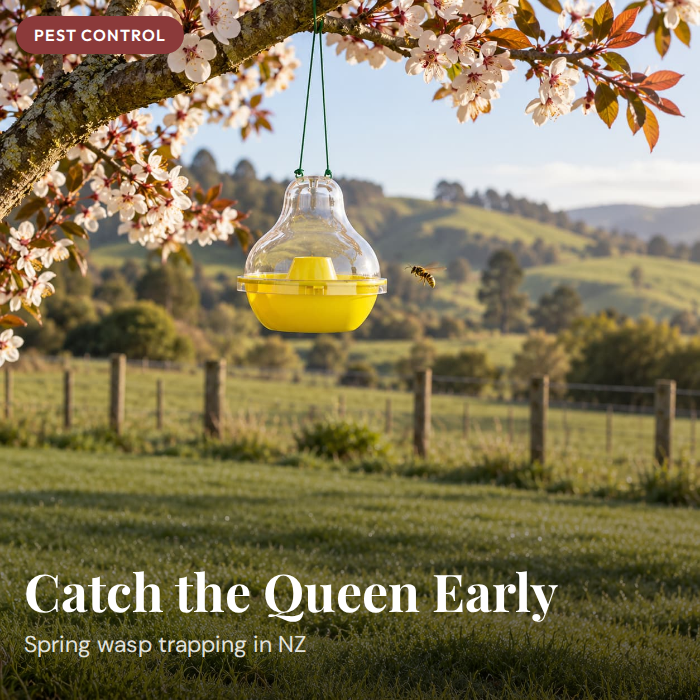
Spring is the only time of year a wasp queen is on her own. She's out of hibernation, building a small nest by herself and feeding her first larvae with no workers to back her up. Catch her now and that nest never forms, which means no colony of thousands and no new queens next autumn.
✓Queens are active from early spring, roughly September to..