
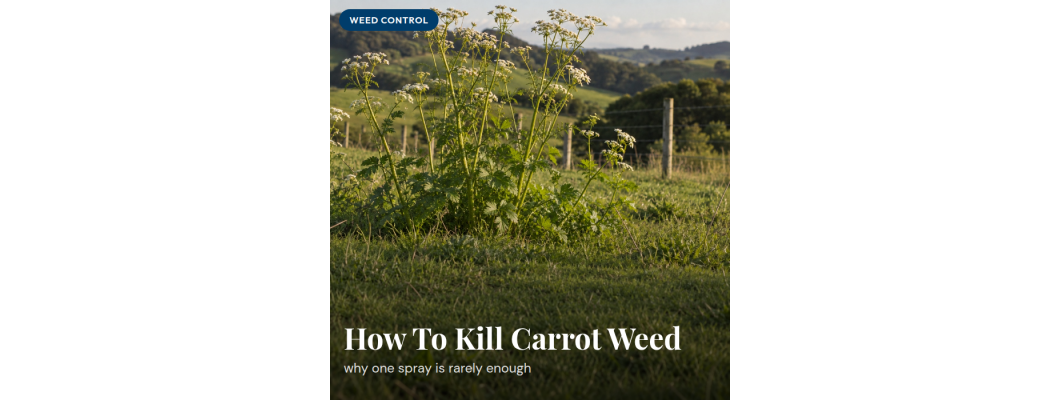
Carrot weed is the common name for parsley dropwort (Oenanthe pimpinelloides), a perennial broadleaf weed that regrows each year from small black tubers on its roots. Stock won't eat it, so it takes over paddocks quietly and then flowers from October through April once it's too late to do much about it. The window that actually works is autumn through early spring, while the plants are young and actively growing.
- ✓It is not wild carrot, despite the name, and the two need different thinking
- ✓Black root tubers mean one spray is rarely the end of it
- ✓Worst in Northland and South Auckland, but showing up further south
- ✓Hay is how it gets onto clean blocks, so check where your baleage came from
On this page
Drive around Northland or South Auckland from October onwards and you'll see it: clusters of small white flowers sitting on top of tall green stems, in paddocks the stock have grazed around rather than through. That's carrot weed. By the time it's flowering it has already had its run at your pasture, and the window to do something useful about it has closed for the season. Here's how to pick it, when to hit it, and why the job is almost never finished in one go.
What carrot weed actually is
Carrot weed is the common name for parsley dropwort (Oenanthe pimpinelloides), a perennial broadleaf weed that comes back each year from a fibrous root system carrying small black tubers. Those tubers are the whole problem, because they hold enough reserve to push new growth after the top of the plant has been knocked over.
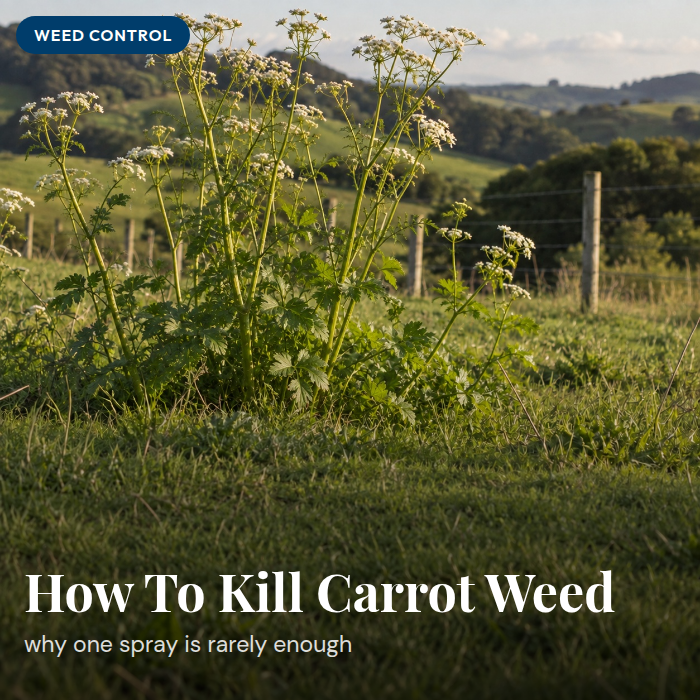
It grows from roughly 30 to 90cm, spreading out from a central stem. The leaves sit on stalks in a rosette, with opposite leaflet segments, and they look a lot like the parsley in your garden. From October to April it throws up flower stalks topped with umbels, small clusters of white blooms about 4mm across. If you've got it in a paddock, that flowering stage is usually when you notice it, and by then the plant is well established underground.
Carrot weed or wild carrot?
These get mixed up constantly, and the name is the reason. Carrot weed is not a carrot and it isn't related to wild carrot. They look similar enough at a glance that people treat them as the same job, which leads to the wrong timing and the wrong expectations.
| Carrot weed (parsley dropwort) | Wild carrot |
|---|---|
| Perennial. Comes back year after year from black root tubers, so control is a multi-season job. | Annual or biennial. Runs from seed rather than from storage organs, so interrupting seed set is what gets you ahead. |
| Parsley-like foliage. Rosette of stalked leaves with opposite leaflet segments. | Fern-like, carrot-top foliage. Finer and more divided, and it has a slender white taproot that smells exactly like a carrot. |
| Concentrated in the upper North Island. Northland and South Auckland are the strongholds. | Widespread. Found through much of the country on roadsides and drier ground. |
| Tubers survive the top-kill. Expect regrowth and plan follow-up treatments. | No tubers. Kill the plant before it seeds and you're genuinely ahead. |
If you're not certain which one you're looking at, the carrot weed (parsley dropwort) weed file and the wild carrot weed file both have identification photos and the control options side by side.
Why it matters in New Zealand
Carrot weed isn't a national problem in the way gorse or ragwort are, but where it turns up it takes ground quickly and quietly.
- It's an upper North Island problem that's moving. Northland and South Auckland carry the bulk of it, and it shows up in other North Island districts too. It's happy in pasture, waste ground, roadsides, disturbed soil, sports fields and lawns, which gives it plenty of places to sit between paddocks.
- Stock leave it alone. It's unpalatable, particularly once those upright flower stalks form in late spring. That means every other plant in the paddock gets grazed and the carrot weed doesn't, so it gets a free run at light and space while the pasture around it is being knocked back.
- Hay moves it around. Carrot weed in a hay crop drops the quality of the bale, and it also travels with that bale onto blocks that never had it. If you're buying in feed, it's worth knowing where it came from.
When to spray it
Autumn, early winter and early spring are the windows worth planning around, because that's when carrot weed seedlings are small and actively growing. A young plant taking up herbicide while it's growing hard is a very different target to a mature one putting energy into a flower stalk.
The late spring and summer flowering period, October through April, is when most people first notice it, and it's the hardest time to get a result from a broadcast spray. It's not wasted time, though. Once carrot weed pushes above pasture height it becomes a good candidate for a weed wiper, because the wiper can reach the weed without touching the grass underneath. That's the one advantage of a weed that stock refuse to graze: it stands up above everything else and makes itself a target.
Whatever timing you pick, graze the paddock down first. It exposes the weed, reduces the clover leaf that's going to cop collateral damage, and gives you a clean shot. Then leave it a week or so before you spray so there's fresh, actively growing leaf to take the herbicide up.
How to tackle it
Herbicide is the practical answer here. Grubbing works on an odd plant, but the tubers make hand removal unreliable on any real infestation, and cultivation tends to spread the problem rather than solve it.
-
Confirm what you've got and map it. Walk the block and mark where it is. Carrot weed usually sits in patches rather than spreading evenly, and knowing that decides whether you're boom spraying a paddock or spot spraying a dozen spots.
-
Graze it down, then wait. Get the cover off so you can see the target and reduce the clover in the firing line. Give it about a week for fresh growth before you spray.
-
Pick the method that matches the situation. Boom spraying for a paddock that's genuinely infested, spot spraying for scattered patches, and a weed wiper once the plants have grown above pasture height. Waste areas and pre-renewal situations are a different job again, and a non-selective approach usually makes more sense there.
-
Book the follow-up before you finish the first one. The tubers mean regrowth is normal, not a sign the spray failed. Plan on treating the same ground again rather than being surprised by it.
Always follow the product label and your regional council's rules for the situation you're spraying in.
What Rainbow & Brown stocks for this one. For pasture, WHACK-2,4-D 800 is the usual starting point, an 800g/kg 2,4-D amine formulation that also handles the wider run of pasture broadleafs. Rainbow & Brown MCPA750 is worth a look where buttercup or thistle is in the mix as well, though it's harder on clover. For waste areas, pre-renewal work or a weed wiper, G-360 Glyphosate, G-540 Glyphosate, Granny Herbicide and MSF600 with a penetrant such as SuperWetter all have a place. Rates and registered uses for each of these sit on the product label and in the carrot weed weed file.
2,4-D amine or ester?
For carrot weed in pasture, the amine formulation is the sensible default, and in some places it's the only option you can legally use for most of the year. Ester formulations of 2,4-D are more volatile, which means more of the product can lift off the target as vapour and move onto something you didn't intend to spray.
Northland is the clearest example. Under the Northland regional plan, ground-based and aerial application of 2,4-D is only permitted between 1 May and 31 August, unless the product is a non-volatile or slightly low-volatile formulation. An amine such as WHACK-2,4-D 800 sits in that exempted group, so it stays available through the months when the ester versions don't. Hand-held application is treated differently again. Rules vary by region, so check your own council's plan before you plan a spray programme around this.
There's a practical side to it too. Amine formulations carry less odour and are generally easier to handle, which matters more than people admit when you're working near houses, shelter belts or a neighbour's crop.
Practical tips
Tip: Deal with it in the paddocks you shut up for hay first. That's where it does double damage, dropping bale quality and then hitching a ride to wherever the bales go.
Tip: Expect your clover to take a hit from any 2,4-D based programme. It's not a reason to avoid spraying, it's a reason to time it where the pasture can recover, and to follow the label on rates.
Tip: Keep a weed wiper in the plan for late spring. Once carrot weed is standing above the sward it's one of the easier weeds to wipe, and you leave the grass alone doing it.
Tip: Check the grazing withholding period on whatever you use before you spray, not after. Some plants become more palatable as they wilt, which is a problem when there are toxic species in the same paddock.
Tip: Take a photo of each patch before you spray. It sounds fussy, but when you come back next season it's the only honest way to tell whether you gained ground.
Common mistakes
Mistake: Treating it like wild carrot. Wild carrot runs from seed, so you can beat it by stopping seed set. Carrot weed regrows from tubers regardless of what the seed head did, so the same plan gets a different result.
Mistake: Waiting until it flowers to act. By October the plant is mature and putting its energy into a flower stalk, which is the worst time to be asking a herbicide to do its job. Mark the patches then, and hit them in the next autumn or early spring window.
Mistake: Assuming one pass finished it. Regrowth from the tubers is expected. Budget for a follow-up in the same season or the next, and judge the programme over two or three years rather than one spray.
Mistake: Spraying into a heavy cover. If the weed is buried in long grass, most of your chemical lands on pasture. Graze it down, wait a week, then spray.
Quick checklist
- Confirm it's carrot weed and not wild carrot before you plan anything
- Walk the block and mark the patches so you know whether this is a boom or a spot job
- Aim for autumn, early winter or early spring while the plants are small and growing
- Graze the paddock down and give it about a week before spraying
- Check your regional council's rules on 2,4-D before you commit to a date
- Read the label for rates, withholding periods and registered uses
- Put the follow-up treatment in the diary now, not after the regrowth appears
Next step: if you're not sure which product suits your paddock, your region and what's growing around it, contact us and we'll point you at the right option, or tell you when something isn't the right fit.
FAQs
Is carrot weed the same thing as wild carrot?
No. Carrot weed is parsley dropwort (Oenanthe pimpinelloides), a perennial with black root tubers. Wild carrot is an annual or biennial with fern-like foliage and a white taproot that smells like a carrot. They're different plants with different lifecycles, and that changes how you go about controlling them.
Why won't my stock eat it?
It's unpalatable, and it gets worse as the plant heads towards flowering in late spring. Animals graze around it, which hands it an advantage over the pasture species that are being eaten.
Will one spray get rid of it?
Unlikely on an established infestation. The black tubers on the roots can push new growth after the top of the plant dies off, so follow-up treatments are normally part of the job. Treat it as a two or three season programme rather than a single application.
Can I spray 2,4-D for carrot weed in Northland over summer?
The Northland regional plan limits ground-based and aerial 2,4-D application to 1 May through 31 August, unless you're using a non-volatile or slightly low-volatile formulation, which includes the amine products. Hand-held application is handled separately. Other regions set their own rules, so check your council's plan before you book a spray.
Does spraying for carrot weed damage clover?
2,4-D based products can knock clover around, and MCPA-based options tend to be harder on it again. Follow the label on rates and timing, and plan the spray for a point in the season where the pasture has time to come back.
Further reading


Leave a Comment