
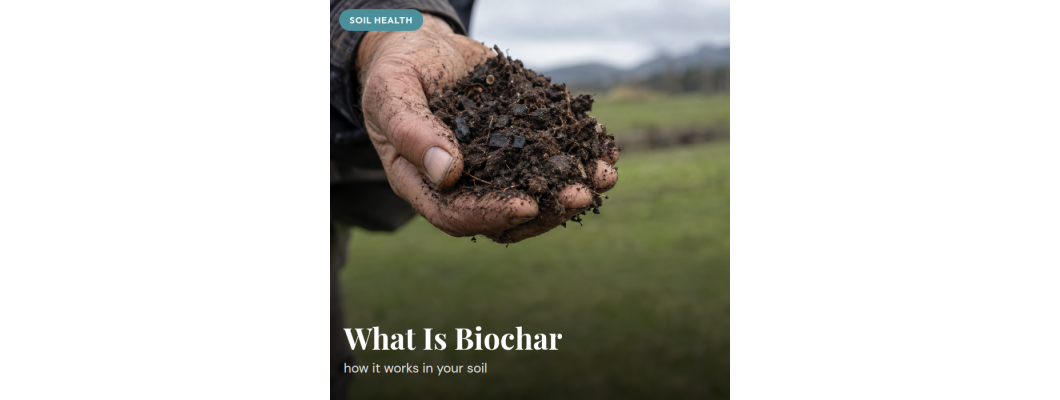
Biochar is a highly porous form of charcoal made by heating wood with very little oxygen, and it works by giving soil (and gut) microbes somewhere to live while holding onto water and nutrients that would otherwise wash straight through. Southland Carbon makes it from New Zealand wood biomass at Pukerau, and the same process that produces the biochar also gives you wood vinegar and a ready-to-use aphid spray as byproducts.
- ✓Improves water and nutrient retention in soil, and cuts nutrient runoff to waterways
- ✓Gives soil microbes a stable carbon structure that can stay in the ground for decades
- ✓Can also be fed to livestock to support rumen function and feed conversion
- ✓The same wood-to-carbon process yields wood vinegar and a natural aphid deterrent
On this page
If you've heard the word "biochar" thrown around at a field day or in a soil health conversation and wondered what it actually is, you're not alone. It's charcoal, but not the barbecue kind, and it's made for one job: to sit in your soil (or your stock) for a very long time, doing quiet, useful work. Here's what it is, why it's worth knowing about in a New Zealand context, and where it actually comes from.
What is biochar?
Biochar is wood that's been heated in a low-oxygen environment until almost everything except carbon burns off, leaving behind a porous, sponge-like structure with a huge internal surface area. A single gram can carry hundreds of square metres of surface once you account for all the internal pores.
That structure is what makes it useful. In soil, it acts like a set of tiny apartments for microbes to live in, and it holds onto water and nutrients that would otherwise drain away. The same structure works inside an animal's gut too, which is why biochar is now sold both as a soil amendment and as a livestock feed additive. Southland Carbon, based at Pukerau in Southland, makes theirs from New Zealand wood biomass rather than importing char from overseas, and Rainbow & Brown stocks their Southland Carbon Premium Biochar as a dual-purpose product for exactly that reason.
Why it matters in New Zealand
Biochar isn't a new idea (people have been burying charred wood in soil for centuries), but it lines up unusually well with a few specific NZ conditions.
- Free-draining soils lose nutrients fast. A lot of NZ farmland, from Canterbury's stony plains to pumice country in the central North Island, drains quickly. Biochar's structure helps hold nutrients in the root zone instead of letting them wash straight through.
- Nutrient runoff is under more scrutiny than ever. Regional councils are tightening rules around nutrient loss to waterways. Biochar's ability to increase cation exchange capacity (its knack for holding onto nutrients rather than losing them) is a genuine tool here, not just a talking point.
- Both pastoral and cropping systems can use it. Because the same biochar works as a soil amendment and a feed supplement, it fits dairy and beef operations as well as market gardens and lifestyle blocks, which is unusually flexible for a single product.
From smoke to soil: how it's made
Southland Carbon's process is straightforward in principle, even if the equipment doing it is not. Untreated New Zealand wood goes in, and three separate products come out the other end.
-
Untreated NZ wood biomass goes into the kiln. Southland Carbon uses 100% virgin, untreated plant material sourced in New Zealand, processed at their Pukerau facility.
-
Controlled pyrolysis strips away everything but carbon. The wood is heated with very little oxygen present, so it chars rather than burns to ash. This is what leaves behind the stable, porous carbon lattice.
-
The smoke is captured, not lost. As the wood chars, it releases smoke, and that smoke is condensed back into a liquid: wood vinegar, also called pyroligneous acid. It's an amber, acidic liquid that gardeners have used for centuries as a soil tonic and mild pesticide.
-
What's left behind is the biochar itself. Over 85% stable carbon with a surface area in the 350 to 550 m²/g range, ready to go into soil, feed, or bulk storage. Southland Carbon makes it to the ANZBIG Code of Practice and it's tested against heavy metal and contaminant limits for feed use.
That's the "smoke to soil" idea: nothing about the process is wasted, and each output does a different job. Always follow the product label and current regulations for the specific use you have in mind.
Two products come out of that same smoke. Southland Carbon Envigorate Wood Vinegar is the concentrated, 100% pyroligneous acid version, used diluted as a plant tonic, root stimulant, and mild pest or fungal control. Southland Carbon Aphid Spray is the same wood vinegar chemistry at a lower, ready-to-use strength (around 5%) in a 1L trigger bottle, purpose-built as a natural deterrent for aphids on roses, vegetables and ornamentals. Customers report good results as part of a regular spray routine; as with any natural deterrent, it works best used consistently rather than as a one-off rescue treatment.
Practical tips
Tip: Start with a Soil Food Web fungi:bacteria test before you commit to a programme. It tells you what your soil actually needs rather than guessing, and gives you a baseline to measure against later.
Tip: If you're feeding biochar to livestock, stick to the stated dry matter intake limit and don't feed it within 48 hours of medication, drenching or vaccination. It can bind more than just toxins.
Tip: Dilute Southland Carbon Envigorate Wood Vinegar before use. It's a concentrate at pH 2.5 to 3.0 and isn't meant to go on undiluted. Southland Carbon Aphid Spray, by contrast, is already at ready-to-use strength, so no mixing is needed there.
Tip: Biochar works best paired with biology, not instead of it. That's the thinking behind Rainbow & Brown's own BioCharge Fungal Feeder range, which uses Southland Carbon's charged biochar as part of a liquid soil-biology programme rather than the raw product on its own.
Tip: Bulk bags up to 1,000L are available on enquiry if you're covering real area. It's worth asking about pricing at scale rather than assuming small pack sizes are your only option.
Common mistakes
Mistake: Assuming all biochar is the same. Feedstock, pyrolysis temperature and testing all affect what you end up with. A feed-grade biochar tested against contaminant limits is a different product to char sold purely as a soil amendment, even if they look identical in the bag.
Mistake: Applying a large amount and expecting an immediate result. Biochar is a long-term structural change to your soil, not a quick fix. The value shows up over seasons, in water-holding and microbial activity, not in the first few weeks.
Mistake: Treating wood vinegar and the ready-to-use aphid spray as interchangeable. They're the same base chemistry at very different strengths. Using the concentrate at aphid-spray rates under-delivers, and using the ready-to-use spray as a soil tonic under-delivers the other way.
Mistake: Feeding biochar around medication time. The same binding property that makes it useful for toxins can interfere with drenches and vaccines, so the 48-hour buffer either side matters.
Quick checklist
- Know whether you want biochar for soil, for feed, or both, since Southland Carbon Premium Biochar is tested and suited to either
- Get a Soil Food Web test done first if you want an actual baseline rather than a guess
- Check your intended dry matter intake limit and medication timing before feeding it to stock
- Decide whether you need the concentrate (Southland Carbon Envigorate Wood Vinegar) or the ready-to-use format (Southland Carbon Aphid Spray)
- Ask about bulk bag pricing if you're covering more than a few hectares
- Read the label for dilution rates before your first application
Next step: if you're not sure which of the three products fits your situation, contact us and we'll talk you through it.
FAQs
Is biochar the same as the charcoal you'd use on a barbecue?
No. Barbecue charcoal is usually made to burn cleanly and completely. Biochar is made to do the opposite: to resist breaking down, so it can sit in soil or move through an animal's gut doing structural work rather than being consumed as fuel.
Can I use Southland Carbon Premium Biochar on pasture and in feed at the same time?
Yes, that's exactly why it's sold as a dual-purpose product, made to a feed-safe standard as well as a soil-amendment one. Just keep the feeding limits and medication timing in mind on the livestock side.
Is wood vinegar safe to use around pets and children?
Southland Carbon Envigorate Wood Vinegar is a concentrated, acidic liquid (pH 2.5 to 3.0), so gloves and eye protection are recommended when handling it neat, and it should always be diluted before use. Southland Carbon Aphid Spray is a much lower-strength, ready-to-use version, but sensible handling still applies to any garden spray.
How often should I use the aphid spray?
Southland Carbon Aphid Spray is generally used weekly on active infestations and around every 14 days as a preventative. Check the label for the specifics on your particular plants.
Further reading

Leave a Comment