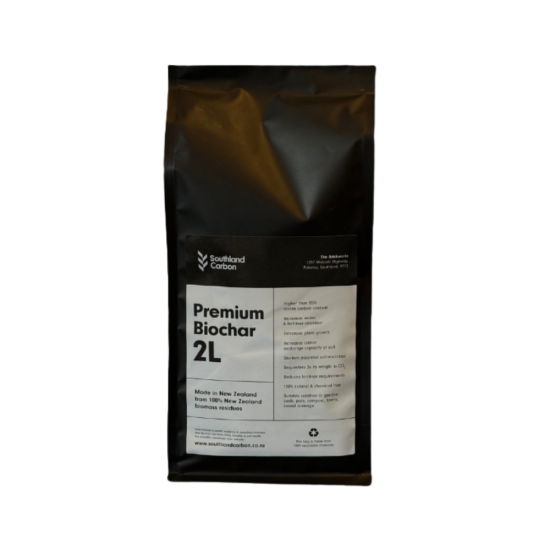
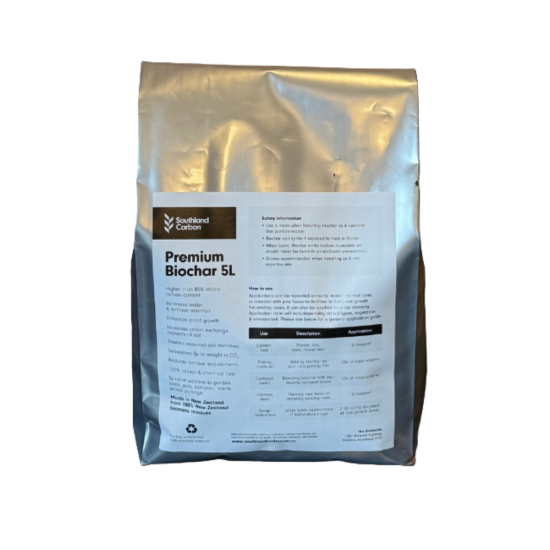
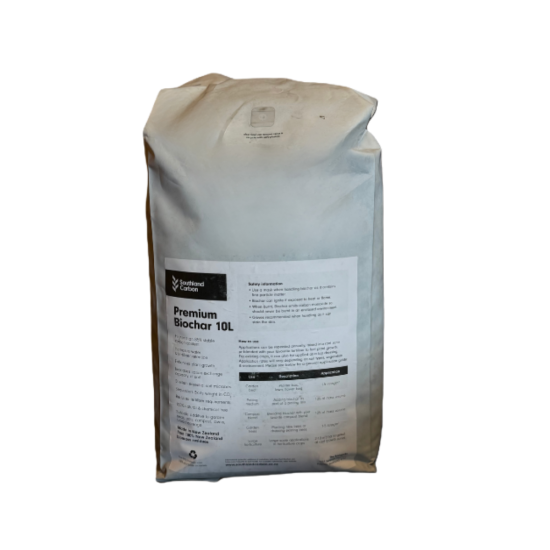
Premium biochar for soil and stock – carbonised New Zealand wood, over 85% stable carbon, 350–550 m²/g surface area
One bag, two jobs. This premium biochar improves your soil and can also be fed to livestock, and it's the same carbonised wood doing both. It's 100% natural and chemical free, made at Pukerau in Southland from untreated New Zealand biomass.
In the garden it holds water, nutrients and microbes where your plants can use them, and locks carbon into the soil for years. Fed to stock, that same sponge-like structure supports gut health, binds toxins, and helps animals get more out of their feed.
Whether you're a lifestyle block owner topping up a few garden beds or a farmer feeding a mob, a little goes a long way. Scroll down for how to use it in the garden, how to feed it to stock, and the full detail.
IF YOU'RE FEEDING IT TO STOCK: DO NOT FEED DURING MEDICATION, DRENCHING OR VACCINATION (ALLOW 48 HOURS EITHER SIDE), AND DO NOT EXCEED 0.8% OF DAILY DRY MATTER INTAKE UNLESS DIRECTED BY A VET.
Best For / Ideal Uses
In the garden and on the block
- Lifestyle block owners improving garden beds, raised beds and pots
- Blending into potting mix or compost
- Lawns, flower beds, and new or established trees
- Larger horticulture, worked into the root zone
- Better water retention and less nutrient runoff on the block
- Anyone wanting to lock carbon into their soil for the long term
As livestock feed
- Cattle, sheep and other ruminants, supporting rumen function and feed conversion
- Dairy and drystock farmers chasing better manure quality and nutrient cycling
- Stock under mycotoxin or feed-quality pressure
- Free-choice feeding alongside minerals, or mixed through a ration
How It Works
Biochar is almost pure carbon with a huge internal surface area. A single gram has the surface of a small room, all folded up into pores. That structure is what does the work, and it does the same basic job whether it's in your soil or in an animal.
In the soil
The pores act like a reservoir, holding water and dissolved fertiliser where plant roots can get to them instead of letting them drain away. That same surface raises the soil's cation exchange capacity, meaning it holds onto more nutrients, helps buffer soil pH, and gives soil microbes a sheltered place to live. By hanging onto nitrogen and phosphorus, it also cuts the nutrients that would otherwise leach out into waterways. Because the carbon is stable, it doesn't break down quickly. It stays put, improving the soil and holding its carbon for years.
In the animal
Fed to stock, the pores give beneficial gut microbes room to colonise, which supports a healthy rumen. The surface binds toxins and pathogens so more of them pass straight through rather than being absorbed, and it holds nutrients for slower release. Biochar can also shuttle electrons, which supports rumen microbial activity, and behaving a bit like fibre it slows feed down so there's more time to absorb it. It's not a drug and it isn't absorbed into the animal. It works physically as it passes through, then ends up in the manure and back in the soil.
Farmers feeding it report healthier, better-doing stock. Depending on your system, biochar may improve feed efficiency, bind mycotoxins and pathogens, reduce the ammonia load in digestion and improve manure quality, with growing interest in its potential to cut methane emissions. Southland Carbon also reports it may support weight gain and milk production, help with fertility and with calf and lamb weaning, reduce reliance on drenching, and ease stomach acidity in horses. These are potential benefits rather than guarantees.
In the Garden: How to Use It
Mix it into the root zone, blend it with your usual fertiliser, or use it as a top dressing on existing crops. Applications can be repeated each year. Rates vary with soil type, planting and conditions, so treat these as a general guide:
- Garden beds, planter boxes, lawns and flower beds: 1 to 5 litres per square metre
- Potting mix: around 10% of the mix by volume
- Compost: blend in at around 10% by volume
- New or existing trees: 1 to 5 litres per square metre around the root zone
- Large-scale horticulture: apply targeted at the root growth zones
Tip: biochar works best when it's already carrying nutrients, so blending it with compost or fertiliser before it goes in means it's not drawing nutrients out of the soil while it charges up.
Feeding Guide & Dosage
These are general guidelines only. For a prescribed dose for your animals, talk to your vet or an animal nutritionist.
How much: 0.25 to 0.8% of daily dry matter intake (DMI) for general supplementation. Do not exceed 0.8% of DMI unless directed by a vet.
How to feed it: mix it through feed, or offer it free choice. On free choice, most animals will self-regulate their own intake. If you're offering it in a trough, make sure the trough is self-draining, and keep the biochar slightly damp rather than floating in water.
Introduce it gradually. Bring it in slowly rather than all at once, and keep an eye on manure consistency, which is a good indicator of whether you've got the dose right.
Always provide clean water. Stock need access to clean water at all times.
Keep it slightly damp. A little moisture keeps the dust down when you're handling and feeding it.
When not to feed it:
- During medication, drenching or vaccination. Allow 48 hours before and 48 hours after before restarting biochar, so it doesn't bind the treatment.
- To animals experiencing constipation or colic.
Technical Details
Product type: carbonised plant material, for soil use and as a livestock feed supplement
Feedstock: 100% virgin, untreated New Zealand wood biomass. No treated timber, no contaminated feedstock, no synthetic additives, catalysts or processing chemicals. Water-only cooling.
Manufacture: controlled pyrolysis above 500°C in a low-oxygen environment, for at least 30 minutes
Stable carbon: over 85%
Fixed carbon: 80–90% (dry basis)
Ash (mineral content): 5–10%
Moisture content: approximately 20–30%
Appearance: black granular material, particle size under 15mm
pH: 7.5–10.2
Bulk density: approximately 100 kg/m³
Surface area: 350–550 m²/g
Carbon sequestration: holds around three times its own weight in CO2
Odour: odourless
Solubility: insoluble in water
Shelf life: indefinite if stored dry and covered
Quality & compliance: made to the ANZBIG Code of Practice for the Sustainable Production and Use of Biochar (2021), and passes the heavy metal and contaminant limits for feed. Produced under controlled, traceable conditions.
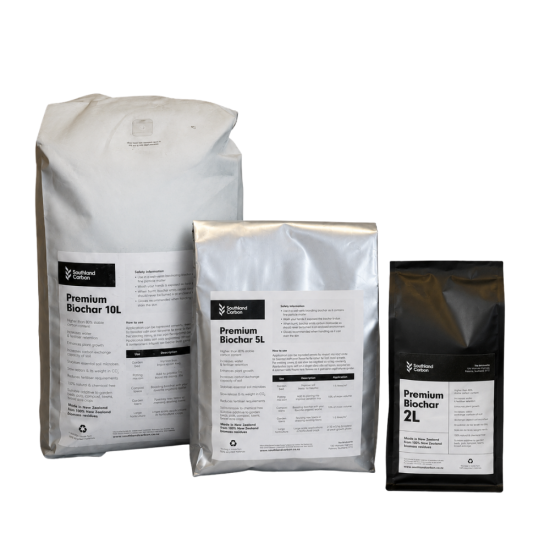
Pack sizes: 2L, 5L, 10L and 20L. Larger bulk bags up to 1,000L are available on enquiry, price on application.
Supplier: Southland Carbon Limited, The Brickworks, Pukerau, Southland
Frequently Asked Questions
Can I use the same biochar in the garden and feed it to animals?
Yes. It's one product for both. It's produced and tested to the feed-safety limits for heavy metals and contaminants under the ANZBIG Code of Practice, so it's fine to feed to stock as well as work into soil.
How much do I use in the garden?
For garden beds, lawns and around trees, 1 to 5 litres per square metre. For potting mix or compost, around 10% by volume. Blend it with compost or fertiliser before it goes in so it's carrying nutrients from the start.
How much do I feed my stock?
The general guideline is 0.25 to 0.8% of daily dry matter intake. Don't go over 0.8% unless your vet directs it. Introduce it gradually and watch the manure to gauge whether the dose is right.
What does it actually do for my soil?
It holds water and fertiliser near the roots, lifts the soil's ability to hang onto nutrients, and gives soil microbes somewhere to live. Because the carbon is stable it doesn't break down quickly, so one application keeps working for years and locks that carbon away.
When should I not feed it?
Stop feeding it during any medication, drenching or vaccination, and leave 48 hours either side before you restart, because biochar can bind the treatment too. Don't feed it to animals with constipation or colic.
Does it really cut methane?
There's real interest in biochar's potential to reduce methane and nitrous oxide emissions, and some promising research, but results vary by system and it's not a guaranteed outcome. Treat the emissions side as a likely bonus rather than the main reason to use it.
Is it safe to handle?
Yes, with basic care. Wear a dust mask and gloves when handling the dry material, avoid breathing in the fine particles, and keep it slightly damp to keep the dust down. It can stain skin, and it will ignite if exposed to flame, so keep it away from fire.
Safety & Compliance
Handling. Wear a dust mask and gloves when handling the dry material, and avoid inhaling fine particles. Keep it slightly damp to suppress dust. It can stain skin. Biochar will ignite if exposed to heat or flame, and gives off carbon monoxide when burnt, so keep it away from ignition sources and never burn it in an enclosed space.
If feeding to stock. Follow the feeding guidelines and dosage, introduce it gradually, and do not exceed 0.8% of daily dry matter intake unless directed by a vet. Biochar is not a veterinary medicine. For animal health concerns or a prescribed dose, talk to your vet or an animal nutritionist. Do not feed around medication, drenching or vaccination (48 hours either side), or to animals with colic or constipation.
Southland Carbon Premium Biochar is not classified as hazardous under the GHS, and is not a dangerous good for transport while it holds around 25% moisture.
Made to the ANZBIG Code of Practice (2021) by Southland Carbon in Pukerau, Southland, and stocked by Rainbow & Brown. Got a question about using it? Get in touch; we’re happy to help.
For full handling and feeding information, see the label, product spec and Safety Data Sheet attached to this listing.