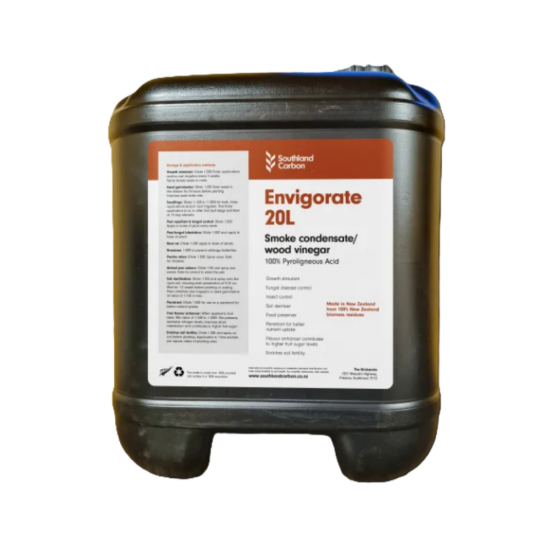
Smoke condensate / wood vinegar – 100% pyroligneous acid, made from untreated New Zealand wood
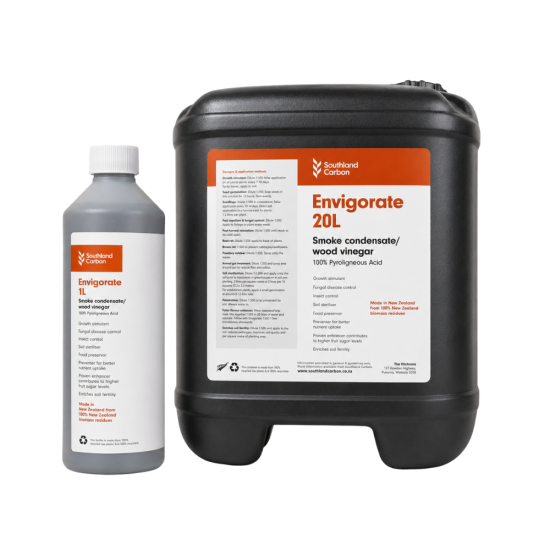
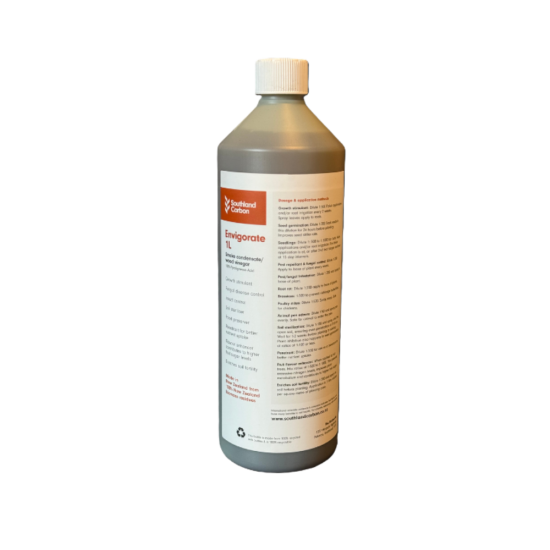
Wood vinegar is the amber liquid captured when wood is turned into biochar. As the smoke cools it condenses into a concentrate full of natural organic acids and phenols, and people have leaned on it in the garden for centuries. Envigorate is Southland Carbon's version, made at Pukerau in Southland alongside their biochar, from 100% untreated New Zealand wood.
It's a real all-rounder: a plant tonic and root stimulant, a natural way to deter pests and knock back fungal problems, and an odour neutraliser around animal housing. One bottle covers a lot, because it's a concentrate that dilutes a long way.
It suits gardeners, growers and lifestyle block owners after a natural, biodegradable option. Scroll down for the full dilution guide, how it works, and the technical detail.
ALWAYS DILUTE BEFORE USE AND TRIAL ON A SMALL AREA FIRST. THIS IS AN ACIDIC CONCENTRATE (pH 2.5–3.0) – WEAR GLOVES AND EYE PROTECTION WHEN HANDLING IT NEAT, AND NEVER INGEST IT UNDILUTED.
Best For / Ideal Uses
In the garden and growing
- A general plant tonic and growth stimulant, foliar or on the roots
- Soaking seeds before planting to help strike rate
- Root growth and seedling establishment
- A penetrant to help plants take up nutrients
- On fruit trees, where growers use it to lift fruit sugar
- Enriching soil and feeding compost
Pest and fungal help
- Deterring insects around plants
- Knocking back fungal problems, including root rot
- Discouraging cabbage butterflies on brassicas
- Poultry mites in the coop (safe for chickens)
Around animals and odour
- Neutralising odour in animal pens and housing
- Bedding and shed treatment
- Effluent and compost odour control
How It Works
When wood is heated in a low-oxygen kiln to make biochar, it gives off smoke. Cool that smoke and it condenses into wood vinegar, a concentrate of organic acids (mostly acetic acid) and phenols. Those natural compounds are what do the work.
It's acidic and mildly antimicrobial, which is why it's used to deter insects and hold back bacteria and fungi. At high dilution it works the other way, acting as a gentle stimulant that supports plant growth, root development and the soil microbes that drive nutrient cycling. Its strong smoky smell is also what makes it useful for masking and neutralising odours around animal housing.
Dilution is everything with wood vinegar. Weak solutions stimulate; strong ones suppress. At 1:100 or stronger it will actually stop seeds germinating, which is why the same product can be used both to help seedlings along and to hold a seedbed back before planting. Always follow the rates below and trial a small area first.
How to Use It & Dilution Rates
These are Southland Carbon's label rates. Wood vinegar is a concentrate, so every use is diluted with water. Always trial on a small area before going over everything.
Plants and growing
- Growth stimulant: 1:500, as a foliar spray and/or root drench every 2 weeks
- Seed germination: 1:200, soak seeds for 24 hours before planting to help strike rate
- Seedlings: 1:500 to 1:1000, foliar and/or root, from the 2nd leaf stage then every 15 days
- Penetrant: 1:500, to help nutrient uptake
- Fruit flavour: 1:500 to 1:1000 on fruit trees
- Enrich soil fertility: 1:200, sprayed on soil before planting at about 1 litre of solution per square metre
Pest and fungal
- Pest repellent & fungal control: 1:200, applied to the base of the plant weekly
- Heavier infestation: 1:300, applied to the base of the plant
- Root rot: 1:200, applied to the base of plants
- Brassicas (cabbage butterfly): 1:500
- Poultry mites: 1:500, sprayed in the coop (safe for chickens)
Soil and odour
- Animal pen odours: 1:50, sprayed evenly (safe for animals to re-enter)
- Soil sterilising: 1:100, sprayed onto open soil for even penetration of 5–10cm. Wait 1–2 weeks before planting or sowing, as it holds back germination at this strength
- Compost activation: 1:50 to 1:100
Tip: start weaker than you think you need and work up. Weak solutions stimulate growth, strong ones suppress it.
Technical Details
Product type: wood vinegar (pyroligneous acid), a natural liquid condensate from wood pyrolysis
Composition: approximately 100% pyroligneous acid, with under 2% phenolic compounds
Feedstock: 100% untreated, virgin New Zealand wood biomass. No synthetic additives or chemicals introduced.
Appearance: brown to dark amber liquid
Odour: smoky, vinegar-like
pH: 2.5–3.0 (acidic)
Density: 1.005–1.050 g/cm³
Solubility: fully miscible in water
Flammability: not classified as flammable
Biodegradable: yes, with low environmental persistence
Shelf life: 24 months stored correctly (sealed, out of direct sunlight, below 30°C)
CAS number: 8030-97-5
Classification: not classified as hazardous under HSNO or GHS, and not a dangerous good for transport, when used as directed
Pack sizes: 1L and 20L.
Supplier: Southland Carbon Limited, The Brickworks, Pukerau, Southland
Frequently Asked Questions
What is wood vinegar?
It's the liquid you get when the smoke from making biochar is cooled and condensed. Also called pyroligneous acid, it's a natural concentrate of organic acids and phenols that gardeners have used for generations as a plant tonic and general garden helper.
How do I dilute it?
It depends on the job, but most garden uses sit between 1:200 and 1:500 with water. Odour control around animal pens is stronger at 1:50. See the dilution guide above, and always trial a small area first.
Is it natural and organic?
Yes. It's made from 100% untreated New Zealand wood with no synthetic additives, it's biodegradable, and it breaks down quickly in the environment.
Can I use it around chickens and animals?
Yes, diluted as directed. Southland Carbon's label covers spraying coops for poultry mites at 1:500 (safe for chickens) and animal pens for odour at 1:50, where it's safe for animals to re-enter once sprayed.
Could it harm my plants?
Only if you use it too strong. Wood vinegar stimulates at high dilution but suppresses growth when concentrated. At 1:100 or stronger it will stop seeds germinating, so stick to the rates and start weak.
How do I store it?
Keep it sealed, out of direct sunlight and below 30°C. Stored that way it lasts around 24 months.
Safety & Compliance
Wood vinegar is an acidic concentrate (pH 2.5–3.0). Always dilute before use and trial a small area first.
Avoid contact with eyes and skin. Wear gloves and eye protection when handling the concentrate, use it with adequate ventilation, and do not ingest it undiluted.
It's not classified as hazardous under HSNO or GHS, and is not a dangerous good for transport, when used as directed. It is biodegradable, but avoid discharging the concentrate directly into waterways.
Store sealed, out of direct sunlight and below 30°C, away from strong alkalis.
Envigorate is made by Southland Carbon Limited in Pukerau, Southland, and stocked by Rainbow & Brown. Got a question about using it? Get in touch – we’re happy to help. For full handling information, see the label, product spec and Safety Data Sheet attached above.