
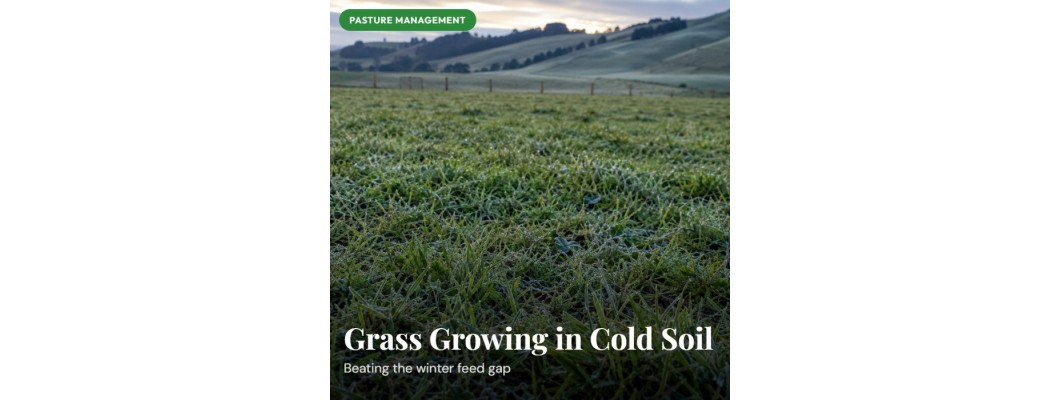
Grass growth stalls once soil temperatures drop below about 10 degrees, which is the winter feed gap every farmer knows. Gibberellic acid, a natural plant hormone sold as Gibb-Gro and Gibber900, can get pasture moving again once soils sit in the 6 to 13 degree range, with a lift in dry matter over about three weeks. It works as a top-up on green, actively growing pasture, not a rescue for bare or frozen paddocks.
- ✓Grass idles once soil temperatures fall below about 10 degrees, and August to September is the classic feed gap
- ✓Gibberellic acid (GA3) is a natural plant hormone that signals grass to grow in cool soils
- ✓It works best on green leaf with moisture and fertility underneath
- ✓It can let you ease back on nitrogen, which matters under the 190 kg N per hectare cap
On this page
Every winter there's a stretch where the grass just stops. The soil's too cold, the stock have eaten the cover down, and you're staring at a paddock that isn't bouncing back. That's the feed gap, and it catches farmers and lifestyle block owners right across the country. Here's what's actually going on underground, and how gibberellic acid can buy you feed in that cold window.
What is gibberellic acid?
Gibberellic acid, usually shortened to GA3, is a natural plant hormone that tells grass to grow. Plants make it themselves, and products like Gibb-Gro and Gibber900 give the pasture an extra dose when the cold has slowed its own production right down.
It's made by fermentation and comes as a highly water-soluble powder. Think of it less as food and more as a signal: it doesn't feed the plant the way a fertiliser does, it prompts the grass to put existing energy and nutrients into new leaf. That's why it can wake up a paddock that has the resources to grow but not the temperature to trigger it.
Why does it matter in New Zealand?
New Zealand's pasture-based farming lives and dies on grass growth, and our winters create a predictable gap where the paddock can't keep up with what the stock need.
- Soil temperature drives it, not air temperature. Once soils sit below about 10 degrees, most ryegrass-based pasture more or less stops growing, and much of the country sits in that range through August and September.
- The gap hits when it hurts. Late winter into early spring is when cows are coming back into milk and ewes are lambing, so feed demand climbs at exactly the point the paddock slows down.
- It varies by region. Warmer Northland and coastal districts get a shorter, milder gap. Colder inland and South Island districts get a longer, deeper one, and in the depths of a hard winter even gibberellic acid has its limits.
How to approach it
Getting a result comes down to timing, soil temperature, and having green leaf for the hormone to work on. Here's the order that works.
-
Check your soil temperature. Aim to apply when soils are sitting in the 6 to 13 degree range. Much colder and the plant can't respond; much warmer and the pasture is growing on its own anyway.
-
Make sure there's green leaf. Gibb works on the leaf that's already there. Graze or top beforehand if you need to, but leave enough green cover for the plant to take it up and put on growth.
-
Sort moisture and fertility underneath. A growth signal only helps if the plant has water and nutrients to draw on. Dry or hungry pasture won't respond well, so a base of decent fertility matters.
-
Apply at label rate and give it time. You'll usually see the lift come through within about three weeks. Treat it as a top-up over that window rather than an overnight fix.
Always follow product label and local regulations.
Where Rainbow & Brown fits in. We're a direct-to-customer supplier of agricultural chemicals and plant nutrition, and we stock two gibberellic acid options: Gibb-Gro and Gibber900. Both are the same active, so it comes down to pack size and what suits your operation.
Not sure whether your soils are in the window yet? Contact us and we'll talk it through for your situation.
Practical tips
- Tip: Treat gibb as a top-up, not a rescue. It buys feed off pasture that's already trying to grow, so use it before the gap bites rather than after the paddock's bare.
- Tip: Pair it with a bit of nitrogen, not a lot. Many farmers get the growth they'd otherwise chase with a heavy urea rate off a lighter rate plus gibb, which matters with the 190 kg N per hectare cap in play.
- Tip: Don't expect much in the depths of a cold snap. If soils are stuck well below the range, hold off and wait for the window to open rather than wasting the pass.
- Tip: Clean uptake helps. Gibb works best when the leaf takes the spray up well, so good spraying conditions and coverage make a difference.
Common mistakes
Mistake: Spraying when soils are too cold. Below the range the plant can't respond and the application is wasted. Wait for soils to lift into the window first.
Mistake: Applying to bare or overgrazed paddocks. No green leaf means no result. Leave enough cover for the plant to work with.
Mistake: Treating it like a fertiliser. Gibb signals growth, it doesn't feed the plant, so it still needs moisture and nutrients underneath to deliver.
Mistake: Expecting it to last all season. It's a three-week lift, not a permanent change. Plan your follow-up feed for after the window closes.
Quick checklist
- Soil temperature sitting in the 6 to 13 degree range
- Green, actively growing leaf on the paddock
- Adequate moisture in the soil
- Reasonable fertility underneath (a light nitrogen rate pairs well)
- Product mixed and applied at label rate
- Realistic expectation: a lift coming through within about three weeks
- Follow-up feed planned for after the window
- Next step: check your soil temperature this week and mark the paddocks sitting in the gibb window. Contact us or order online.
FAQs
Does gibberellic acid work in winter?
It works in the cool shoulder of winter, when soils are in roughly the 6 to 13 degree range. In the depths of a hard frost or very cold soils it won't do much, because the plant is simply too cold to respond to the signal.
Is there a withholding period?
Gibberellic acid products have grazing and withholding requirements, so always check the current product label before grazing treated pasture. We've covered the detail in a separate post (linked below), and you're welcome to contact us if you want to talk it through.
How much extra growth will I actually get?
It depends on your soil temperature, moisture and fertility, so there's no fixed number. Customers report a useful lift in dry matter over about three weeks in the right conditions. If you want a realistic read for your paddocks, get in touch and we'll help you weigh it up.
Can I use less nitrogen if I use gibb?
Many farmers do exactly that. Pairing a lighter nitrogen rate with gibberellic acid often delivers growth you'd otherwise chase with more urea, which is handy under the 190 kg N per hectare synthetic nitrogen cap and can save money at the same time.
Further reading
- Reduce Nitrogen and Save Money with Gibb-Gro
- Is There a Withholding Period for Gibber?
- Gibb-Gro (gibberellic acid) product page
Gibb-Gro and Gibber900 are ACVM registered products. Always read and follow label directions. Grazing and withholding periods apply; observe them before grazing treated pasture. Contact us for advice specific to your situation.

Leave a Comment