
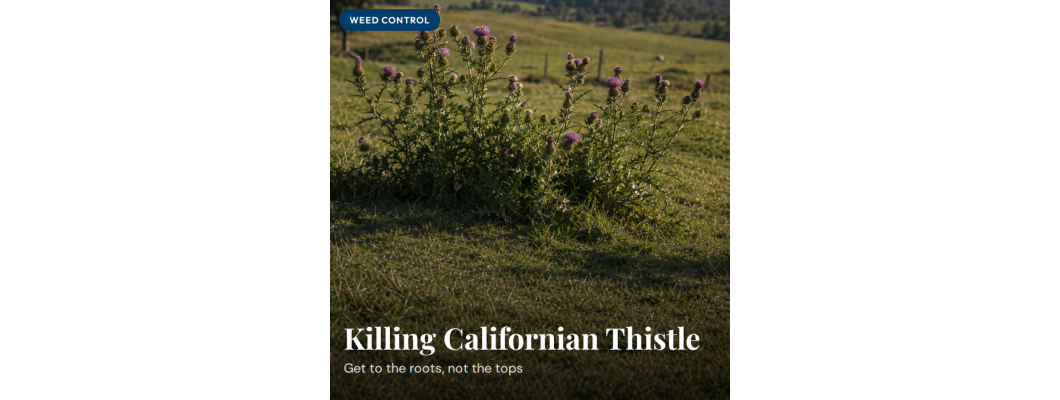
Californian thistle is hard to kill because the plant you see is only the top of a deep, spreading root system that keeps throwing up fresh shoots from root buds. Knocking back the top growth won't get on top of it. The reliable approach is a herbicide that moves through the whole plant down to the root buds, applied while the thistle is actively growing and before it flowers. Mixes containing aminopyralid, like GrassMate XTRA, are built for exactly this.
- ✓The thistle you see is the top of a deep, creeping root system that resprouts from root buds
- ✓Top-kill alone won't beat it; you need a herbicide that reaches the roots
- ✓Spray while it's actively growing, before flowering, for the best uptake
- ✓Aminopyralid (in GrassMate XTRA) is taken up through leaf and root and moves toward the root buds
On this page
If you've got Californian thistle, you already know the frustrating part. You spray, the tops die off, and a few weeks later it's back like nothing happened. That isn't a dud spray. It's the root system. Here's why this weed is so stubborn, and how to actually get on top of it.
Why Californian thistle is so hard to kill
Californian thistle is a creeping perennial, and the plant you see above ground is only a small part of it. Underneath is a deep, spreading root system that runs laterally through the paddock and stores plenty of energy. That root system is the whole problem.
Those roots carry buds that throw up fresh shoots, often well after the foliage you sprayed has died off. So a herbicide that only burns off the top growth gives you a tidy-looking paddock for a few weeks, then a new flush comes through from the roots. That's why a property with a real thistle problem can end up fighting the same battle in the same spots year after year. To make progress you have to get the herbicide down into that root system, not just onto the leaf.
Why does it matter in New Zealand?
Californian thistle is one of the most persistent pasture weeds in the country, and it costs you feed and grazing every season it's left to spread.
- It spreads under the fence line and across the paddock. Because it travels by root as well as by seed, a small patch doesn't stay small. Left alone it expands outward every year.
- It takes feed off your stock. Dense thistle crowds out pasture and the spiny growth means stock graze around it, so you lose usable pasture in the patches where it takes hold.
- Top-kill flatters to deceive here. Our growing season gives the roots plenty of time to resprout, so a knockdown that looks great in spring can be back by summer. Beating it in NZ conditions means targeting the roots and following up.
How to get on top of it
Getting on top of Californian thistle comes down to the right timing, a herbicide that travels to the roots, and follow-up. Here's the order that works.
-
Spray while it's actively growing. Aim for the rosette to early-bud stage, typically spring into early summer, with autumn regrowth another option. That's when the plant is moving sugars (and herbicide) down to the roots.
-
Pick a herbicide that reaches the roots. A contact, top-kill product won't cut it. You want a systemic that moves through the plant to the root buds. Aminopyralid-based mixes are built for thistles and other Asteraceae weeds.
-
Get good coverage on healthy leaf. The more healthy green leaf you treat, the more active moves down. Avoid spraying dusty, drought-stressed or frosted plants, they don't take it up well.
-
Follow up on the survivors. One pass rarely clears an established patch. Check for regrowth and re-treat. Getting on top of a serious infestation is usually a two to three season job, not a one-off.
Always follow product label and local regulations.
Where Rainbow & Brown fits in. We're a direct-to-customer supplier of agricultural chemicals and plant nutrition. For Californian thistle where the root system is the real problem, GrassMate XTRA adds aminopyralid to a triclopyr and picloram base, so it's aimed at brushweeds and the tougher broadleaf pasture weeds like thistle and ragwort. For general brushweed jobs where thistle isn't the main headache, standard GrassMate is still the one to reach for first.
Not sure which fits your situation? Contact us and we'll talk it through.
Practical tips
- Tip: Time it for active growth, not flowering. Once it's flowering, the plant is putting energy into seed rather than roots, so less herbicide travels down. Hit it earlier while it's growing hard.
- Tip: Don't waste effort on top-kill alone. Mowing just removes the leaf and the roots carry on. Mowing and then spraying the fresh regrowth can work better than either on its own.
- Tip: Mind aminopyralid residues. Aminopyralid can persist in treated plant material, so don't use clippings, hay or manure from treated paddocks in the vege garden or compost, as it can damage sensitive plants. Follow the label on this.
- Tip: Plan for more than one hit. Treat an established patch as a two to three season job. Steady follow-up beats one big effort you don't come back to.
Common mistakes
Mistake: Spraying only the top growth and calling it done. The roots just resprout. Use a systemic that moves to the root buds, not a contact top-kill.
Mistake: Leaving it until it's flowering. Uptake to the roots drops off once the plant flowers. Spray while it's actively growing.
Mistake: Expecting one pass to clear it. An established root system needs follow-up. Check the patch and re-treat the regrowth.
Mistake: Composting treated material. Aminopyralid can carry over in clippings and manure. Keep treated material out of the garden and compost.
Quick checklist
- Thistle actively growing, before flowering
- A herbicide that moves systemically to the root buds
- Good coverage on healthy leaf, plants not stressed or frosted
- Clover impact considered (these mixes knock clover about)
- Treated clippings and manure kept out of the compost and vege garden
- Follow-up treatment planned for regrowth
- Next step: walk the paddock, mark the patches, and get onto them while they're growing.
FAQs
What actually kills Californian thistle?
A herbicide that moves through the whole plant to the root buds, not one that just burns off the top. Aminopyralid-based products (such as GrassMate XTRA) are taken up through both leaf and root and move systemically, which is what helps reduce regrowth from the root system. Spray while the thistle is actively growing, and plan on follow-up.
Is GrassMate XTRA the same as Tordon Brushkiller XT?
It carries the same three actives at the same concentrations: triclopyr, picloram and aminopyralid. It's registered for the same broad list of brushweeds (gorse, blackberry, broom, sweet briar and more) plus a solid range of broadleaf pasture weeds including ragwort, docks and cape weed. Tordon Brushkiller XT is a registered tradename of Corteva Agriscience New Zealand Limited.
When's the best time to spray?
While the thistle is actively growing and before it flowers, usually spring into early summer, with autumn regrowth another good window. Avoid frosted, dusty or drought-stressed plants, they don't take herbicide up well.
Will one spray get rid of it?
Rarely, for an established patch. The root system is extensive, so plan on follow-up treatment and treat it as a multi-season job rather than a one-off. If you want a hand working out a plan for your paddocks, get in touch.
Further reading
- GrassMate XTRA product page
- Ralid: clopyralid for thistle in pasture
- GrassMate or Triclo: which to use
Related products: GrassMate XTRA · GrassMate · Ralid
GrassMate and GrassMate XTRA are ACVM registered products. These mixes affect clover, so factor that into pasture where clover matters. Always read and follow label directions and observe withholding periods. Contact us for advice specific to your situation.



Leave a Comment