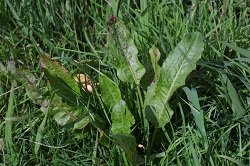
Docks
Broad-leaved dock – Rumex obtusifolius
Fiddle dock – Rumex pulcher
Clustered dock – Rumex conglomeratus

DESCRIPTION
There are several dock species in New Zealand, with Broad-leaved Dock being the most common. While this file focuses on Broad-Leaved Dock, the control methods are generallyapplicable to all dock species, such as Fiddle Dock and Clustered Dock .
Dock is a deep-rooted perennial weed that flowers and seeds primarily in spring and summer (October-February). It produces large, waxy leaves up tp 35cm long and 15cm wide, growing from a single, extensive taproot that can extend 1-2 metres deep. Plants reach approximately 1 metre tall at flowing, producing erect stalks with small green-to-red flower whorls that develop into brown, triangular nuts containing numerous long-lived seeds.
The extensive seed production and longevity creat persistentsoil seed banks, making prevention of seed set crucial for long-term control. Seeds can remain viable in soil for several years, leading to ongoing germination waves.
Habitat
Docks thrive in damp, poorly drained soils and are commonly found in:
- Dairy farm paddocks and gateways
- Wet areas around water troughs and drainage lines
- Compacted soil areas with poor drainage
- Disturbed ground and cultivation areas
- Roadside and waste areas
The leaves of docks contain bitter tannins that make them unpalatableto cattle and horses, although they are usually readily eaten by sheep. This, combined with the plant’s preference for damper soils, means docks become particularly problematic on dairy farms where cattle traffic creates ideal growing conditions.
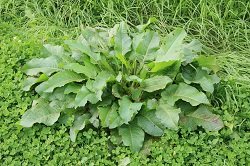
Broad Leaf Dock
MANUAL REMOVAL
Manual removal is ineffective due to extensive taproot (up to 2m deep) that regrow from remaining fragments. Grubbing tools cannot remove all viable roots. Mowing is furtile as severed stalks regrow. Cultivation alone causes serious re-infestation from taproot regrowth and seedlings, requiring pre-treatment herbicides.
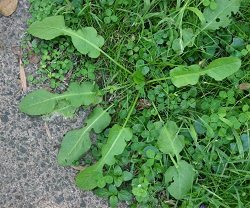
Fiddle Dock
HERBICIDE CONTROL
Optimal Timing: Spring application (October – December) during active growth before seed head development. Critical to control docks in new pasture as they out-compete immature pasture species.
Boom Spraying
Selctive Options for Pasture:
- Ranger Herbicide – 20g/ha – Controls seedling and mature docks. Temporary yellowing; clover recovery up to 4 months.
- PastureMate – 4L/ha – Grass/clover friendly. Good seedling control, suppresses later stages.
- WHACK – 2,4-D 800 – 2.5kg/ha – Controls seedlings, suppresses regrowth
- Dicamba 500 SL – 100ml + MCPA750 260ml/100L water - Will kill clover.
- Dicamba 500 SL – 120-140ml + WHACK – 2,4-D 800 535g/100L water – Will kill clover.
For Cereals:
- WHACK – 2,4-D 800 1.50kg/ha.
- Ranger Herbicide – 20g/ha.
- An alternative is LawnMate at 3-4.5L/ha/ 200L water BUT THIS IS NOT APPROVED FOR PASTURE/CROPLAND.
Spot Spraying (knapsack)
- GrassMate – 6ml/L covering 30m2 - Grass friendly, suppress clover.
- Dicamba 500 Select – 15ml + Rainbow & Brown MCPA750 40ml per 15L water.
- Dicamba 500 Select - 20ml + WHACK – 2,4-D 800 72g per 15L water.
- PastureMate – 100ml per 10L covering 250m2 - Pasture friendly.
- LawnMate – 120ml per 10L covering 250m2 BUT THIS IS NOT APPROVED FOR PASTURE/CROPLAND.
- GrassMate XTRA – 6ml/L by knapsack – Apply during active growth from full leaf to early flowering
Spot Treatment
- Cut'n'Paste Original - Apply to crushed plant centre.
- Buckshot – 2g per plant to crushed centre.
Non-Selective Options
- MSF600 - 5g/ha (seedling) or 10g/ha (establish).
- Ranger Herbicide – 20g/ha + G-360 GLYPHOSATE, G-540 GLYPHOSATE or Granny Herbicide at label rates.
- Terbguard 500 – 15-19L/ha + G-360 GLYPHOSATE, G-540 GLYPHOSATE or Granny Herbicide at label rates.
- DoubleShot– 15-25L/ha in 200-300L water.
Important Notes:
- Glyphosate alone inadequate for dock control.
- Follow up spot treatment may be needed for larger plants.
- Best results 1-2 weeks after grazing to maximize seedling emergence.