
TWIN CRESS
Lepidium didymum
Download the PDF

DESCRIPTION
Twin cress is a common annual weed that mainly germinates in spring and autumn.
It starts out as a rosette, but when mature it sprawls outward at ground level on leafy stems for 40cm or so. At that stage it can form a fairly dense mat.
It’s a member of the brassica family, so is related to cabbage, kale and similar plants.
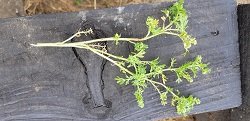
The leaves are feathery and very finely divided. The colour is a slightly yellowish green. When crushed, the leaves have a very strong, pungent smell (more on that below). Lower leaves are stalked, but upper leaves are stalkless.
Flowers are very small, just 1-2mm, usually white but hardly noticeable as flowers. After flowering, the plant produces fruit in very distinctive double pods about 2-2.5mm in size, and it’s from these double pods that the plant gets its common name of twin cress. Each side of the pod contains one seed, and the pods separate as they become fully mature.
The root system is a taproot, fairly long for the initial size of the plant.
MILK TAINT
As mentioned above, the crushed leaves have a strong, unpleasant smell. And because the plant is readily eaten by stock, this persistent odour can cause severe milk taint problems. Twin cress is one of the most severe and common causes of milk taint downgrades, and can lead to total rejection of milk from affected farms until the problem is solved.
HABITAT
Twin cress is commonly found in new and open pastures, crops, waste areas, cultivated ground, heavily pugged paddocks, and around stock tracks and camps where pasture cover is sparse.
It is rarely found in well-established, dense pastures, because it is a poor competitor and won’t successfully establish in such mature pastures.
HERBICIDES TO CONTROL TWIN CRESS
Spray Herbicides to Kill Twin Cress
The plant is well controlled, especially when young, by most selective herbicides. The problem is to control it without excessive clover damage. This limits the use of broad-spectrum sprays like GrassMate. That’s why it’s best to treat twin cress while it is young, when it is still susceptible to less damaging sprays.
When seedlings are very small, MCPB is effective, and is not going to damage establishing clover.
- Rainbow & Brown MCPA750 – 2-3L/ha is effective against rosettes, but only at the cost of some clover suppression. Grazing hard before spraying to remove clover leaf will minimise the damage, as long as the pasture is sufficiently established to tolerate a fairly hard graze.
- WHACK – 2,4-D 800 – 1-1.5kg/ha. This will cause some clover damage, however.
- Decision – 50g/ha is effective against twin cress at all growth stages up to and including the 4-leaf stage, and has the advantage of being a clover-friendly treatment.
- PastureMate – 3-4L/ha will have good control in seedling stage (2-3 leaves). Useful suppression at later growth stages too.
Caution: After spraying with any treatment, the plant becomes even more palatable, while retaining its milk-taint properties. So it’s essential to keep milking stock out for three weeks after spraying.