
Bindweed or Convolvulus
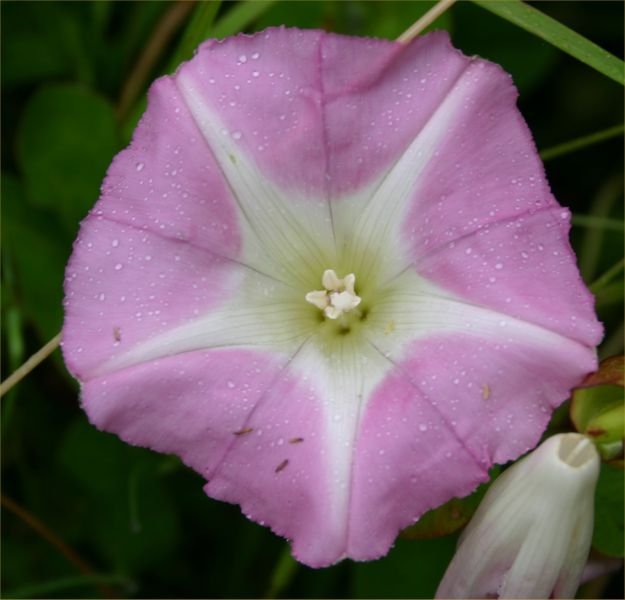
Pink Bindweed – Calystegia sepium
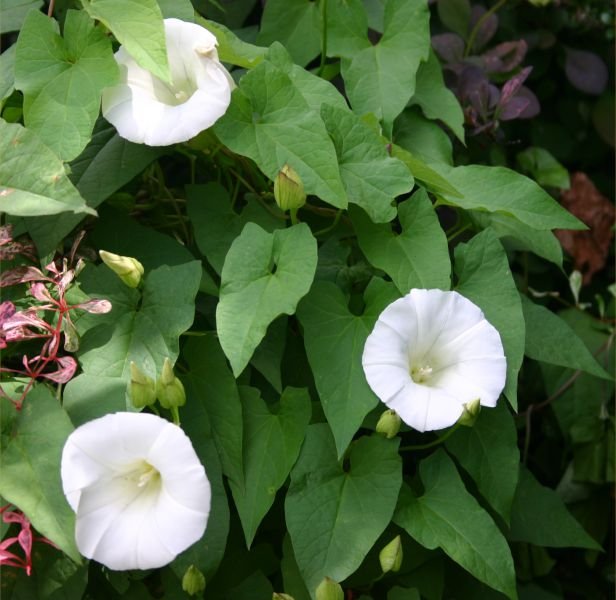
Great Bindweed – Calystegia silvatica
Field Bindweed – Convolvulus arvensis

DESCRIPTION
All of these related species are part of the same family, also known as CONVOLVULUS. This Weed File concentrates on the Great Bindweed but refers to the others where they are distinctly different. However, the Herbicide Control section is relevant to all of them.
The Great Bindweed is a very robust climbing and sprawling perennial plant that grows to 3 to 4 metres in height. It originated in Southern Europe and grows throughout New Zealand. The stems are hairless and twisting, often purple-tinged where exposed to sunlight. These stems form a dense and convoluted mass (hence the alternate name Convolvulus) that twines in an anti-clockwise direction when viewed from above.
Key identifying features:
• Flowers: Large white trumpet-shaped flowers up to 9cm in diameter (Great Bindweed)
• Pink Bindweed: Similar but slightly smaller pink flowers
• Field Bindweed: Smallest flowers (3cm diameter), either white or pink
• Leaves: Arrow or shield-shaped, varying in size (Great: 18cm long, Field: 4cm)
• Stems: Hairless, twisting, purple-tinged, forming dense masses
HABITAT
Bindweeds have an extensive underground rhizome structure that is very persistent and damage tolerant. These plants are highly adaptable, found in gardens, pastures, waste places, forest edges, roadsides, hedges, riversides, and cultivated areas. New shoots emerge in spring, followed by rapid summer growth and flowering from October to May. In autumn, plants send sugars to rhizomes for winter storage, while above-ground parts die back during winter.
DISTRIBUTION
Great Bindweed occurs throughout New Zealand in gardens, waste places, forest edges, and roadsides. Pink Bindweed is common throughout the North Island and Upper South Island. Hybrid forms between Great Bindweed and Pink Bindweed are common, producing plants with pale pink flowers. Field Bindweed is widespread across New Zealand, particularly in cultivated and disturbed areas.

MANUAL REMOVAL
Grubbing or digging out is rarely effective long-term due to the plant's ability to regenerate from remaining rhizome sections. Small individual plants may be removed manually if care is taken to remove the whole underground structure, and all plant material must be removed from the site. Herbicide treatment is generally more effective.
HERBICIDE CONTROL TO KILL BINDWEED (CONVOLVULUS)
For best results, apply herbicides in autumn when the plant is moving sugars to its rhizomes. To prevent resistance, rotate between different herbicide types and combine with non-chemical control methods. Regular monitoring and equipment cleaning help prevent spread of resistant populations.
Stump Swabbing to Kill Convolvulus
Cut the stem close to the ground and remove the cut foliage and stems for mulching. Liberally swab fresh-cut stump with one of the following:
- MSF600 at 5g per litre of water
- G-360 GLYPHOSATE at 100ml per litre of water.
- G-540 GLYPHOSATE at 70ml per litre of water.
- Granny Herbicide at 45g per litre of water.
Cut'n'Paste Gels to Kill Convolvulus (Bindweed)
Cut the stem close to the ground and remove the cut foliage and stems for mulching. Using the convenient brush on squeeze pack apply a smear of any of the following Cut'n'Paste products onto the freshly cut stems.
Spray Herbicides to Kill Convolvulus (Bindweed and Greater Bindweed)
- GrassMate at 60ml per 10 litres of water, applied anytime to the whole plant, + SuperWetter at 10ml per 10 litres of water.
- Dicamba 500 Select - 10ml + 27ml Rainbow & Brown MCPA750 in 10L water.
- Dicamba 500 Select - 24ml + 27g WHACK – 2,4-D 800 + SuperWetter 10ml per 10L water.
- LawnMate – 12ml per 1L of water. Grass friendly but may suppress or damage young fine turf. Apply only to turf at least 12 months old with actively growing weeds. Do not use on pasture or cropland. LawnMate is similiar to the old Banvine(1) product.
- GrassMate XTRA 6ml/L by knapsack – Apply during active growth from full leaf to early flowering
Note: all above spray applications are grass friendly BUT will kill clover.
- Additionally, MSF600 at 5g plus SuperWetter at 10ml per 10 litres of water but will kill grass and clover, so non-selective.
IMPORTANT: Because of the ability to regrow from the rhizome system, it is essential to follow up with a second spray programme once any regrowth or fresh growth has become evident. This second spray treatment will normally provide a high level of control with very little further regrowth.
(1) Registered trademark of Corteva AgriScience LLC.