Foxglove
Digitalis purpurea

DESCRIPTION
Foxglove is an erect plant growing to over 2 metres in height. It’s a biennial or short-lived perennial, which means each plant lives for two years, or sometimes a bit longer.
It’s particularly notable for two reasons. First, for its beautiful trumpet-shaped flowers which appear in its second year on the tall, single stalk. And second, for its being quite poisonous.
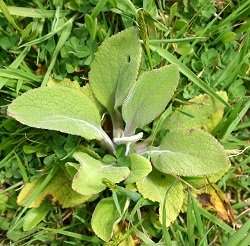
The foxglove is quite a leafy, rosette-style plant, but erect rather than widely spreading. The leaves are very large; up to 25cm long and half as wide, in a tapering pointed oval shape. They’re darkish green on the upper surface, and woolly grey underneath.
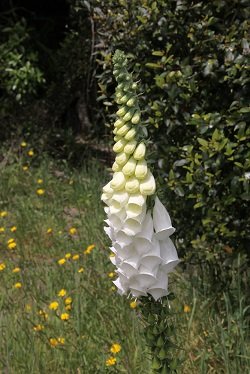
Flowers are spectacular, standing clear of the leaf section of the plant on the single central stalk, on which the purple or white drooping flowers are arranged in an elegant tapering spike. Flowering occurs around October to January.
The fruit is an egg-shaped capsule (well, actually it’s a lot of capsules), containing many small rectangular seeds.
The central stem of the foxglove is unbranched, hairy and very tall once flowering. The roots are fibrous.
HABITAT
Foxglove is found most often in poor pastures, roadsides, regrowth forest and bush, waste ground and disturbed ground. It prefers acidic soils. Once pasture has been improved, foxglove will generally not persist in the paddock.
Distribution is common throughout the whole of New Zealand.
POISONOUS
All parts of the foxglove are poisonous, and the seeds are especially toxic. Ingestion provides the main risk of poisoning, but even handling the leaves presents some toxicity risk. Effects in humans are nausea, vomiting, diarrhoea and blurred vision, but in small children, it can even be fatal.
The heart treatment drug ‘digitalin’ comes from the foxglove.
LIVESTOCK
The poisonous nature of foxglove is applicable to all classes of livestock, including poultry, as well as dogs and cats. Fortunately, none of them is stupid enough to willingly eat it, so the risk to animals from foxglove is normally theoretical only. However, once sprayed and starting to die off, the plant does become more palatable while remaining just as poisonous, so stock removal from sprayed sites is essential.
MANUAL REMOVAL
Isolated plants can be reasonably easily pulled out by hand (wear gloves!), but every part of the plant must be removed fro the soil and from the site, or it will regrow. Even sprayed plants must be removed from the site once dead, because any small surviving fragments of viable plant material will regrow. Removed material must be burned or otherwise destroyed. Plants should be removed before reaching the seeding stage of growth.
HERBICIDES TO CONTROL FOXGLOVE
Herbicide Sprays to Kill Foxglove
Spraying foxglove will work best when the plant is growing actively. It’s much better to spray foxglove before it sets seed, because the seed will remain viable after the plant is killed, and seeds last a long time in the soil.
- GrassMate – 250ml/100L by handgun. This is grass-friendly but will damage clover.
- Granny – 425g/100L by handgun (Glyphosate 360 use 1L/100L). Add SuperWetter at 100ml/100L water. Damaging to pasture species, especially grasses.
Herbicide Pastes or Gels to Kill Foxglove
If you have foxglove popping up in the lawn or around desirable plants any of the glyphosate-based Cut'n'Paste Gels will kill foxglove and because you are applying only to the foxglove won't affect desirable plants or natives nearby.