Chickweed
Stellaria media

DESCRIPTION
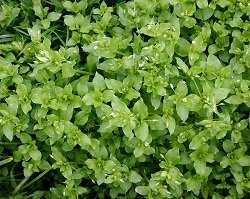
Chickweed is an annual species. It grows low to the ground and spreads (actually, it sprawls or scrambles) to about 50-60cm across. It is able to grow up and over other plants, and this, coupled with its speed of growth, can make it a seriously invasive weed in both pastoral and cropping situations.
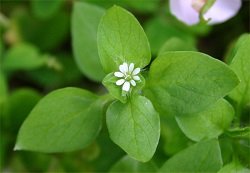
It may germinate at any time of the year, but most commonly it appears in the autumn and grows through the winter. It does not easily survive in the drier conditions of late spring and summer, but while growing it’s a prolific and early seeder, and this will ensure the unwelcome return of chickweed when the right conditions roll around again. The leaves are light green in colour, hairless, and oval in shape with a distinctly pointed tip. They grow in opposite pairs on the stalk. Leaf size is around 30-40mm in length, and 15mm in width.
The stems are very fragile and easily broken. The branched stems permit extensive sprawling and climbing and are equipped with a row of hairs. Flowers are small and white, with five very deeply divided petals that appear at a casual glance to be ten separate petals, giving the flower a daisy-like structure. Chickweed flowers predominantly from September to February. The flowers grow in clusters at the ends of the stems.
CHICK WEED HABITAT
Chickweed is common throughout New Zealand. It prefers cooler and damper conditions and is most commonly found in coastal sites, in gardens and in cultivated land, as well as roadsides and waste places. It will grow in new crops, where it's scrambling, covering nature can be a significant threat to the optimum development of the crop.
It’s a particular problem in sites that are autumn-cultivated for cropping or for pasture renovation.
Although the weak and fragile stems mean that it breaks up by stock trampling if a pasture is ‘saved’ in autumn for winter feed any chickweed present can grow very rapidly and seriously diminish the feed value.
Note that chickweed is not the same species as the weed known as ‘mouse-eared chickweed’.
LIVESTOCK AND CHICKWEED
Stock do not like eating chickweed, so any control via grazing is limited to the effects of trampling. There have also been some reports of lamb and horse deaths from eating it.
MANUAL CONTROL OF CHICKWEED
Chickweed is removed from a garden by pulling it out and disposing of it off-site, but in other situations, manual removal is rarely practical.
HERBICIDES TO CONTROL CHICKWEED
MCPA, MCPB and WHACK - 2,4-D 800 are not effective against chickweed. ‘Decision’ gives useful control in pasture (including new pasture), as well as in certain crops including Lucerne, chicory, maize and clover.
Best results will come from spraying as early as possible after the appearance of chickweed, not only because it is more easily controlled at that stage but also because chickweed can produce viable seeds within 6 weeks of germination. In new pasture, chickweed can be safely sprayed with Decision after the emergence of the true two-leaf stage of clover
- Decision at 30g/Ha when applied to seedling and smaller chickweed, or at 65g/Ha when applied to larger chickweed plants. For best results add BioWet spray oil at 500ml/100L water. Some people use SuperWetter penetrant at 100ml per 100L of water but BioWet is preferred. Water rate should be about 100-300L/Ha, with the higher volume required when the growth is dense
- Ranger Herbicide when applied at 20g/ha for controlling buttercups will also give reasonable control of chickweed
- Dicamba 500 Select - 120-140 ml Rainbow & Brown Dicamba 500 SL plus 536ml of WHACK – 2,4-D 800 in 100 litres water/ ha. ( this is the recommended label application for most weeds although the WHACK – 2,4-D 800 is not really effective on Chickweed.
Non-Selective Herbicides to Kill Chickweed in non-cropland areas
- TerbGuard 500 – Broadcast application at 15 – 19L/ha in 150 – 300L water. Add G-360 GLYPHOSATE, G-540 GLYPHOSATE or Granny Herbicide at the recommended label rates. TerbGuard 500 IS NOT SUITABLE FOR PASTURE OR CROPLANDS.