THORNAPPLE
Datura stramonium
Download the PDF

DESCRIPTION
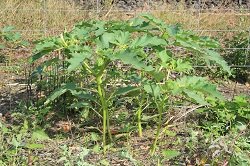
Thornapple is a vigorously growing summer annual weed found extensively in the North Island, and in northern parts of the South Island.
The plant is a stout, branched weed that has in some regions been incorrectly referred to as ‘prickly pear’ presumably because of its prickly-spined fruit (see below). The real prickly pear is a many-lobed cactus plant and does not look at all like Thornapple.
Thornapple can grow to a height of about one metre, but is more commonly found at only about half that size.
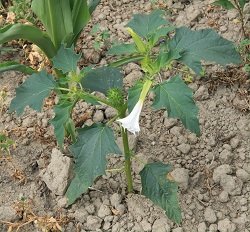
The leaves are large (up to 30cm x 20cm) and dark green, growing alternately from the main stems on stalks about 7cm long. The leaf margins are jagged or toothed, and their surface is hairless.
Stems of Thornapple are very stout, upright, and green in colour, sometimes with a tinge of purple.
The flowers are a usefully distinctive recognition feature, being very conspicuous, white and trumpet-shaped, of about 10cm in length. They appear singly on the leaf axils, and open fully only in the evenings. Flowering is generally from November to April.
The fruit is an egg-shaped capsule up to 5cm long, green in colour, and covered with long prickly spines. When ripe the fruit splits into four segments to reveal the numerous large, brown or black kidney-shaped seeds.
HABITAT
Thornapple prefers gardens, roadsides, waste areas and the disturbed ground around gateways, and is also quite common, especially in the North Island, in both new pastures and crops.
POISON
Thornapple is a poisonous plant. All parts of the plant are poisonous, but especially the seeds. Stock will usually avoid eating growing Thornapple plants, but the plant remains poisonous even in hay, and stock fatalities have been recorded in Australia from grazing of Thornapple.
MANUAL REMOVAL
Isolated individual plants can effectively be pulled out by hand. This should be done before flowering and seeding, and the pulled plants removed from the site.
HERBICIDES TO CONTROL THORNAPPLE WEED
Thornapple becomes resistant to many herbicides as a maturing plant, and treatment at the seedling stage gives the best results. The herbicide resistance is especially a problem in dry conditions, presumably because translocation of the chemical into all parts of the Thornapple plant is very inefficient under those conditions.
Spot Treatment Herbicides to Kill Thornapple
Where spot treatment is practical and some grass damage is not a concern. This recommendation applies to Thornapple plants at all stages of growth (mature as well as seedlings).
- GLYPHOSATE – 100ml/10L water, plus 10ml SprayWetter penetrant.
Spray Herbicides to Kill Thornapple
All of the following recommendations are grass-friendly, although Rainbow & Brown MCPA 750 will damage clover and GrassMate and Dicamba 500 Select will kill clover. Neither is effective against mature Thornapple plants.
a. Spraying in Crops & Pasture up to 6 leaf stage
- Rainbow & Brown MCPA 750 – 1.5L/Ha plus 100ml of SprayWetter penetrant per 100L water.
- Dicamba 500 Select - 100ml plus 260ml Rainbow & Brown MCPA 750 in 100L water per hectare.
- Dicamba 500 Select - 120-140ml plus 595ml WHACK – 2,4-D 800 per 100L water per hectare.
- WHACK – 2,4-D 800 used at 3kg/ha for seedlings only, established plants are not well controlled.
b. Spraying after the 6 leaf stage
- GrassMate – 2L/Ha plus 100ml of SprayWetter penetrant per 100L water.
- Dicamba 500 Select - 100ml plus 260ml Rainbow & Brown MCPA 750 in 100L water per hectare.
- Dicamba 500 Select - 120-140ml plus 500g WHACK – 2,4-D 800 per 100L water per hectare.
Note: For a clover friendly option use a product containing predominantly MCPB, but this will only kill Thornapple at the very small 1-2 leaf seedling stage.