STORKSBILL and MUSKY STORKSBILL
Erodium cicutarium - storksbill
Erodium moschatum – musky storksbill
Download the PDF

DESCRIPTION
There are two common and closely related storksbill species, and this weed file discusses both. Measures for their effective control are largely identical.
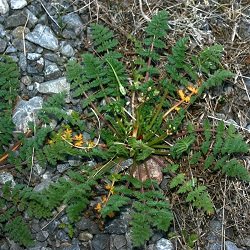
Storksbill and musky storksbill are annual to biennial weeds that grow as a large rosette up to 30cm in diameter, and up to 50cm tall at flowering.
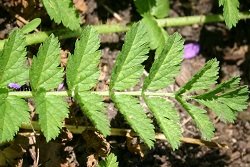
The leaves of both species are fern-like in appearance, radiating out from the central point to form the distinctive rosette shape. The individual leaflets of the musky storksbill are less finely divided than those of the storksbill.
It is sometimes reported that grazing the foliage of both varieties of storksbill can cause photosensitisation and staggers in lambs and cattle, although other reports hold that storksbill can be good feed for lambs. Perhaps a bit of both is the truth of the matter.
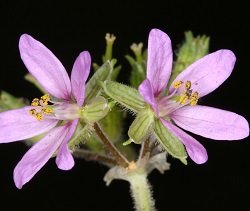
Flowers of both species are similar, and are mauve-pink, or occasionally white. Both plants are musk-scented, though the leaves of the musky storksbill also have a musk scent when crushed. Flowering is from September to May.
Both species have a taproot that becomes very substantial and deep once the plant is mature.
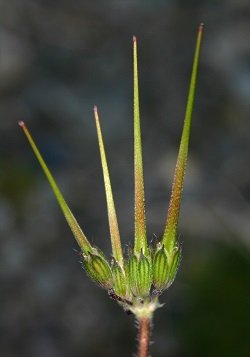
The seed head of both varieties is in the form of long (4-5cm) capsules, which have a slender and sharp beak on top (the shape of this capsule being the source of the common name of storksbill). The pointed fruits contained within can actually pierce the skin of animals, and burrow their way into the flesh.
Storksbill photos below
HABITAT
The preferred habitat tends to be the most distinguishing feature between the two types of storksbill. The musky storksbill is more common in the North Island, and especially in the more fertile conditions to be found in dairy pastures, while the regular storksbill is more commonly found in drier conditions and in the South Island. But it’s not exclusive and each can sometimes be found in the other’s preferred territory.
Storksbills require some exposed soil to get established, and will often appear and quickly proliferate after drought, heavy grazing or winter stock damage have opened up the pasture sward.
Lucerne and other crops are sometimes affected by musky storksbill.
Storksbills also appear in turf and sports grounds, although the rosette is so large and unsightly that the grounds staff will usually deal to them pretty quickly.
MANUAL CONTROL
At the early rosette stage the plant can be fairly easily pulled by hand and removed. In later growth stages the taproot becomes more extensive and fibrous, making manual removal less easy.
HERBICIDES TO CONTROL STORKSBILL AND MUSKY STORKSBILL
The most critical point with storksbill is to not allow it to seed, so treatment before seeding will always be most effective, especially in terms of minimising any regrowth. Storksbills are not very susceptible to 2,4-D sprays at any stage of their development.''
Weed Wiper Herbicies to Kill Storksbill
- G-360 GLYPHOSATE – 330ml/L
- G-540 GLYPHOSATE – 220ml/L
- Granny Herbicide – 15g/L
These are non-selective so would normall kill pasture but because you are wiping erect weeds above the level of the grazed pasture this effectively becomes a selective method of control.
Spot Spray Weedkillers to Kill Storksbill
- GrassMate – 60ml/10L water. This is effective on smaller plants. Spray into the centre of the rosette.
- WHACK – 2,4-D 800 – 1.5-2kg/ha for seedlings graze to expose weeds and reduce clover and 2-3kg/ha for small rosettes well established plants may only be checked.
There are some reports that flumetsulam (Decision) might be effective but because no formal trials have been done we can't recommend this. However if you were to try it is likely that this also might only be effective on younger storksbill weeds and Decision is pasture and clover friendly.
Glyphosate is effective but of course is not selective and will kill grass and severely knock back clover.
- G-360 GLYPHOSATE – 20ml/10L
- G-540 GLYPHOSATE – 13ml/10L
- Granny Herbicide – 19g/10L
Boom Spray Weed Killers to Control Storksbill
- Rainbow & Brown MCPA750 – 1.5-2.0L/Ha in 200/300L water. This will be effective against seedlings and small rosettes only.
- GrassMate – 2L/Ha. This will be effective against smaller plants, but will be severely damaging to clover.
- Glyphosate - if you are spraying out you can use the non-selective options below:
- G-360 GLYPHOSATE – 2.0L/ha
- G-540 GLYPHOSATE – 1.3L/ha
- Granny Herbicide – 900ml/ha
In all cases when spraying, for best results add SprayWetter penetrant at 10ml/10L water to ensure thorough penetration of the herbicide into the plant.
Non-Selective Herbicides to Kill Storksbill in non-cropland areas
- TerbGuard 500 – Broadcast application at 15 – 19L/ha in 150 – 300L water. Add G-360 GLYPHOSATE, G-540 GLYPHOSATE or Granny Herbicide at the recommended label rates. TerbGuard 500 IS NOT SUITABLE FOR PASTURE OR CROPLANDS.
Musky Storksbll photos below