Cape Weed (Cape Dandelion)
Arctotheca calendula

DESCRIPTION
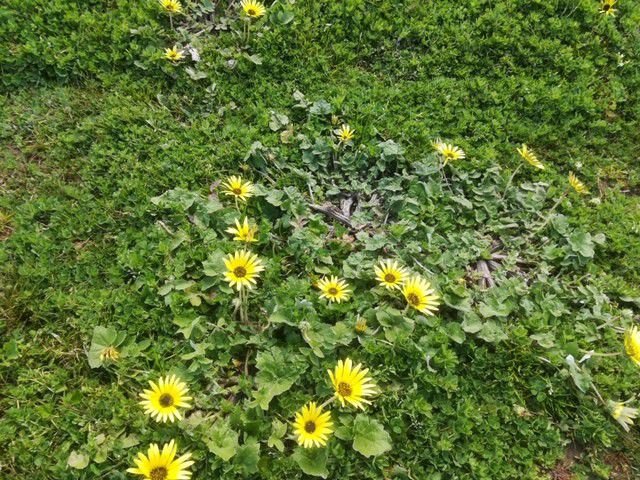
Cape weed is an annual plant with daisy-like yellow flowers and is sometimes incorrectly referred to as Cape daisy.
The plant forms large spreading rosettes that are particularly unwelcome visual blemishes in lawns, turf and sports grounds.
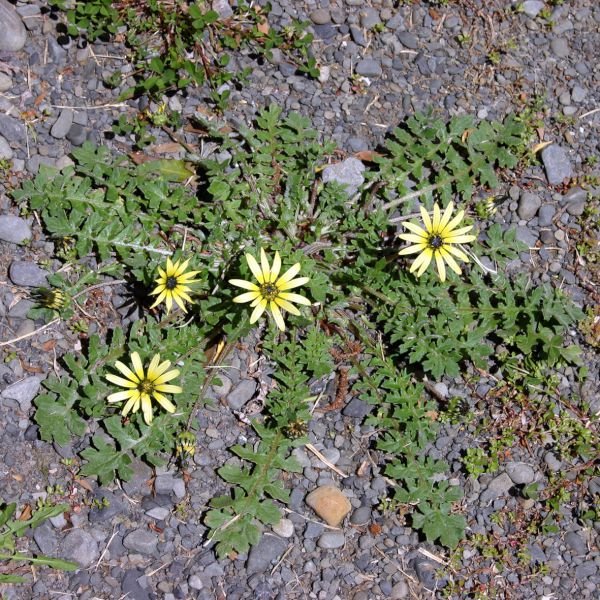
The leaves are deeply lobed and are more jagged in appearance than other related dandelion-type flowering flat weeds. The terminal (tip) lobe is larger and more rounded than the rest, and individual leaves reach about 20cm in length The leaf colour is green/grey on the upper side, and much paler and slightly woolly on the undersides.
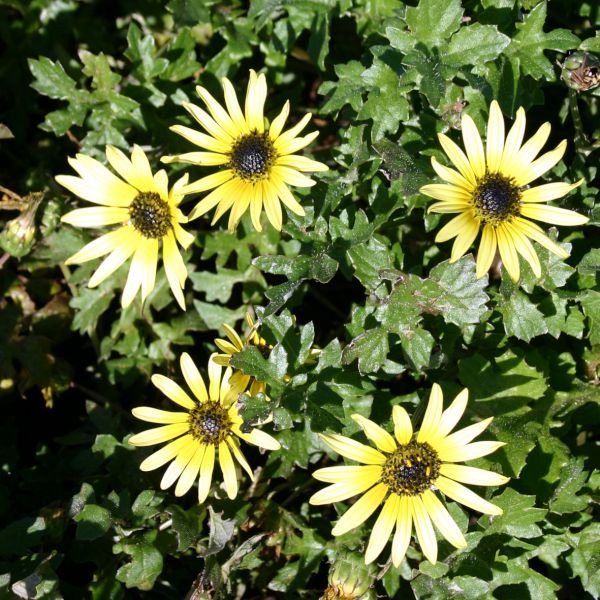
Flowers are the most distinctive identification feature. They are up to 4cm in diameter and of the ‘daisy’ style, with dark purple centres and yellow florets (petals). The florets are bright yellow near the base, but becoming distinctly paler toward the tips. The flowers appear singly on stalks standing to about 10cm high. The Cape weed generally flowers from October to December.
The root system consists of a substantial fleshy taproot.
Cape weed (Cape dandelion) is known to be poisonous and has poisoned both cattle and sheep in Australia, as well as cattle in New Zealand. As with most poisonous weeds, the stock will normally not eat it. though with such large spreading rosettes it will presumably be difficult to avoid entirely.
HABITAT
Cape weed appears in most parts of New Zealand and is spreading. It is most often found at roadsides, waste areas, lawns and turf, recreational grounds, and in pastures (though less frequently). It prefers the light sandy soils of coastal areas but copes well with heavier conditions and is appearing more frequently in non-coastal situations.
Cape weed establishes readily where turf or pasture has been made sparse by drought. Recreational grounds using drought-resistant cultivars will be able to better resist infestation. Cape weed is most commonly spread by seed, and mowers used on lawns and recreational grounds should be well cleaned immediately after mowing flowering Cape weed, and especially before use on any un-infested areas.
In lawns, Cape weed can be controlled by preventing it from flowering and forming seed, via mowing and by spot spraying (see below).
HERBICIDES TO CONTROL CAPE WEED (CAPE DANDELION)
Cape weed is controlled by several herbicides, with the choice depending on the situation. Best results follow treatment when the rosette stage is young and growing actively.
Spot Spraying Herbicides to Kill Cape Weed (Cape dandelion)
- Granny Herbicide at 45g/10L water (will damage over sprayed adjacent grass)
- G-360 GLYPHOSATE at 100ml/10L water (will damage over sprayed adjacent grass)
- G-540 GLYPHOSATE at 70ml/10L water (will damage over sprayed adjacent grass)
- GrassMate at 60ml/10L water (grass friendly, but damages clover)
- Dicamba 500 Select at rate varies depending upon the crop and may perform better in some situations when mixed with Rainbow & Brown MCPA750 or WHACK – 2,4-D 800. Read the Dicamba 500 Select Product leaflet for exact rates
- GrassMate XTRA at 6ml/L by knapsack – Apply during active growth from full leaf to early flowering
Herbicides to Kill Cape Weed in Recreational Grounds and Pasture - Boom Spray
- GrassMate at 2L/Ha in 200-300L water, boom sprayed when the weed is young and active, and preferably before flowering. This treatment will not damage grass species but will damage clover.
- GrassMate XTRA at 2L/Ha – Apply to heavy infestations only. best results are achieved from application prior to flowering.
- Clopyralid 600g/L at 1-2L/Ha in 200-300L water. Use the lower rate on seedlings. This treatment will damage clover. Note that Clopyralid products CANNOT be used if the treated area is to be mowed and the clippings used for composting or disposed of in a green waste recycling centre.