
HEDGE MUSTARD
Sisymbrium officinale

DESCRIPTION
Hedge mustard is an annual, sometimes biennial, weed that can germinate at any time of the year, though it’s usually going to appear in either spring or autumn. It’s actually a member of the brassica family, which makes it a relative of species like turnips and cabbages.
Hedge mustard is also known by some other names, including tumbleweed and wireweed (incorrectly, in the case of wireweed; see below). And it was originally known as Oriental mustard, although this too refers to a slightly different plant.
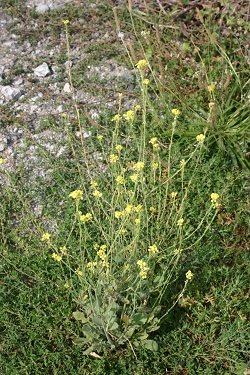
In form, the plant is quite variable during its life. Initially it forms a rosette, and at that stage is easily confused with other rosette weeds. But then it produces flower stems that grow up to 1 metre in height, and this makes accurate identification easier.
The rosette is 15-30cm in diameter and has broad hairy leaves of a dull green colour, deeply divided into pairs of rounded lobes, and with a similar rounded tip lobe. Leaves on the flower stems are more spear-shaped, although still with smaller pairs of lateral lobes, but the tips are distinctly pointed.
The stems are upright, and become very hard as they mature, which is why the plant is often known as wireweed. Technically it’s not; there is another plant correctly called wireweed (Polygonum aviculare). But that said, the stems of hedge mustard are indeed like wire!
Once the leaves die off the plant slumps into a rounded tangled and dry mass that’s easily blown about by the wind, inspiring the other common partial-misnomer of tumbleweed.
The plant flowers from October to January. The small yellow flowers appear on the tips of the flower stems. The flowers are smaller (just 3mm in diameter) than the somewhat similar wild turnip plant, and are a good identification feature.
The fruit appears on the stems as pods, reaching 15mm long by just 2mm wide, and the pods are closely pressed against the stems; another useful identification feature for hedge mustard.
The root system consists mainly of a long taproot.
HABITAT
The preferred habitat for hedge mustard is pasture, crops and cultivated land, and roadsides. It also often appears along fence lines.
It occurs throughout New Zealand, and is most common in the Waikato and Bay of Plenty regions
MANUAL CONTROL
On small blocks hand pulling of scattered hedge mustard plants is feasible, and the removed plants should be placed immediately in a bag, to prevent seeds escaping when the removed plant dries off.
HERBICIDES TO CONTROL HEDGE MUSTARD
The best time to spray hedge mustard is in autumn and winter, while it is in the seedling stage. It’s much easier, and cheaper, to kill at that point than it is as a fully mature plant.
Herbicides to Kill Hedge Mustard in Pasture
- Rainbow & Brown MCPA 750 – 1.5L/Ha in 200-300L water for hedge mustard seedlings, or – 2L/Ha once the weeds are larger in size.
- PastureMate – 4L/ha in 200L of water for seedlings. Useful suppression at later growth stages too.
- WHACK – 2,4-D 800 – 1-1.5kg/ha for seedlings and 1.5-2kg/ha for small rosettes.
- Dicamba 500 Select - 100ml plus 260ml Rainbow & Brown MCPA 750 in 100L water per hectare.
- Dicamba 500 Select - 120-140ml plus 535g WHACK – 2,4-D 800 per 100L water per hectare.
Note that both Rainbow & Brown MCPA 750 and WHACK – 2,4-D 800 will suppress clover in pasture. Dicamba 500 Select will kill clover.
Herbicides to Kill Hedge Mustard in Cereal Crops
- Rainbow & Brown MCPA 750 – 1.5L/Ha in 200-300L water, boom sprayed when the weed rosette is at the 2-6 leaf stage, and when the cereal crop is between 5 leaf and jointing.
- WHACK – 2,4-D 800 – 1kg/ha apply from the 6-leaf stage of crop to jointing (when the nodes are visible at the base of the stem). DO NOT apply to barley or wheat between the jointing stage and flowering. Spring sown crops undergoing rapid growth should be treat with an Rainbow & Brown MCPA 750 formulation approved for use on cereals.
- Dicamba 500 Select - rate varies depending upon the crop and may perform better in some situations when mixed with Rainbow & Brown MCPA 750 or WHACK – 2,4-D 800. Read the Dicamba 500 Select product leaflet for exact rates.
- PastureMate – 4L/ha in 150-250 litres of water. Use between crop growth stages 2 leaf to 1st node detectable. Use the higher rate.
Brassica Crops
Because hedge mustard is itself a member of the brassica family, it is very difficulty to remove selectively from standing brassica crops – the weed and the crop share the same herbicide resistance characteristics.
Herbicides to Kill Hedge Mustard by Spot Spraying or in Waste areas
If spot spraying is required, along a fence line for example, any of the above herbicides will be effective (e.g. Rainbow & Brown MCPA 750 at 5ml per litre of water). Or you can use pretty much any general-purpose herbicide, such as GLYPHOSATE at label rates.
