
Cleavers
Galium aparine

DESCRIPTION
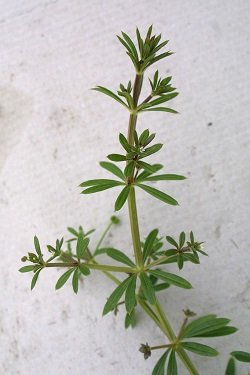
Cleavers is a scrambling annual plant that hooks onto any available support, so it can smother fencing and other plants including, alas, crops.
It’s a plant that seems to be ‘sticky’ – the leaves, stems and seeds all give that impression, though it’s not literally true. The stickiness actually comes from a covering of very fine hooks which act much like Velcro. As a result, the seeds of cleavers have an irresistible attraction for trouser legs, woollen socks, cats and dogs. Not unexpectedly, this is how this cunning plant spreads its seeds.
The stems are weak, and square in cross-section. They’re just 2mm or so thick, but can extend to 2 metres or more in length, especially if they have found some host plant or structure to support them.
The individually slender leaves grow in whorls of about 6 to 8 leaves at intervals along the stem. And they’re liberally armed with the tiny, clinging, ‘sticky’ hairs for which the cleavers plant is known.
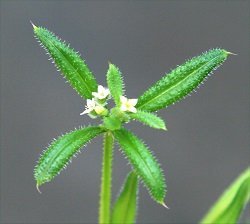
The flowers are very small (2mm) and white, with four wee petals. They appear in small clusters of 2 to 5 (see the accompanying pictures). Flowering occurs from mid-winter through to mid-autumn.
The seeds are small (5mm) and tenaciously ‘sticky’ due to the covering of tiny hooks. Initially the seeds are green, becoming dark to black over summer.
Cleavers is very common throughout all of NZ. It is commonly found in crops, gardens and orchards, and neglected waste areas.
In crops, cleavers can scramble over the erect crop plants, causing them to become top-heavy and fall over, especially with some wind assistance
PHYSICAL CONTROL
HERBICIDES TO CONTROL CLEAVER
Non-selective Herbicides to Kill Cleavers
- G-360 GLYPHOSATE at 100ml/10L water, or Granny Herbicide at 45g/10L water will give decent control. Add SprayWetter at 10ml/10L water for best results and for reduced rain risk period.
- GA200 at 3-5L/ha or at 1L/100L water applied by handgun or knapsack. Add 100ml SprayWetter per 100L water. Being mostly a contact herbicides GA200 is generally considered safe to use in orchards and vineyards.
Selective Herbicides to control Cleavers in Pasture
- Decision at 50g/Ha gives good control of smaller cleavers plants, while being a grass and clover friendly treatment. Add SprayWetter at 100ml/100L water.
- Dicamba 500 Select at 100ml plus 260ml Rainbow & Brown MCPA750 in 100L water per hectare.
- Dicamba 500 Select at 120-140ml plus 536ml WHACK – 2,4-D 800 per 100L water per hectare.
Selective herbicides to control Cleavers in Crops
- Dicamba 500 Select - rate varies depending upon the crop and may perform better in some situations when mixed with Rainbow & Brown MCPA750 or WHACK – 2,4-D 800. Read the Dicamba 500 Select product leaflet for exact rates.
- Another option is to use a spray containing mecoprop before the cleavers get too large. There are perhaps a few other options, but check with your supplier first because some specialist crop herbicides don’t control cleavers well at all.
Cut'n'Paste Herbicide Gels to Kill Cleavers
Use Cut'n'Paste Original Gel for Woody and Leafy weeds as a spot treatment.
