Mallow
Malva spp.
Download the PDF

Tall Buggers:
- Tree mallow (Malva arborea)
- Cretan mallow (Malva linnaei)
Creeping Chaps:
- Small-flowered mallow (Malva parviflora)
- Dwarf mallow (Malva neglecta)
- Creeping mallow (Modiola caroliniana)
Intermediate Bloke:
- Large-flowered mallow (Malva sylvestris)
DESCRIPTION
Mallows are common weeds around the world, with quite a few varieties being well represented in NZ. Strictly speaking, mallows are all from the Malva genus, but there are also some non- Malva species that we commonly refer to as mallows, just because we all enjoy confusion and contradiction so much. One of those, creeping mallow (Modiola caroliniana), is included in this weed file. The name Malva derives from a Greek word for ‘soft or soothing’, though mallows aren’t all that soothing when they invade your Lucerne paddocks.
LIFESTYLE CHOICES
Mallows can be annuals, biennials and perennials. If conditions are favourable to them, most mallows will behave as short-lived perennials, meaning they’ll live for several years, but if conditions aren’t so accommodating the mallows will behave as annuals (1 year lifecycle) or biennials (2 years) instead.
VISUAL COMPARISONS
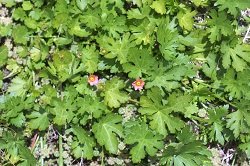
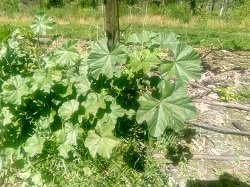
Some species are tall and erect (tree mallow – grows to 2M tall), some are small and spreading (dwarf mallow – less than 50cm high), and some are in between (large-flowered mallow - 1.2M tall). One thing that the mallows do have in common is the shape of the leaf, which in all species is distinctly ‘geranium-like’ in appearance. The size of the leaves does vary, generally in proportion to the overall size of the particular species of mallow, but the distinctive rounded shape of the leaf, with shallow lobes, is fairly similar in all species, as can be seen from the photographs. The leaves of mallows also tend to have a ‘folded’ appearance, as if they’ve been creased along the main rib.
Mallow flowers, however, vary quite a bit in appearance, size and colour:
- Tree mallow has vivid lilac or deep pink bell-shaped flowers, 40mm in diameter, appearing from August to May.
- Cretan mallow flowers are softer, pastel coloured, less than 20mm in diameter, and deeply divided into five distinctive ‘petals’.
- Small-flowered mallow produces pale mauve to white flowers, very small in size (not surprising, given the name) at 5mm diameter, with five petals. Note in the pictures the very small flower size in comparison to its leaf size. It flowers from September to April.
- Dwarf mallow has near white flowers, with some highlights in lilac, and the petals are considerably larger than the small-flowered species, at 20-30mm diameter.
- Creeping mallow has orange flowers, growing singly on short stalks, and having a diameter of about 15mm. It flowers from October to March.
- Large-flowered mallow has, again not unexpectedly, larger flowers at 40mm diameter than most of the other mallows. They are deep pink to red and appear in clusters of two to ten flowers. The five petals are each deeply notched at the outer end, creating a ‘ten-pointed’ flower appearance. Flowering occurs from November to April.
DISTRIBUTION & HABITAT
Mallows occur throughout NZ, though not every species grows everywhere. Small-flowered mallow is probably the most common, and large-flowered mallow the most conspicuous. The preferred habitat is bare ground, waste areas, stock yards and camps, and roadsides. Mallows will establish in pasture especially in bare patches, in horticultural blocks, and in arable crops. Mallows can be a serious problem in lucerne crops, because most of the usual herbicides safe to use over standing lucerne don’t control mallows well.
TOXICITY
Mallows are not readily eaten by stock because the leaves (at least of some species) are mildly toxic. In Australia, staggers in sheep is associated with both small-flowered and creeping mallow species.
HERBICIDES TO CONTROL MALLOWS
Herbicides to Kill Mallows in Orchards and Vineyards:
- GA200 – 1-2L/100L water applied by handgun or knapsack. Add 100ml SprayWetter per 100L water. In pasture and Lucerne, the best results will come from spraying when the mallow is in the seedling stage where possible. Successful spot spraying can be done at any stage of the mallow’s growth.
Herbicides to Kill Mallow in Crops & Pasture:
- Decision – 50g/Ha by boom or rosette spray. (Add SuperWetter at 100ml/100L water for best results). In Lucerne, use of Decision at this rate will provide good control (kill) of seedling mallows, and will suppress larger mallows sufficiently to permit the Lucerne to be cut.
- Dicamba 500 Select - rate varies depending upon the crop and may perform better in some situations when mixed with Rainbow & Brown MCPA750 or WHACK – 2,4-D 800. Read the Dicamba 500 Select product leaflet for exact rates.
Pasture:
- Decision – 50g/Ha by boom or rosette spray. (Add SuperWetter at 100ml/100L water for best results).
- Dicamba 500 Select - 100ml plus 260ml Rainbow & Brown MCPA750 in 100L water per hectare.
- Dicamba 500 Select - 120-140ml plus 535ml WHACK – 2,4-D 800 per 100L water per hectare.
Spot Spray Weedkillers to Kill Mallow:
- GrassMate – 60ml/10L of water. Add SuperWetter – 10ml/10L water for best results. This will be grass friendly, but will damage clover.
- MSF600 – 1g/10L of water. Add SuperWetter – 10ml/10L water for best results. This option is inexpensive and very effective, but will damage both grass and clover; the grass will recover moderately soon, but the clover may take several months.