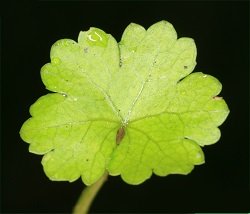
HYDROCOTYLE
Hydrocotyle spp.
Download the PDF

DESCRIPTION
Hydrocotyle is the name used for several related and very similar species. They differ primarily in the shape of the leaf, and a selection of leaf details of the more common Hydrocotyle is illustrated on this page. The various types can all be treated the same in terms of control, so it hardly matters whether or not you can tell them apart.
Hydrocotyle is a perennial, and is most often a problem in lawns and turf. It is a prostrate, ground-creeping plant, and left uncontrolled can form quite a dense mat of growth.
The leaves of all species are close to circular in shape, and generally up to about 10mm in diameter. In tightly mown areas (e.g. golf and bowling greens) the leaves can be much smaller however, while in entirely unmown areas the leaves will be larger – up to 20mm diameter. The leaf is dull green, and is partially divided into distinct segments; normally five to seven, although in one species it is three major segments. The leaf stalks are attached at the near centre of the leaf disc. In one case (Hydrocotyle moschata) the leaves are hairy, but just as with humans the presence or absence of hair is of little consequence.
The flowers are tiny and sufficiently inconspicuous as to be irrelevant to the identification of hydrocotyle. The fruit appears as small clusters of fruiting bodies, initially green but subsequently brown in colour and hairless.
The stems of hydrocotyle are slender branching stolon's, and readily take root at the nodes. It is by this method that the hydrocotyle creeps and invades so efficiently.
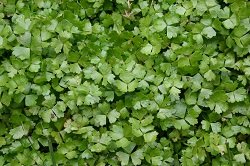
HABITAT
Occurs throughout New Zealand. In addition to being a common invader of lawns and turf, hydrocotyle often appears at native forest margins and clearings. It also sometimes becomes a problem in overgrazed pastures, in particular those in damper regions, when its low and densely matted growth will choke out and exclude other vegetation including pasture grasses.
SITE MANAGEMENT CONTROL
In some situations hydrocotyle can be controlled or at least minimised by non-chemical means. In bowling greens the growth of hydrocotyle is most aggressive in damp patches, so removal of even very slight hollows and also avoidance of overwatering will usually be discouraging to hydrocotyle proliferation. In lawns the same is also true, although the presence of shaded areas of lawn can hardly be totally avoided, and this shade with its relatively greater dampness appears to encourage hydrocotyle. It will therefore usually be necessary to spray the hydrocotyle as well, at least in the beginning.
HERBICIDES TO KILL HYDROCOTYLE WITHOUT KILLING GRASS
Most lawn and turf herbicides are either ineffective or only partially effective. This includes commonly grass friendly herbicides like Rainbow & Brown MCPA750, WHACK – 2,4-D 800, mecoprop and Dicamba 500 Select.
The most consistently effective active ingredient is triclopyr, which is present in two herbicides that we recommend for hydrocotyle control. Application rates and costs are the same for these two, and the choice between them depends on the situation.
- TRICLO Herbicide – 2ml/10 square metres of lawn or turf, applied using a knapsack, handgun or if appropriate a small boom spray apparatus (such as a specialised greens/turf sprayer or a quad mounted system). This normally equates to around 6ml/L in a knapsack sprayer but check to make sure you are applying at 2ml/10m2.
- GrassMate – 2ml/10 square metres of lawn or turf, applied using a knapsack, handgun or if appropriate a small boom spray apparatus (such as a specialised greens/turf sprayer or a quad mounted system). Again this normally equates to around 6ml/L in a knapsack sprayer but check to make sure you are applying at 2ml/10m2.
In both cases the addition of a wetter/penetrant is not strictly necessary, but if one is available such as Spraywetter or Superwetter then add it at 0.1% of spray volume ( to get the best possible result, and to minimise the rain risk time.
Note: At the recommended rate, GrassMate is grass-friendly but will damage clover. TRICLO Herbicide is grass friendly and is a little bit easier on clover but it will still knock back your clover. This difference will best determine which one is best for a given situation (in pasture you probably want to keep the clover, while in lawn you probably don’t).