Creeping Yellow Cress
Rorippa sylvestris

DESCRIPTION
This is a brassica-type plant originally from temperate regions of Europe and Asia.
It’s common throughout New Zealand, and forms dense infestations especially on low-lying pastures and other ground adjacent to rivers.
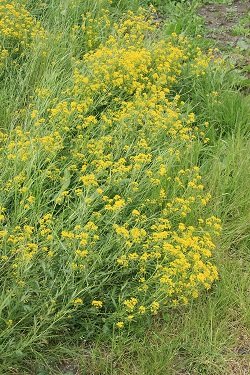
The plant is a smallish, hairless perennial herb, producing straggling growth up to about 70cm in height. Its creeping rhizomes result in stands of creeping yellow cress that can smother infected pasture land.
The flowers are yellow, 4-6mm in diameter, and grow on thin, erect stems. Each flower has four separated petals. Flowering occurs Dec –Feb. In dense infestations, the flowers form a spectacular if unwelcome display.
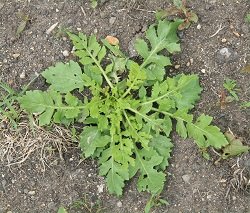
The leaves have toothed margins, and are variable in shape. The lower, rosette leaves are deeply divided into up to ten lobes. The upper leaves on the flower stalk are smaller, with fewer lobes.
The stem structure comprises creeping rhizomes, plus the skinny erect flower stems. Roots are spreading, creeping rhizomes that establish new roots at the nodes.
HABITAT
The most common sites for creeping yellow cress are cultivated ground, gardens and market gardens, damp pasture and riverbeds. Particularly common in the Waikato.
HERBICIDES TO KILL CREEPING YELLOW CRESS
Spraying before flowering will give the best results.
- Decision herbicide at 50g/Ha plus a suitable spraying oil like BioWet added at 1L/ha. Use 100 – 300L of water per hectare, with the higher rate for very dense infestations. This treatment is grass and clover friendly.
A second, follow-up treatment at the same rates will be necessary the next season, because creeping yellow cress is a perennial, and some regrowth is inevitable in the year after first spraying. Further treatments in subsequent years will likely be needed to control seedling growth. - Rainbow & Brown MCPA750 at 1.5-3L/ha will give temporary suppression.
- WHACK – 2,4-D 800 at 1.7 - 3.4L/ha will also give temporary suppression
- In other countries but not an 'on-label' use in NZ a mix of Triclo Herbicide and Dicamba 500 Select at label rates also appeared to work well but will kill clover.
- G-360 GLYPHOSATE, G-540 GLYPHOSATE and Granny Herbicide kills the top but not the whole rhizome system, so will only give temporary suppression.