SCOTCH THISTLE
Cirsium vulgare
Download the PDF

DESCRIPTION
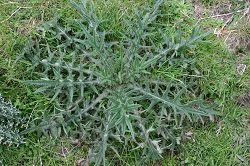
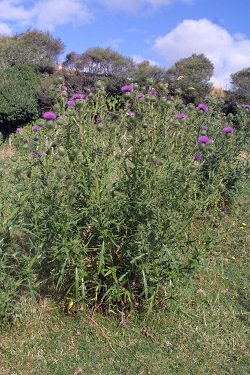
Scotch thistle is a biennial weed, meaning that it normally lives for two years maximum, but doesn’t flower until the second year. It therefore relies heavily on achieving establishment from seed. The usual cycle of the Scotch thistle in pasture is to germinate in late autumn, winter or early spring, passing its first summer as a rosette form plant, and then flowering in its second summer. Once established as a multi-branched shrub it can grow to a substantial bush of 1.5 metres in height.
The Scotch thistle has a substantial tap root, as do most thistles. However the Scotch thistle is also distinctive among all New Zealand thistles in its leaves; it has sharp spines both on the leaf margins and on the surface of the leaves, while other thistles have spines only on the leaf margins. The foliage is also a darker green than most other thistle species.
The flower head is quite distinctive, reddish purple in colour, and up to 60mm long by 50mm in diameter, and usually appears singly, but can be in 2 or 3 flower clusters on a stem. On the flowering stem, the lower leaves will be on stalks while the upper leaves are stalkless. The flowers are smaller than the nodding and variegated thistles, but larger than the Californian and winged thistles.
The stems are erect, quite substantial, and are branched with spiny wings.
The seed heads are a collection of florets, with each seed attached to a pappus known as thistledown, allowing seed distribution by the wind.
The Scotch thistle is abundantly established throughout New Zealand. It appears in pastures, roadsides, waste areas and arable land, and is often prolific after fire or soil disturbance. It is rarely eaten by sheep or cattle, but goats will graze it in the flowering stage.
PASTURE MANAGEMENT
The best control measure is pasture management, because a tight pasture sward will minimise thistle germination and throttle growth of any thistle seedlings. However, thistles will usually find some opportunity to establish themselves, and one plant quickly becomes a clump, which soon becomes an infestation.
GRUBBING-OUT
Individual plants and isolated clumps can be grubbed or chipped out successfully before seeding. Take the entire crown and at least 5cm of the taproot to avoid regrowth.
MOWING
In the vegetative rosette stage, Scotch thistles can tolerate mowing. In the later stage when erect stems are forming, mowing will remove the stem before flowers can form, preventing seed development. However, the crown will remain and will need to be removed or sprayed to prevent re-emergence of flowering stems.
HERBICIDES TO CONTROL SCOTCH THISTLE
Large infestations are best sprayed. The optimum times for spraying are late autumn/early winter or in spring, when the plants are seedlings and more susceptible. If there’s good pasture cover present, graze it well a week before spraying to maximise results and minimise pasture damage.
Boom Spraying
- WHACK – 2,4-D 800 – 1-1.5kg/ha on seedlings, 1.5–2kg/ha on small rosettes, with no damage to pasture grasses. Clover damage is minimised where clover is largely dormant, or has been hard grazed shortly before spraying.
- Rainbow & Brown MCPA750 – 3L/ha on seedlings, 4L/ha on small rosettes with crowns to 4cm diameter. This herbicide will damage clover if present.
- PastureMate * 3-4L/ha. Controlled at all growth stages before flowering and will not damage grasses and clovers.
- Dicamba 500 Select -100ml plus 200ml Rainbow & Brown MCPA750 in 200-300 litres of water per hectare.
- Dicamba 500 Select – 200-280ml in 200-300L per hectare. Grass friendly but will kill clover.
- Ralid (used alone) – 1L/ha until early flowering. Ralid is also an excellent addition at 100-200ml/Ha to both Rainbow & Brown MCPA750 and PastureMate combo where larger, multicrown or otherwise hard-to-kill thistles are present.
- G-360 GLYPHOSATE – 4L/Ha, or G-540 GLYPHOSATE – 2.65L/Ha, or Granny Herbicide at 1.8kg/Ha, sprayed onto seedling-infested pasture over late autumn-winter. This is not a pasture-friendly solution, but is effective where pasture damage is not a concern.
Spot Spray Weedkillers to Kill Scotch Thistles
- GrassMate – 6ml/L applied anytime to whole plant. Grass friendly, but will kill clover.
- WHACK – 2,4-D 800 – 45g/10L will control seedlings.
- Ralid – 25ml/10L (knapsack) or 100ml/100L (handgun). Effective anytime against larger plants.
- GrassMate XTRA – 6ml/L by knapsack (Rosette and multi-crowned plants)
Spot Treatment Herbicides to Kill Scotch Thistles
- Buckshot applied dry at 2g to the crushed centre of each plant. Best applied to smaller plants, but effective against larger plants as well. An excellent option for killing thistles that have survived or been missed in earlier treatments.
Weed Wiper Herbicides to Control Scotch Thistles
- MSF600 applied at 2g/L of water. For faster visible results add GLYPHOSATE – 250ml/L water. Graze to reduce pasture height prior to treatment, so that the wiper can be set as low as possible. Make multiple passes over thick patches. Where a weed wiper can be used, this method is cheap, very effective against even mature & multi-crown thistles, and of course is totally pasture-friendly.
Non-Selective Herbicides to Kill Scotch Thistle in non-cropland areas
- TerbGuard 500 – Broadcast application at 15 – 19L/ha in 150 – 300L water. Add G360-GLYPHOSATE, G- 540 GLYPHOSATE or Granny Herbicide at the recommended label rates. TERBUTHYLAZINE 500 IS NOT SUITABLE FOR PASTURE OR CROPLANDS.