
Californian Thistle
Cirsium arvense
Part 1 Download PDF Part 2 - Download PDF

This Weed File comes in two parts (Part 1 and Part 2, of course) because there’s a bit more information than will reasonably fit on one page. So please make sure you read both parts to get the full story.
Part 1
WHY IS THE CALI DIFFERENT?
The Californian thistle (also known as the “Cali” thistle) differs from other thistles in New Zealand in that it is a perennial. All our other thistles are annuals or biennials, and they all have tap roots on the individual plants. But the Californian thistle instead has a far-creeping root system that sends up a large number of aerial shoots, and it is these that we normally think of as being “a thistle” rather than just part of the thistle. Thus a clump of Calie thistles is almost invariably all growing from a single root system, and is thus effectively a single plant. This can extend to an entire paddock’s population of Californian thistles all actually being one giant plant.
The aerial portion of the plant dies back in the late autumn or winter with the early frosts, but the huge root system remains viable and fresh growth emerges in the spring.
Because of the extensive nature of this root system, Californian thistles can be difficult to eradicate, and virtually impossible with any single treatment. The aerial growth that is “killed” by mowing or spraying is soon replaced by fresh growth. The implication of this is discussed in detail in Part 2 of this Weed File.
DESCRIPTION
Californian thistle is an erect perennial that grows to about 150cm tall and generally in dense colonies or patches. The stems are erect and furrowed, and multi-branched towards the top. The stems do not have spines. The leaves are fleshy and lance-shaped, dark green on top and lighter below, are about 150mm long by 50mm wide, and have small-toothed edges as well as 5-10mm spines.
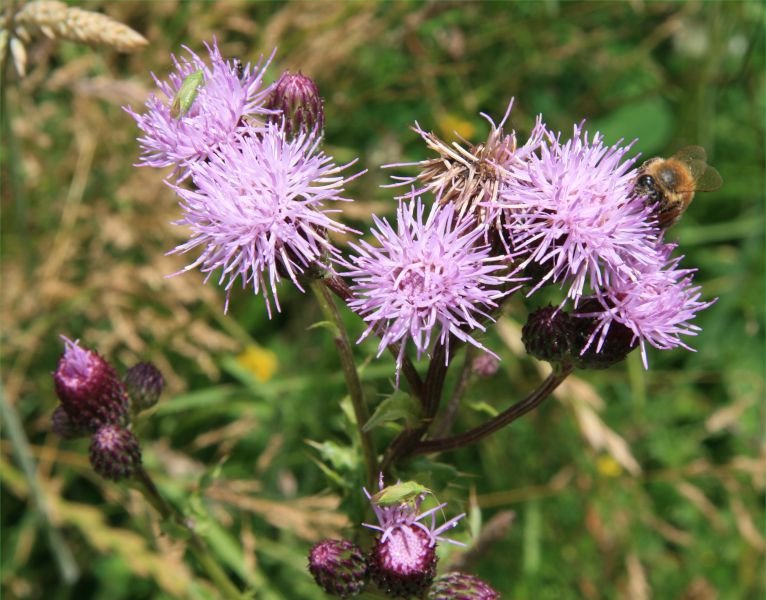
The flowers of the Californian thistle are purple, mauve or white, egg-shaped and about 20mm long by 15mm wide. This is smaller than Scotch and nodding thistles, although of similar size to the winged thistle.
The flowers on a single plant (or plant complex) are either all male or all female, and therefore pollination is often very poor with little if any viable seed being produced in a pastoral situation. Flowering occurs in summer and autumn.
DISTRIBUTION
The Californian thistle is common throughout all parts of New Zealand and in many areas is the major thistle problem, indeed in some regions it is the major pastoral weed pest of any kind. It will inhabit pastoral, arable and waste areas, and is able to grow in almost any climate. The plant was introduced from Europe.
PASTURE THEFT
Stock (except goats) will avoid grazing close to Californian thistle because of the sharply spined leaves. This leads to very poor utilisation of the closely adjacent pasture. The total effect of effective pasture loss with Calis has been reported as 600kg/Ha in a low thistle density paddock! The Californian thistle is without doubt the most economically significant of NZ’s pastoral weed species.
Additionally, sheep grazing pastures containing Californian thistles can suffer from scabby mouth, a viral infection of the punctures in the lips and mouth caused by the thistle spines.
CROPS
Californian thistle is highly competitive in crops, and can quickly establish in a new crop from an old root system. The residual herbicides that are often used in advance to protect new crops are not necessarily effective against the Cali because the thistle’s root system lies deeper in the soil than the effect zone of the residual herbicide, so that the thistle plant is unscathed and can product unexpected and considerable new growth.
AN IMPORTANT CONSIDERATION
At different stages of its growth, the sugars within the aerial (above ground) portion of Californian thistles will move in one direction or the other. At early flowering (late spring/early summer) the sugars are flowing predominantly up and out, from the upper leaves into the flowers. In late summer, at the end of flowering, the sugars begin flowing actively in the other direction, down into the root system. This change of direction of the plant’s “biological flow” can be exploited to maximise the effect of both chemical and non-chemical control measures, as will be discussed in Part 2 of this Weed File.
Part 2
CONTROL METHODS
There are three recognised methods used to control Californian thistles: Pasture Management, Biological Control, and Chemical Control. None of these is a failsafe solution, but with good timing and understanding of the processes involved, very pleasing results can be obtained.
PASTURE MANAGEMENT
A combination of mowing and heavy (sheep) stocking can be used to obtain quite good levels of control over a two year programme. It’s a four-step process, as follows:
1. Mow the thistles in mid-December or after weaning when ewes are mobbed.
2. Immediately graze ewes over the mown area at about 350 per Ha until mowed thistles are eaten off.
3. Return ewes to the area every 3-4 weeks to eat new growth while it’s soft.
4. Repeat the process next year (even though thistle numbers will be much lower than year 1).
Spraying with Rainbow & Brown MCPA750 has also been successfully used instead of the hard grazing.
Alternatively a decent result can be had simply from constant mowing timed just at flower bud stage, but before bud burst. Repeat the mowing each time the thistles reach this stage. Over two years this will also substantially reduce the density of Californian thistles in a paddock due to gradual depletion of the root reserves, and thus provides much better pasture utilisation. There will however continue to be at least some regrowth from any surviving root sections.
BIOLOGICAL CONTROL
There are two types of imported beetles being used or trialed in New Zealand, the Californian Leaf Eating Beetle and the Californian Thistle Flea Beetle. These are promising but it may be some years yet before the complete picture is known.
HERBICIDES TO KILL CALI THISTLES
Weed Wiper Herbicide Control of Californian Thistles
Weed wiping is an excellent control method for Californian thistles, for two reasons. Firstly, it allows the use of metsulfuron-methyl, a herbicide that the thistle is especially vulnerable to at all stages of its growth, and that is safe, easy and very inexpensive, but which cannot be sprayed because of grass and clover damage. And second because the Cali is such an erect weed that a very useful proportion of its total area is sticking up into the wiping zone, safely above the pasture.
- MSF600 applied at 50g/10L of water.
- G-360 GLYPHOSATE at 5% or 500ml/10L water. G-540 GLYPHOSATE at 333ml/10L water or Granny Herbicide at 225g/10L water
- Or our recommended solution which will give quicker visible results is:
- MSF600 at 25g/10L water plus either G-360 GLYPHOSATE at 250ml/10L, G-540 GLYPHOSATE at 170ml/10L water or Granny Herbicide at 110g/10L
In all cases graze to reduce pasture height prior to treatment, so that the wiper can be set as low as possible. Make multiple passes over thick patches.
Herbicide Boom Spraying to Kill Cali Thistles
Best results with spraying will come from making two applications in each of two successive years, as follows:
- Rainbow & Brown MCPA750 applied in early summer to the then smaller plants at 4L/Ha.
- Rainbow & Brown MCPA750 at 4L/ha plus Ralid 300g/L a.i. at 200ml/ha applied in autumn. This will take out any fresh growth plus and now-large survivors from the early season treatment above, but will cause some clover damage. Ralid is also very effective at killing root systems at this stage of growth.
- PastureMate at 4L/ha treating at flower bud stage.
- Dicamba 500 Select - 100ml plus 260ml Rainbow & Brown MCPA750 in 100L water per hectare.
- Dicamba 500 Select - 120-140ml plus 482g WHACK – 2,4-D 800 per 100L water per hectare.
- Ralid used alone in a conservation tillage situation at 1L/ha until early flowering. To be used under the personal control of a suitably qualified handler only.
- WHACK – 2,4-D 800 applied at 1.5-2kg/ha at hard ball stage once per season. Do not spray hay or silage paddocks though. Graze paddocks before application to remove clover foliage. Some clover suppression may occur. Repeat applications over following season will be required to achieve good levels of control.
- GrassMate XTRA - 2L/Ha – Apply to heavy infestations only. best results are achieved from application prior to flowering. Retreatment may be required.
Herbicide Spot Spraying to Kill Californian Thistles
- GrassMate at 6m/L applied anytime to whole plant. Grass friendly, but will suppress clover.
- WHACK – 2,4-D 800 at this needs to be applied at 45g/10L covering an area between 250m2 to just over 300m2 to get on the equivalent of 1.5-2kg/ha recommendation above.
- Rainbow & Brown MCPA750 at this needs to be applied at the equivalent of 3L/ha so test how much you spray but this is likely to be a spot rate of around 12ml/L
- Ralid at 25ml/10L (knapsack) or 100ml/100L (handgun). Effective anytime against larger plants. To be used under the personal control of a suitably qualified handler only.
- GrassMate XTRA at 6ml/L by knapsack – Apply during active growth from full leaf to early flowering – retreatment may be required.
Herbicide Spot Treatment of Cali Thistles
- Buckshot applied dry at 2g to the crushed centre of each plant. Best applied to smaller plants, but effective against larger plants as well. An excellent option for killing thistles that have survived or been missed in earlier treatments.
Cut Stem Herbicide Paste Treatment to kill Californian Thistles
- Cut the weed down to about 2cm above a node and dispose of cuttings appropriately.
- Take your bottle of Cut'n'Paste Bamboo Buster, hold it upside down and gently squeeze a layer of Bamboo Buster glyphosate gel onto the whole surface of the cut stem from the edge to the centre.
- Leave it to die off.
- For the best effects paste the Bamboo Buster herbicide gel onto the Bamboo immediately after cutting