
The Ultimate Guide to Controlling Onehunga Weed: When and How to Spray for Best Results
If you've ever walked barefoot across a New Zealand lawn and suddenly jumped in pain, you've probably met Onehunga weed (Soliva sessilis). This notorious little pest has been the bane of bare feet across the country for decades, and if you're dealing with an infestation, you're definitely not alone.
The good news? With the right knowledge about timing and treatment methods, you can effectively control this prickly problem. In this comprehensive guide, we'll walk you through everything you need to know about identifying, understanding, and most importantly, eliminating Onehunga weed from your property.
What Exactly is Onehunga Weed?
Onehunga weed hardly needs an introduction to most New Zealanders. Those painful prickles embedded in your feet are unforgettable! But understanding this weed's characteristics is the first step toward effective control.
Originally from South America, this unwelcome import gets its local name from the Auckland suburb where it was first reported in New Zealand. The plant thrives in our climate because it originates from similar latitudes, making our conditions perfect for its growth and spread.
This very low-growing, creeping annual weed forms expanding patches that can quickly take over lawns, turf, and sports fields. What makes it particularly frustrating for homeowners is that it grows so low to the ground that regular mowing typically passes right over it, leaving the plant untouched to continue spreading.
The Onehunga Weed Lifecycle: Understanding Your Enemy
Here's where it gets interesting (and slightly infuriating). Onehunga weed is primarily a winter annual, which means it has a specific growth pattern that's crucial to understand for effective control:
- Autumn: Seeds germinate as temperatures cool
- Winter: Plants grow and establish through the colder months
- October-December: Flowering occurs
- Summer: Fresh seeds are produced and spread by unsuspecting foot traffic
But just when you think you have it figured out, Onehunga weed throws a curveball. Some plants decide to germinate in spring instead, ensuring year-round potential for new infestations.
The leaves are quite distinctive once you know what to look for. They're 15-50mm long and finely divided with a feathered appearance due to their branching segments. The flowers are small and green, hiding inconspicuously within the leaf axils – it's almost as if the plant knows it's unwelcome and tries to stay hidden!
Of course, the fruits (those dreaded prickles) are anything but inconspicuous. Each small, oval-shaped fruit is about 3-4mm long and equipped with a sharp 2.5mm spine that seems designed specifically to find bare feet. The plant spreads through shallow, fibrous roots and creeping stems that root at nodes, allowing individual plants to form patches up to 40cm across.
Where You'll Find Onehunga Weed in New Zealand
Onehunga weed has made itself thoroughly at home throughout New Zealand, though it's more problematic in some areas than others. The weed is most common throughout the North Island, particularly in the upper regions. South Islanders aren't completely off the hook though – scattered populations exist in the upper and central areas.
This adaptable weed shows a clear preference for maintained areas where people spend time, which is part of what makes it so frustrating. You'll typically find it in:
- Home lawns and gardens
- Playing fields and sports grounds
- Parks and recreational areas
- Golf courses
- Sparse, stony pastures
- Waste areas and disturbed ground
The pattern is clear: anywhere people walk regularly becomes a potential highway for seed dispersal, helping the weed establish new colonies.
Why Most Herbicides Don't Work Against Onehunga Weed
If you've tried treating Onehunga weed with standard lawn herbicides and been disappointed with the results, you're not imagining things. This weed has proven resistant to many common herbicide treatments, which is why it continues to be such a persistent problem.
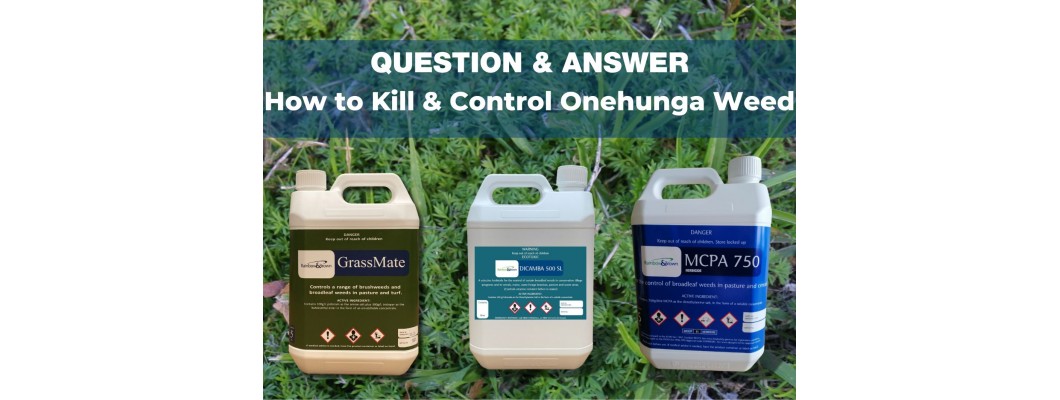
Most standard lawn and turf care herbicides simply don't work well against Onehunga weed. The usual phenoxy herbicides like Rainbow & Brown MCPA750 and WHACK – 2,4-D 800 that handle many broadleaf weeds are largely ineffective against this particular species unless they're boosted with additional active ingredients like Rainbow & Brown Dicamba 500 SL.
Effective Herbicide Options for Onehunga Weed Control
Fortunately, there are herbicides specifically effective against this stubborn weed. Here are the options that actually work:
For Home Garden Use:
- GrassMate at 2ml per 10 square metres is ideal for smaller-scale residential use. A major advantage is that it doesn't create grass clipping disposal issues, making it much more convenient for home gardeners.
- Lawnclean at 75-100ml in 10L water covering 250m² offers another choice, though it's not approved for pasture or cropland use.
For Commercial/Agricultural Use:
- Ralid is highly effective but comes with restrictions. Use 100ml per 100L water for spot spraying, or 1L per hectare for boom spraying. For knapsack sprayers, the rate is 25ml per 10L water. Important note: Ralid is not approved for home garden use and requires a qualified handler. Additionally, treated plants and clippings cannot be composted for at least six months after application.
- Rainbow & Brown Dicamba 500 SL combined with MCPA750 provides another professional-grade option. Use 800ml of Dicamba plus 1.5L of MCPA750 in 150-200L water per hectare.
The Growing Problem of Herbicide Resistance
Here's something that might concern long-term Onehunga weed battlers: resistance is becoming an issue. Some strains of Onehunga weed have developed resistance to the active ingredients in both Ralid and GrassMate (picloram and triclopyr).
If you've noticed that these products aren't working as well as they used to, or if control seems to be declining over the years, you might be dealing with a resistant strain. The good news is that resistant strains are still relatively uncommon and can be identified by their sparser, more slender leaf appearance compared to typical Onehunga weed.
The solution? Rotate your herbicide choices. If you suspect resistance, switch to an Rainbow & Brown MCPA750/mecoprop/Rainbow & Brown Dicamba 500 SL combination to regain control, then alternate between different active ingredients to prevent resistance from developing further.
When to Spray Onehunga Weed: Timing is Everything
Now we come to the crucial question that can make or break your control efforts: when should you spray Onehunga weed? Get the timing wrong, and even the best herbicides will disappoint you. Get it right, and you'll see dramatically better results.
The Primary Spray Window: Late Autumn (May-July)
This is your golden opportunity for Onehunga weed control. During late autumn, several factors align to make herbicide treatment most effective:
- Seedlings are small and actively growing, making them most vulnerable to herbicide treatment
- Young plants (2-8 weeks after germination) haven't yet developed the resilience of mature specimens
- Cooler, moist conditions improve herbicide uptake and effectiveness
- Plants haven't established extensive root systems, so control is more thorough
The Secondary Window: Early Spring (August-September)
Spring offers a second chance, particularly for:
- Plants that escaped your autumn treatment
- Spring-germinating plants (remember, some Onehunga weed germinates in spring)
- Areas where you've discovered new infestations
The key is to spray before flowering begins in October. Once plants start flowering, they become much more resistant to herbicide treatment.
When NOT to Spray: Timing to Avoid
Understanding when not to spray is just as important as knowing the optimal windows:
- Summer (December-February): Plants are often dormant or dead, making herbicide treatment ineffective and wasteful
- Peak flowering period (October-December): Mature plants are naturally more resistant to herbicides
- During active seed dispersal: There's a risk of disturbing and spreading viable seeds while treating
Your Seasonal Spray Calendar
To make timing simple, here's a month-by-month guide:
- May-June: Primary treatment window – target autumn seedlings
- July: Extended window for late-germinating plants
- August-September: Secondary window for spring germinators
- October onwards: Too late – plants are mature and setting seed
Application Tips for Maximum Effectiveness
Even with perfect timing, application technique matters. Here's how to get the best results:
- Temperature: Apply when temperatures are between 10-25°C for optimal herbicide activity
- Weather conditions: Choose calm, overcast days to reduce herbicide drift and evaporation
- Soil moisture: Ensure adequate soil moisture but avoid waterlogged conditions
- Mowing: Don't mow for 2-3 days after spraying to allow proper herbicide absorption
Taking Action: Your Onehunga Weed Control Strategy
Armed with this knowledge, you're ready to tackle your Onehunga weed problem effectively. Remember, successful control comes down to three key factors: using the right herbicide, applying it at the right time, and following up consistently.
Start by assessing your current infestation level and choosing the appropriate herbicide for your situation. Mark your calendar for the optimal treatment windows, and don't forget to consider resistance management if you've been fighting this weed for several years.
Most importantly, be patient. Onehunga weed didn't establish overnight, and complete control takes time and persistence. But with the right approach, you can reclaim your lawn and enjoy barefoot walks without fear of those notorious prickles.
Your feet (and your family's feet) will thank you for the effort!

Leave a Comment