
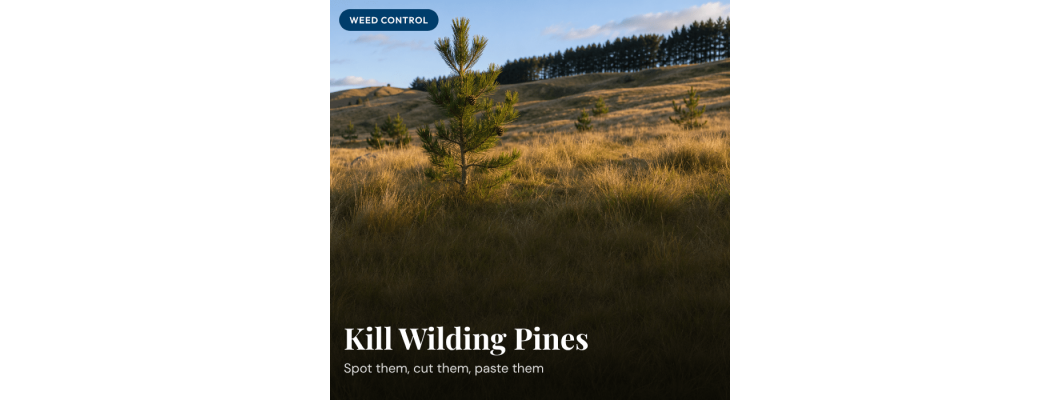
Wilding pines are self-sown pines, firs and larches spreading out of forestry blocks and shelterbelts onto farms, lifestyle blocks and conservation land. Pull seedlings under about 500mm by hand, and cut and paste anything bigger with a herbicide gel straight onto the fresh stump. Check the species first, because a couple of common wildings don't respond to every herbicide.
- ✓Count the needles in each bundle: it's the fastest way to tell the species apart
- ✓Hand-pull seedlings under 500mm, roots and all
- ✓Cut low, strip every bit of green, and paste the stump within seconds
- ✓Lodgepole, maritime and Corsican pine need a different approach to other wildings
On this page
That young pine coming up along your boundary fence or out in the back paddock probably wasn't planted by anyone. Wilding pines seed themselves from shelterbelts and forestry blocks, and once they start coning they throw seed for kilometres. This guide covers how to identify wilding pines in NZ, which species need special care, and how to kill them with the cut and paste method, so you can deal with them while they're still small and cheap to remove.
What are wilding pines?
Wilding pines (or wilding conifers) are introduced pines, firs and larches growing where nobody planted them. They're the wind-blown offspring of trees planted from the 1800s onwards for timber, shelter and erosion control.
Around ten species do most of the damage. Lodgepole pine (Pinus contorta) is the worst of them: it cones young, spreads furthest and has been an unwanted organism under the Biosecurity Act since 2010, so it can't be sold, propagated or planted. Douglas fir is the next most invasive. Radiata, Corsican, Scots, maritime, bishop, ponderosa, mountain and dwarf mountain pine, plus European larch, also go wilding.
There's no biological control for wilding conifers in New Zealand, so it comes down to pulling, cutting and herbicide.
Why do wilding pines matter in New Zealand?
Wilding pines already cover more than 2 million hectares of New Zealand and could spread across up to 7.5 million hectares within three decades if left alone. On a farm or lifestyle block, the cost of control climbs fast as trees get bigger.
- Shelterbelts are a common seed source. Older pine shelterbelts on farms and lifestyle blocks can seed into paddocks, gullies and retired areas, especially downwind of the prevailing wind.
- They take over open country. Tussock, high country, scrub and native regeneration areas are all easily overrun. Dense stands shade out pasture and native plants and use a lot of water.
- Your regional council may have rules. Regional pest management plans set out who has to control wilding conifers and where. Nine regions also run coordinated control under the National Wilding Conifer Control Programme, so check with your council before tackling a big infestation, as there may be support available.
How do I identify wilding pines?
Start by counting the needles. Pines hold their needles in small bundles of two, three or five, while firs have single needles and larches have soft tufts that drop in autumn. Needle length, cones and bark then narrow it down.
Here are the main wilding species you're likely to come across, based on the National Wilding Conifer Control Programme's Quick ID Guide.
| Needles | Species | What to look for |
|---|---|---|
| 2, short | Lodgepole (contorta) pine | Needles 2.5-6.5cm, stiff, often twisted and pointing forward. Small cones 3-6cm with a fine prickle on each scale. The one to check for first. |
| 2, short | Scots pine | Needles 4-7cm with a blue-grey, almost silvery tinge. Upper trunk and branches have thin, flaking orange-red bark. |
| 2, short | Mountain and dwarf mountain pine | Needles 3-7cm, stiff and dense like a scrubbing brush. Cones 3-5cm with no spines. Often low and shrubby. |
| 2, long | Corsican pine | Needles 8-16cm, grey-green, sometimes in threes. Dark grey bark in long ridges. |
| 2, long | Maritime pine (Pinus pinaster) | Needles 6-17cm, dull green. Big cones 7-16cm, shiny brown. Thick, deeply fissured bark with reddish plates. |
| 2, long | Bishop pine | Needles 7-16cm with a bluish tinge. Spiky cones held in rings around the branches. |
| 3 | Radiata pine | Needles 9-13cm, dark green. Cones 7-15cm, often in clusters. |
| 3 | Ponderosa pine | Long, stiff needles 13-25cm. Mature trees have big reddish, plate-like bark. |
| Single | Douglas fir | Flat, soft needles 1-2cm, pale underneath, orange-scented when crushed. Cones 5-10cm with three-pronged bracts poking out between the scales. |
| Tufts | European larch | Soft 2-4cm needles in dense tufts. Turns bright yellow and drops its needles in autumn. |
Don't confuse wildings with our native podocarps. Kahikatea (white pine), rimu (red pine) and mātai (black pine) are protected natives, not invasive pines, so always check the needles and growth form before you cut anything.
Not sure what you've got? Take a photo of a needle bundle next to a ruler, plus a cone and the bark, and send it to us. Getting the species right matters for which herbicide will work.
How do I kill wilding pines with cut and paste?
Cut and paste means cutting the tree off low and applying a herbicide gel to the fresh stump straight away. It's the go-to method for saplings too big to pull, and it's tidy enough to use near fences, tracks and plantings you want to keep.
Seedlings up to about 500mm tall don't need herbicide at all. Pull them out by hand, roots and all, ideally when the soil is damp. For trees over about 10cm trunk diameter, drill and fill is the other well-documented option, covered in our Wilding Pines weed file.
-
Confirm the species. Use the needle count above. If it's lodgepole, maritime or Corsican pine, read the gel section below before you start.
-
Cut low and level. Cut the trunk as close to the ground as you can, with a flat, horizontal cut. Then strip off every bit of green growth left below the cut. Any live branch or needle left on the stump can let it survive.
-
Paste immediately. Apply the gel within 15 seconds of cutting, before the cut surface starts to dry and seal. Cover the whole cut surface generously. On bigger stems, make sure the outer ring just inside the bark is well covered, along with the bark down to ground level, including the root collar.
-
Come back and check. Check treated stumps 3 to 6 months later and re-paste any green regrowth or missed stems. Then walk the site every spring or early summer to pull new seedlings while their roots are shallow, as more seed keeps blowing in.
Always follow product label and local regulations.
Which herbicide gel should I use on wilding pines?
For cut stumps on most wilding pines, a high-strength picloram gel gives the most reliable result. Maritime and Corsican pine need a glyphosate gel instead, and glyphosate is also the safer choice near waterways, native plants or anything you're unsure about, because it doesn't stay active in the soil.
Cut'n'Paste gels for wilding pines
Cut'n'Paste Picloram Plus+ is the top pick for cut stumps on most species, including lodgepole pine, and also knocks back gorse, broom and blackberry growing around the stumps. It isn't effective on maritime or Corsican pine. Its label rules out grazed pasture, home gardens and lawns, so keep it for shelterbelts and waste areas well away from stock and gardens. Cut'n'Paste Picloram also works well on cut stumps.
Cut'n'Paste Bamboo Buster and Cut'n'Paste Glimax are glyphosate gels. They're the pick for maritime and Corsican pine, where thick bark and heavy resin make metsulfuron and picloram unreliable, and for anywhere near waterways, natives or when you're unsure of the species.
Cut'n'Paste MetGel (metsulfuron) is best suited to drilling larger standing trees rather than cut stumps. Don't use it on lodgepole pine: the National Wilding Conifer Control Programme's Drill and Fill guide states metsulfuron doesn't work on that species. It's a home garden product that isn't ACVM-registered, so keep it away from food or feed crops, grazed pasture and other feed-producing areas.
Check for lodgepole pine first. For lodgepole (Pinus contorta) cut stumps, use Picloram Plus+, which Cut'n'Paste rate as excellent on this species. Don't use MetGel or any other metsulfuron product on lodgepole: the National Wilding Conifer Control Programme's Drill and Fill Good Practice Guide (V3.1, March 2025) states metsulfuron doesn't work on Pinus contorta.
MetGel and both picloram gels stay active in the soil for 6 to 12 months or more and can move through it to the roots of nearby trees and shrubs. Never use them inside the drip line (canopy edge) of trees or plants you want to keep, or near waterways and wetlands. As a guide, keep a 3 to 5 metre buffer on flat ground, and 5 to 10 metres if you're working uphill of plants you want to keep, as heavy rain can carry the herbicide downhill through the soil.
Practical tips for wilding pine control
- Tip: Take out the seed trees first. Coning trees upwind or up the slope keep reseeding everything below them, so stop the seed source before you clear the young ones. Then keep on top of seedlings: wildings take around 5 to 8 years to start coning, so regular sweeps mean none ever get there.
- Tip: Work while trees are actively growing. Spring through to late summer is the best window, when trees move herbicide through the stem most readily.
- Tip: Pick a dry day. Rain on a freshly pasted stump can wash gel off before it's absorbed. Check the rain-free time on the product label.
- Tip: Have the gel open before you cut. You've got about 15 seconds before the cut starts sealing, so cut one stump, paste it, then move to the next.
- Tip: Map your outriders. Note or pin the scattered trees on your block. They're the leading edge of the spread, and they're easy to lose track of once grass and scrub grow up around them.
Common wilding pine control mistakes
Mistake: Felling a pine and walking away. Pines with live growth left on the stump can survive. Strip all the green and paste the stump straight away.
Mistake: Treating every pine the same. Lodgepole, maritime and Corsican pine don't respond to every herbicide. Count the needles and confirm the species before you pick a product.
Mistake: Waiting too long to paste. Once the cut dries, the gel can't get into the stem properly. Paste each stump within 15 seconds of cutting it.
Mistake: Using a soil-active gel next to trees you want to keep. MetGel and picloram gels can move through the soil to nearby roots. Near shelter, natives or gardens, use a glyphosate gel instead.
Quick wilding pine checklist
- Needles counted and species confirmed (lodgepole, maritime and Corsican flagged, natives ruled out)
- Regional council rules checked for your area
- Seedlings under 500mm pulled out by hand, roots and all
- Right gel chosen for the species and for what's growing nearby
- PPE on, as per the label, and chainsaw safety gear if you're felling
- Stumps cut low and level, with all green growth stripped off
- Gel applied within 15 seconds of each cut
- Dry weather forecast for the label's rain-free time
- Stumps rechecked at 3 to 6 months, and the site swept for seedlings every spring
Next step: Walk your boundaries and shelterbelt margins this week and count how many young pines you've got coming through.
Wilding pine FAQs
Can I just cut a wilding pine down?
Cutting alone works on some pines if you cut below all the live branches, but it's not reliable. Pasting the fresh stump with a herbicide gel straight after cutting gives you a much better chance of a clean kill, especially on bigger trees.
What's the best gel for wilding pines?
For cut stumps on most species, Cut'n'Paste Picloram Plus+. For maritime or Corsican pine, or anywhere near waterways, natives or plants you want to keep, use a glyphosate gel such as Bamboo Buster or Glimax. For lodgepole pine, use Picloram Plus+ on the cut stump, not MetGel.
Do I have to control wilding pines on my land?
It depends on your region. Regional pest management plans set the rules, and some require landowners to control wilding conifers or stop them spreading to neighbouring land. Lodgepole pine is an unwanted organism nationwide, so you can't plant, propagate or sell it. Check with your regional council for the rules where you are.
How long does a treated pine take to die?
Expect needle browning and yellowing within a few weeks to a few months, with the tree fully dead over the following months. Check at 3 to 6 months and re-treat anything still green. It depends on the size of the tree, the species and the time of year, so don't expect an overnight result.
Further reading
- Wilding Pines weed file: drill and fill rates and method for larger trees
- The Cut'n'Paste range: how the gels work and which one suits which weed
- Herbicide guide for native planting sites: what to do with the ground once the pines are gone
References and external links
- Wilding Conifer Quick ID Guide (2023): photos and ID features for every main wilding species, from the National Wilding Conifer Control Programme
- Wilding conifer good practice guides: the Programme's cut stump, drill and fill and aerial control guides
- Wilding pines: information for landowners: what the Programme offers landowners and how to get involved
- Environment Canterbury: wilding pine: an example of the regional pest management rules for wilding conifers
- NZ Plant Conservation Network: check native podocarps like kahikatea, rimu and mātai before you treat anything
- Cut'n'Paste: Battling Wilding Pines: Cut'n'Paste's own identification and gel control guide
- Cut'n'Paste: Picloram Plus+ safety notes: more on using Picloram Plus+ safely
Rainbow & Brown has been helping New Zealand landowners deal with tough weeds since 1999. Not sure which pine you've got or which gel suits your block? Contact us and we'll help you work it out.

Leave a Comment