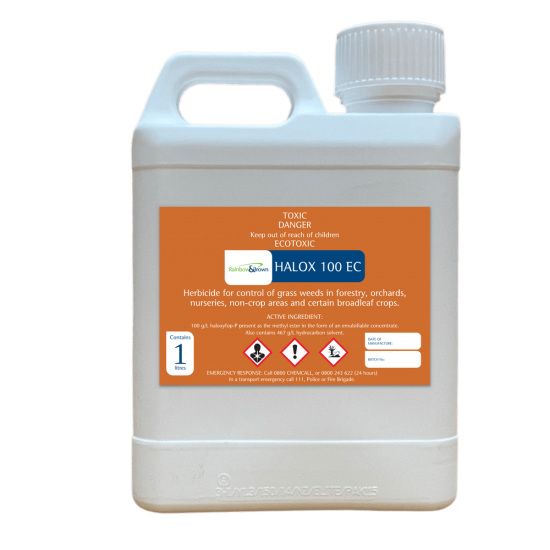
Selective Grass Herbicide – 100 g/L Haloxyfop-P
Halox 100 EC takes grass out of broadleaf crops, trees and non-crop areas without harming the broadleaf plants around it. It's registered for forestry, tree nurseries, pipfruit and citrus orchards, peas, lentils, asparagus, onions and non-crop areas.
It controls a long list of annual and perennial grasses, from wild oats, annual ryegrass, barnyard grass and annual poa through to tougher species like couch, kikuyu, paspalum, browntop and ratstail. At higher rates it also handles pampas grass and African feathergrass.
Foresters use it for tree release over radiata pine and eucalyptus, and nurseries spray it over seedling trees. On a lifestyle block it's handy for freeing up shelter belts, woodlot plantings and the home orchard, where grass competes hard for water and nutrients over summer.
Because it only targets grasses, it can go over the top of many broadleaf plants, so you don't need to shield or hand-weed around every tree.
Halox 100 EC uses the same active ingredient at the same strength as Scorp EC(1), Hurricane(2) and Ignite(3).
NOT REGISTERED FOR USE ON PASTURE OR GRAZING CROPS. KILLS LAWN GRASSES INCLUDING RYEGRASS, BROWNTOP, KIKUYU AND PASPALUM.
MUST BE UNDER THE CONTROL OF A SUITABLY QUALIFIED HANDLER WHEN MIXED, LOADED OR APPLIED.
Weed Identification Help
Not sure exactly what grass you're dealing with? Correct identification is the first step to getting good control.
Browse the Rainbow & Brown Weed File library to view photos of common New Zealand weeds and learn the best control options for each species.
Our Weed File includes practical information on problem weeds commonly found on farms and lifestyle blocks, helping you match the right product to the right weed.
Tip: Grass weeds vary a lot in how hard they are to kill. Annual grasses need a low rate, while kikuyu, couch and paspalum need the top rate, so identifying the grass first saves product and gets a better result.
What Halox 100 EC Controls and Where
Registered use areas
- Forestry tree release over radiata pine and eucalyptus species
- Tree nurseries: seedling radiata pine, eucalyptus, acacia, casuarina and other seedling plantation and ornamental tree species
- Pipfruit and citrus: as a directed spray around the base of the tree
- Peas and lentils
- Asparagus (after the final cut)
- Onions
- Non-crop areas
Grass weeds controlled
- Annual grasses: wild oats, annual ryegrass, summer grass, barnyard grass, bristle grass (including yellow bristle grass), volunteer cereals, annual poa
- Perennial grasses: cocksfoot, prairie grass, Yorkshire fog, sweet vernal, soft brome (goosegrass), perennial ryegrass
- Hard-to-kill perennials: cultivated couch, sod bound couch, mercer grass, browntop, ratstail, Indian doab, kikuyu, paspalum
- Large tussock grasses: pampas grass, African feathergrass
Hair grass and chewings fescue are not controlled at the label rates.
Good fits on the farm and block
- Releasing young pines and eucalypts from grass competition
- Clearing grass from around young shelter belt and woodlot trees
- Keeping grass down around apple, pear and citrus trees in the home orchard
- Spot spraying pampas in non-crop areas
- Grass control in peas, lentils, asparagus and onions
Directions by Situation
Forestry tree release
Can be applied over radiata pine and eucalyptus species. To also control broadleaf weeds in radiata pine, atrazine, simazine, terbuthylazine or clopyralid can be added. In eucalyptus, clopyralid can be added. Don't add spraying oil to mixtures with clopyralid or terbuthylazine. Some tree scorch can occur if trees are in spring flush.
Tree nurseries
Can be applied over seedling radiata pine, eucalyptus, acacia, casuarina and other seedling plantation and ornamental tree species. Where there's no previous experience, spray a few plants first before treating larger areas. Don't add spraying oil.
Pipfruit and citrus
Apply mixed with spraying oil as a directed spray around the base of the tree, keeping it off the fruit.
Peas and lentils
No more than 1.5 L/ha. Don't mix with any other herbicide unless previous experience has shown it's safe, and don't add spraying oil.
Asparagus
Apply mixed with a spraying oil such as BioWet after the final cut.
Onions
No more than 1.5 L/ha, mixed with a spraying oil such as BioWet. Best results come when the weeds are small and actively growing.
Mixing
Part fill the spray tank, add the Halox 100 EC, agitate, then add the rest of the water. If tank mixing with a compatible herbicide, add that first.
Application
- Aerial: 100–300 L/ha water, coarse spray quality
- Boom: at least 200 L/ha water, medium spray quality
- Spot gun: extension lance with a solid cone nozzle
- High volume: full-coverage wetting spray, hand lance with solid cone or handgun with a No. 4 tip at 500–2000 kPa, 1000–1550 L/ha
- Knapsack: wetting spray to saturation, at least 500 L/ha
For export crops, check with your exporter or crop advisor before spraying.
How It Works
Haloxyfop-P is absorbed through the leaves and moves through the plant to the growing points. It blocks an enzyme grasses need to build new cell membranes, so growth stops and the plant slowly yellows and dies off from the centre.
Broadleaf plants have a different version of that enzyme, which is why trees, shrubs and broadleaf crops are usually left alone.
Results aren't instant. Grass usually stops growing within days, but it can take two to three weeks to brown off fully, and longer on established perennials like couch and kikuyu.
It won't touch broadleaf weeds. If you want everything gone, including the grass, a non-selective spray like G-360 Glyphosate, G-540 Glyphosate or Granny Herbicide is the better tool. Halox is for when you need to keep the plants around the grass.
Technical Details
- Active ingredient: 100 g/L haloxyfop-P, present as the methyl ester, in the form of an emulsifiable concentrate. Also contains 467 g/L hydrocarbon solvent
- Herbicide group: Group A (aryloxyphenoxypropionates, "FOPs")
- Rainfast: 1 hour after application
- Spraying oil: use with a suitable spraying oil such as BioWet for best results, except on peas, lentils and nursery plants, and when mixed with other herbicides
- Tank mixes: compatible with terbuthylazine, simazine, atrazine and clopyralid
Rates (broadcast L/ha | knapsack mL/10L | spot gun mL/L | handgun mL/100L)
- Wild oats: 0.5 L/ha | 12.5 mL | 6 mL
- Annual grasses (annual ryegrass, summer grass, barnyard grass, bristle grass, volunteer cereals): 0.6 L/ha | 12.5 mL | 6 mL
- Annual poa: 1.5 L/ha | 30 mL | 15 mL | 300 mL
- Cocksfoot, prairie grass, Yorkshire fog, sweet vernal, soft brome, perennial ryegrass: 1.25–2.5 L/ha | 25 mL | 12.5 mL | 250 mL
- Cultivated couch: 1.25–2.5 L/ha (broadcast)
- Sod bound couch, mercer grass, browntop, ratstail, Indian doab, kikuyu, paspalum: 3.75–5.0 L/ha | 60 mL | 40 mL | 375 mL
- Pampas grass, African feathergrass: 7.5 L/ha | 150 mL | 60 mL | 500 mL
Peas, lentils and onions: no more than 1.5 L/ha. Water rates are under Directions by Situation.
Withholding period
- Peas and lentils: do not apply later than flowering
- Asparagus: do not apply during the cutting season
- Onions: do not apply within 5 weeks of harvest
Soil residues: do not plant cereal, maize or grass crops within 12 weeks of treatment.
Resistance: rotate with herbicides from a different group to slow the build-up of resistant grass biotypes.
Pack sizes: 1L, 2L, 5L and 20L (4 x 5L).
Registration: ACVM P009925. HSNO approval HSR008025.
Frequently Asked Questions
Will Halox kill kikuyu?
Yes. Kikuyu is on the label at the top rate (3.75–5.0 L/ha, or 60 mL per 10L knapsack). Established kikuyu is tough, so a repeat application may be needed where it's at an advanced growth stage or stressed.
Can I use Halox on my lawn?
Most NZ lawns are made up of ryegrass, browntop, kikuyu or paspalum, and Halox controls all of them, so in a typical lawn it'll take out the lawn along with the weed grasses. Chewings fescue and hair grass aren't controlled at label rates. Although Halox isn't specifically approved for use in lawns, we've had customers with fine fescue lawns tell us they've been getting good results taking out other grasses – it might be worth testing on a small patch first if that's your situation.
Can I use Halox on pasture?
No. Halox 100 EC isn't registered for pasture or grazing crops. Stick to the registered uses: forestry, nurseries, pipfruit and citrus, peas, lentils, asparagus, onions and non-crop areas.
Is it safe to spray around young trees?
It's registered for spraying over radiata pine, eucalyptus and other seedling trees, which is why it's widely used for tree release. Some tree scorch can occur if trees are in spring flush, so time it accordingly. Grass-like plants will be affected.
How long before I see results?
Grass usually stops growing within a few days, with yellowing and browning over the following two to three weeks. It's rainfast after one hour.
Safety & Compliance
Always read and follow label directions before use.
This product must be under the control of a suitably qualified handler when it's mixed, loaded or applied.
Wear overalls, boots, gloves and eye protection when mixing and applying. Don't spray directly into or onto water.
Avoid spray drift onto lawns, pasture and other grasses you want to keep. Check what your lawn is made of before spraying anywhere near it.
Got a question about using it? Get in touch – we're happy to help. For full handling information, see the label, leaflet, Safety Data Sheet and HazNote attached to this listing.
(1) Scorp EC is a registered tradename of Adria New Zealand Ltd.
(2) Hurricane is a registered tradename of Agsin Pte Limited.
(3) Ignite is a registered tradename of Arxada NZ Limited.