KIKUYU
Pennisetum clandestinum
Download the PDF

DESCRIPTION
Kikuyu is a perennial grass originating from north and east Africa. It is quite invasive, and spreads via creeping stems (stolons) above the ground, as well as similar rhizomes below the ground. Kikuyu prefers warm, moist and sunny conditions, and is particularly prevalent in Northland, but also occurs further south at least as far as Taranaki.
It is capable of growing and spreading in areas where most grasses perform poorly, including sandy sites, bare clay, roadsides and waste areas. Once established in these marginal locations it will spread out into pastures.
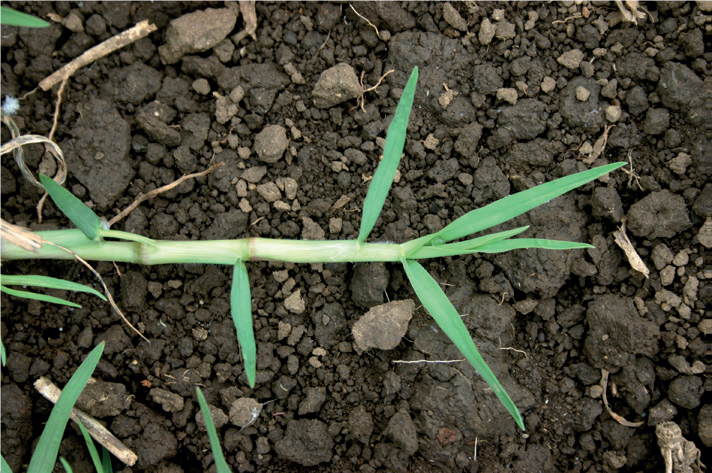
At the seedling stage it is hard to distinguish from ryegrass, but identification becomes clearer by December, when the stolons begin to rapidly elongate … they grow as much as 25mm a day in Dec to Feb. The leaf blades are long, and are hairy at the point where they join the stem. Colour is a light yellowish green.
Prior to December, kikuyu has a reasonable feed value and is valued by some farmers for its drought resistance, although it needs to be carefully managed to avoid rapid loss of quality after mid-summer, and also because it can at times be poisonous.
Because it quickly grows into a dense mat, kikuyu can smother out all other species, and also provide a habitat for crickets, army worms and black beetles.
The spread of kikuyu occurs mainly due to clippings, stolon fragments and seeds transported by machinery and the hooves of stock. Rhizome fragments are also spread by cultivation. It appears that kikuyu does not seed in some more southerly locations, which does make eradication easier in those areas. In Northland, where kikuyu does seed well, the seeds are known to last up to seven years in the soil.
PHYSICAL CONTROL
Grazing provides some measure of control, but if the kikuyu forms a dense mat of stolons over a large area it should be mulched or mowed in April right to ground level, in order to expose the soil for re-grassing (e.g. with ryegrass).
If smaller patches are physically removed by digging, all broken rhizomes must be removed or they will regrow. The difficulty of doing this, and of subsequent disposal, makes the process largely ineffective in most cases.
HERBICIDES TO CONTROL KIKUYU
Herbicides to Kill Kikuyu when spraying out pasture:
- G-360 GLYPHOSATE – 6L/Ha. Note that 6L/Ha is a higher rate than is normally required for spraying out old pasture. The ‘normal’ GLYPHOSATE rate of 3-4L/Ha is NOT ENOUGH to kill kikuyu … the use of 6L/Ha is essential to get a satisfactory result.
- G-540 GLYPHOSATE – 4L/ha. Equals the same effective application rate as for the 360g/L version above, when adjusted for the higher concentration.
- Granny Herbicide soluble granular glyphosate - sprayed at 2.7kg/ha. Equals the same effective application rate as for the 360g/L version above, when adjusted for the higher concentration.
- Halox 100 EC is non-selective and will kill most pasture grasses
- 3.95-5.0L/ha Halox 100 EC grass killer by boom spray
- 60ml Halox 100 EC per 10L knapsack sprayer
- 375ml Halox 100 EC per 100L via handgun
- If you want to suppress Kikuyu in Lucerne crops use the lower rate of 2.5L/ha Halox 100 EC
Wetter/Penetrant: When spraying kikuyu with GLYPHOSATE of any strength (360 or 450g/L) you’ll get best results if you DO NOT add a wetter/penetrant.
Herbicide performance will also be improved on dense infestations if you first cut it and then spray the more vigorous fresh regrowth.
Herbicides for Selective spraying of Kikuyu in pasture:
- TRICLO Herbicide, boom sprayed at 2L/ha during autumn, when there is enough soil moisture to ensure that growth conditions are good. This spray is pasture and ryegrass friendly but will severely knock back clover. As such it avoids the need to replace pasture that is in otherwise good condition, as long as the kikuyu has not become too dominant. It is possible to eradicate kikuyu using this method, but it will require one or possibly two similar follow-up treatments at 4-6 week intervals.
Cut'n'Paste Gels to Kill Kikuyu
Use Cut'n'Paste Original Gel > Hold up the Kikuyu with a gloved hand and wipe the herbicide gel onto the Kikuyu.