RATSTAIL
Sporobolus africanus
Download the PDF

DESCRIPTION
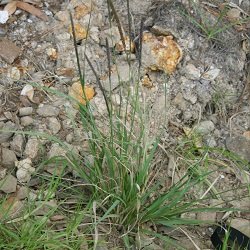
Ratstail is a grass weed. It’s an upright perennial grass that forms dense clumps about half-a-metre tall. Ratstail is not palatable to stock, and so tends to be a waste of space in grazing land.
Originally from South Africa, Sopobolus africanus is commonly called Paramatta grass in most countries it has invaded (in spite of Paramatta actually being located in Australia). But in New Zealand, it’s called ratstail.
Alas, one or two other grass and weed species are also called ratstail in some regions of NZ, leading to a wee bit of confusion for those not grasping the Kiwi sense of humour. But the real ratstail is Paramatta grass, which is Sporobolus africanus. Got all that? ‘Course you have!
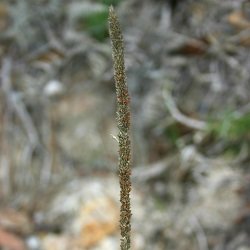
Ratstail is called ratstail because of its most distinctive feature, which is the seed head; a 20-30cm-long slender cylinder (technically it’s a panicle) composed of many hundreds of single-seeded spikelets, the whole of which looks rather like a rats tail. These seeds remain viable in the soil for up to 10 years, and are easily spread by stock, vehicles, and via contaminated grass seed mixes.
The leaf is unusual in that when it’s mown it doesn’t cut off cleanly but instead whispy, whitish leaf fibres remain visible, fluttering from the cut end of each leaf. The leaf itself is green, slender, shiny and very tough. There’s a white central grove in the lower part of the green leaves.
Ratstail likes swampland and margins, but also does well in dry northern pastures in NZ. It’s often seen infesting steeper hill faces.
MANUAL CONTROL OF RATSTAIL WEED
You can chip the smaller clumps out reasonably readily, and the whole plant can also be pulled out by the roots, though it’s very difficult work! If you do decide to pull or chip a few clumps out, be sure to first cut off all the seed heads and bag them for removal.
HERBICIDES TO CONTROL RATSTAIL WEED
There are really only a few herbicide options:
- G-360 GLYPHOSATE – 5L/ha or G-540 GLYPHOSATE – 3.3L/ha or Grannny Herbicide at 2.25kg/ha, when spraying out. Glyphosate herbicide is non-selective, very cheap, effective and has only a 1-day witholding period in line with good agricultural practice.
- Halox 100 EC – non-selective for grasses so will kill most grasses
- 3.75-5.0L/ha Halox 100 EC weed killer when boom spraying
- 60ml/10l when knapsack spraying
- 375ml/100L when handgun spraying
- You can suppress Ratstail in lucerne crops at the lower rate or 2.5L/ha
- Flupropanate, which we do not currently offer, is moderately selective, very expensive, effective, and has 4 months’ withholding for grazing.
The only advantage of flupropanate is the fact that it does only moderate damage to pasture species especially clover, whereas GLYPHOSATE and Halox 100 EC kills all pasture grasses, though not clover. Otherwise. GLYPHOSATE or Halox 100 EC beat flupropanate on a best-of-three-benefits basis, every day of the week.
Weed Wiper Herbicides for Selective Control of Ratstail Weed
The best possible broadacre treatment, terrain permitting, is to use a towed weed-wiper, with G-360 GLYPHOSATE, G-540 GLYPHOSATE, or Grannny Herbicide.
This effectively makes the GLYPHOSATE becomes a ‘selective’ herbicide, because it’s only being applied to targets above a certain height, and because ratstail sticks up above the grass & clover, it’s a perfect target for weed wiping.
Exact mix rate depends on your wiper, but in general rates of around 1 part G-360 GLYPHOSATE liquid to 3 parts water, 1 part G-540 GLYPHOSATE to 4 parts water, or 1 part Grannny Herbicide to 5 parts water, will give decent results.