
This Blog section is for news about Rainbow & Brown products and their application but especially new products.
30 Apr
Withholding Period for Herbicides
Although this information is available on our labels, we frequently receive inquiries about withholding periods. To address this, we have prepared a summary of the ACVM approved withholding periods for our product range.
| PRODUCT | WITHOLDING PERIOD – STOCK AND/OR PLANT BACK |
| WHACK – 2,4-D 800 | Poisonous plants such as ragwort and others may become more palatable after spraying and livestock should be kept out until plants have died off. For animal safety reasons do not graze treated pasture for 2 weeks after application. This will also allow WHACK – 2,4-D 800 to penetrate through the plant for maximum efficacy. |
| BUCKSHOT | Except for animal safety reasons, in line with good agricultural practice, a withholding period of 1 day is required. |
| DECISION | Do not graze crops or treated pasture for 14 days after treatment. |
| DICAMBA 500 SL | Do not graze treated areas or feed treated crops or threshings to livestock for two weeks after application. |
| GA200 | 28 days on all crops. |
| RAINBOW & BROWN GLYPHOSATE 360 | In line with good agricultural practice, a withholding period of 1 day is required. |
| RAINBOW & BROWN GLYPHOSATE 540 | A withholding period of 1 day after application is required as good agricultural practice. It is recommended that grazing or cultivating is delayed for 1 day after treatment of annual weeds or 3 days if perennial weeds are present to ensure absorption of Rainbow & Brown Glyphosate 540 Herbicide. |
| GRANNY GLYPHOSATE | In line with good agricultural practice, a withholding period of 1 day is required. |
| GRASSMATE | Other than for animal safety or re-establishment of clovers, a withholding period of 1 day after application is required as good agricultural practice. |
| HALOX 100EC | SOIL RESIDUES: Do not plant cereal, maize, or grass crops within 12 weeks of treatment. |
| RAINBOW & BROWN MCPA 750 | Except for animal safety reasons, a withholding period of 1 day after the application is required as good agricultural practice. |
| MSF600 | Keep dairy cows out of treated areas for at least three days after spraying. Keep other stock out for one day. |
| RANGER | Do not graze treated areas for 7 days after application. |
| TRICLO | Other than for animal safety or re-establishment of clovers, a withholding period of 1 day after application is required as good agricultural practice. |
|
ANIMAL SAFETY: Poisonous plants such as ragwort may become more palatable after spraying. If concerned that stock health may be affected, the stock should be kept away from treated areas until plants have died down. Delay grazing for two weeks after spraying as treated weeds will be palatable to stock. |
|
26 Oct


0
646
Every NZ farm that uses hazardous substances needs an up-to-date chemical inventory and a current safety data sheet (SDS) for each product, kept where workers and emergency services can get to them. When WorkSafe checked 680 sheep, beef and dairy farms in late 2025, missing SDSs and inventories were behind 94% of the improvement notices issued. B..
08 Oct
0
2131
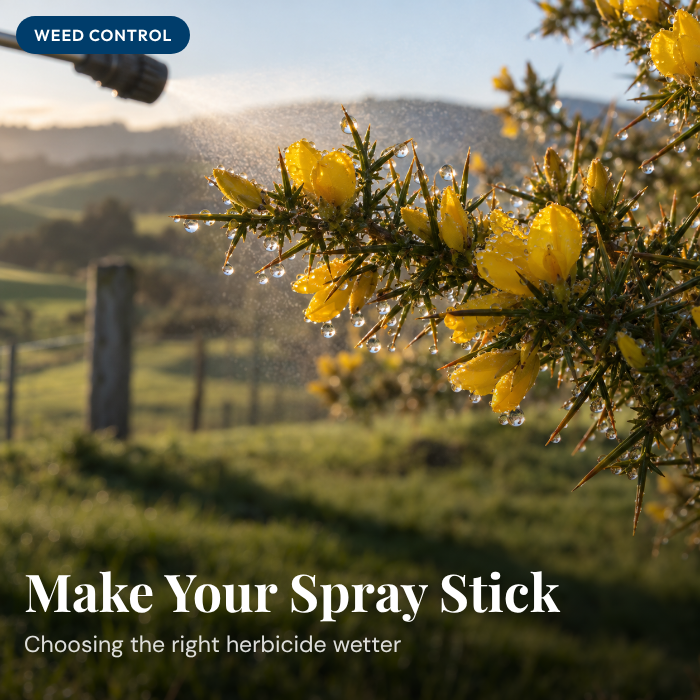
A wetter helps spray droplets spread across a leaf and stay there, instead of beading up and rolling off before the herbicide gets in. Use a non-ionic wetter for everyday spraying, and step up to an organosilicone wetter for waxy, hairy, dusty or stressed weeds. Always check the herbicide label first, because it tells you whether a wetter is need..
30 Sep

0
3420
Spring is the only time of year a wasp queen is on her own. She's out of hibernation, building a small nest by herself and feeding her first larvae with no workers to back her up. Catch her now and that nest never forms, which means no colony of thousands and no new queens next autumn.
✓Queens are active from early spring, roughly September to..
Leave a Comment