
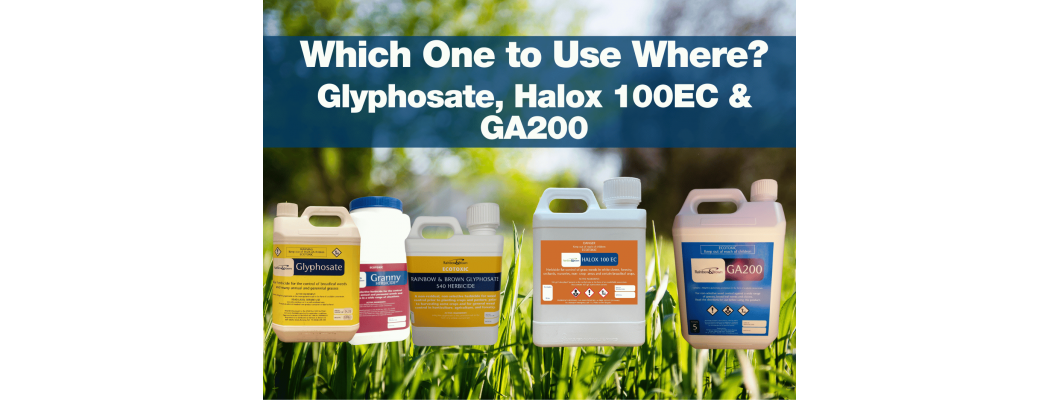
Glyphosate, Halox 100EC and GA 200 – Which one to Use Where?
We often get asked which of these three herbicides to use and where to use them.
Rainbow & Brown Glyphosate 360, Glyphosate 540 and Granny (high strength soluble granular Glyphosate)
Glyphosate, a broad-spectrum herbicide, is one of the most widely used chemicals globally. It is known for its effectiveness in controlling a broad range of weeds and grasses. Glyphosate inhibits an enzyme essential for plant growth, leading to the eventual death of treated plants. One of the primary advantages of Glyphosate is its systemic nature, allowing it to be absorbed through plant tissues, leading to more thorough weed control. Glyphosate pretty much deactivates in the soil so doesn’t have any residual activity. It is though, quite weak on clover so if you need to get rid of clover as well you will usually need to mix it with other herbicides.
Generally, of the 3 products, Glyphosate will be the most cost-effective with the cost per hectare being around $25.50+GST per hectare.
Halox 100 EC
Halox (haloxyfop 100g/L active ingredient), commonly known as a “post-emergent” herbicide, belongs to the group of selective herbicides. It is specifically designed to target and control grassy weeds while sparing broadleaf crops. This herbicide works by disrupting lipid synthesis in grasses, leading to their demise.
Halox is highly effective against various annual and perennial grassy weeds commonly found in grain and cereal crops. Halox 100 EC is also commonly used in forestry and nurseries where in many cases it can be sprayed over other non-grass plants without damage and to only kill the grass.
Quite cost-effective at around $40.00+GST per hectare.
GA200
GA200 (Glufosinate ammonium) is a non-selective herbicide that efficiently controls both broadleaf and grassy weeds. Our product is virtually identical to the well-known Buster(1) product used extensively in many orchards and vineyards.
It acts by inhibiting the production of glutamine in plants, leading to their death. While it shares some similarities with Glyphosate in its non-selective nature, glufosinate-ammonium is distinct in its mode of action. Unlike Glyphosate, GA200 will control clover.
GA200 has limited translocation and is more of a contact spray. Generally, if the spray gets onto nontarget plants it will only kill the part of the plant the spray is on and not kill the whole plant. This has saved my bacon a number of times when spraying around the Buxus hedges.
Least cost-effective at around $159+GST per hectare.
So which one to Use?
There is no simple answer to this. It depends on what you are trying to achieve.
If you are trying to clear out mainly grass around trees or gardens then Halox 100EC is a great option. If you want to clear out weeds and grass then either Glyphosate or GA200. Because of the cost if you want to clear out both weeds and grasses then stick with Glyphosate. If you are spraying around desirable plants, shrubs or trees then GA200 is a good option. You still need to be careful but any accidental overspray is likely to be less harmful than Glyphosate.
Prices are based on Rainbow & Brown pricing for 20L quantities and based on the aerial or boom spray rates recommended to kill perennial ryegrass. Many other types of grass will need lower rates and therefore be a lower cost again.
(1) – Buster is a registered tradename of BASF New Zealand Limited
Leave a Comment