Clover – Red
Trifolum pratense
Download the PDF

DESCRIPTION
Red clovers, though often valued as pasture plants, can become problematic weeds. It is a perennial legume that spread via seeds and creeping stems.
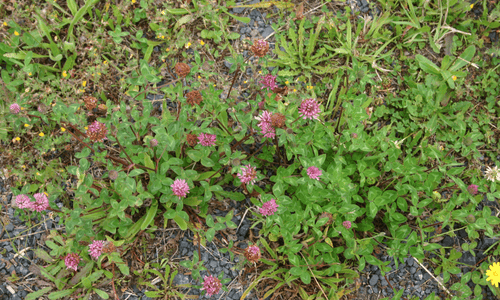
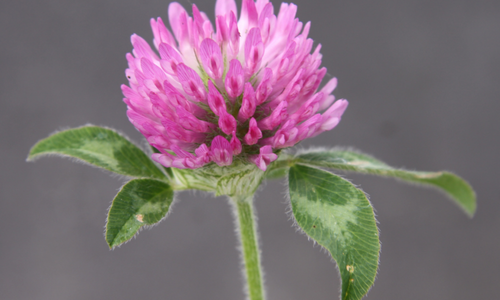
Red Clover is a short-lived perennial (2-4 years), growing upright up to 50 cm tall. Its hairy leaves feature oval leaflets with a pale “v” marking. Red-purple flower heads, containing 15-30 florets, bloom from October to March. It has a deep taproot, providing good drought tolerance. Both clovers produce abundant seeds and spread rapidly through seed dispersal and vegetative growth. Red clover is more resistant to clover root weevil, making it particularly persistent in some areas.
HABITAT
Red clovers thrive throughout New Zealand.
Red Clover:
• Summer-dry areas and less intensively grazed pastures
• Field margins, road verges, and disturbed ground
It prefers full sun but tolerate partial shade. They’re commonly found in cultivated areas, gardens, and fertile soil.
MANUAL REMOVAL
Control methods include hand pulling or digging, which is most effective on young plants in moist soil and requires removing stolons (white clover) or deep taproots (red clover). Regular mowing can prevent seed formation but won’t eliminate established plants, as white clover adapts to low mowing. Deep cultivation may help, though stolon fragments can regrow. Combining methods and monitoring regrowth yield the best results.
HERBICIDES TO CONTROL RED & WHITE CLOVER
Spray Application
Selective Herbicides (generally pasture and turf friendly – check the product label).
Selection of which herbicide to use really depends on what other weeds you might be wanting to kill as well as clover. All of the following will kill clover but each product has different weeds they target.
- Ranger Herbicide - 20g/ha or knapsack 1g/10L water for 500m2. Great if spraying for dock and buttercup as well.
- GrassMate – also great for brushweeds and many broadleaf weeds: Aerial 10L/ha, Boom spray 2L/ ha, or Knapsack spray 60ml/10L for 300m2.
- WHACK - 2,4-D 800 - Knapsack @ 45g/10L water. May only check clover so use with Dicamba 500 Select at 12-14ml/10L water depending on what other weeds you are trying to remove.
- Dicamba 500 Select 800ml + Rainbow & Brown MCPA750 1.5L in 200L water/ ha – for turf
- Dicamba 500 Select 800ml + Rainbow & Brown MCPA750 1.5L in 200L water/ ha – for pasture. Rainbow & Brown MCPA750 on its own won’t kill clover.
- Ralid - Aerial 0.7L/ha, Handgun 70ml/100L, or Knapsack 17ml/10L – apply to actively growing plants. Great for thistles.
- LawnMate – for turf, lawn and sport grounds: Aerial 3-4.5L/ha per 200L water, Handgun 75-110ml/10L water, or Knapsack 75-110ml per 250m2. Do not use on pasture or cropland.
Non-Selective Herbicides
Generally will damage or check pasture, turf and many lawns – check the product label
- MSF600 – Aerial 50g/ha, Handgun @ 5g/100L, or Knapsack 1g/10L.
NOTE: Generally, glyphosate is not very effective against clover.
Orchards/Vineyards
- GA200 (non-selective but low systemic movement so generally only affects the parts of plants hit by the spray). Kills most weeds and grasses:
- Seedling stage – Aerial 3-5L/ha, Handgun 300-500ml/100L, or Knapsack 45-75ml/15L.
- Flowering/established – Aerial 5-7.5L/ha, Handgun @ 500-750ml/100L, or Knapsack 75-115ml/15L.
Spot Treatment
Buckshot – apply 2-4g granules evenly over clovers. Grass friendly and good on many other broadleaf weeds also.