
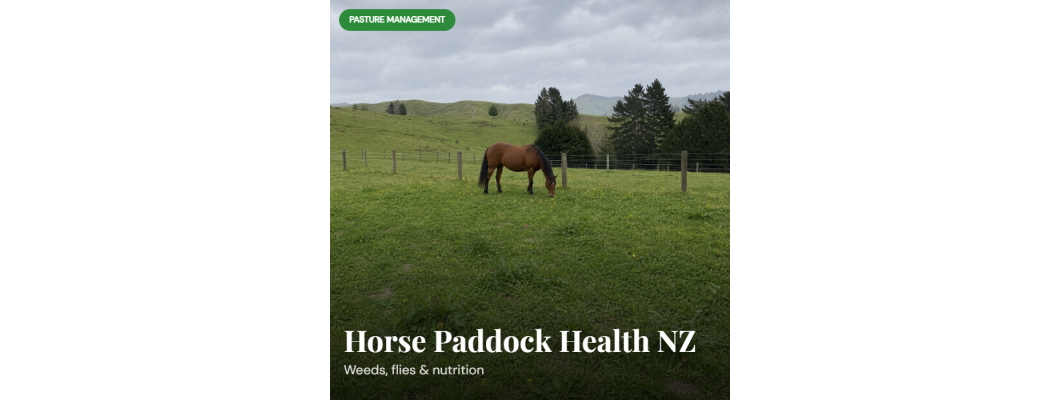
Healthy horse paddocks in NZ need a three-pronged seasonal approach: weed control for persistent species like docks and buttercups, residual fly and tick management through summer, and trace mineral support to fill gaps that good pasture alone can miss.
- ✓Docks and buttercups reduce pasture quality and can irritate horses; treat in early spring when weeds are actively growing for the best results
- ✓Summer fly pressure causes stress and disease risk; treating stable surfaces with a residual insecticide is more effective than topical repellents alone
- ✓NZ soils are often trace mineral-deficient; even well-managed horses on good pasture can be running short on zinc, copper, and selenium
- ✓A consistent seasonal plan beats reactive treatment every time
On this page
Horse paddocks have a way of looking great in autumn and terrible by Christmas. Docks come back in the same spots every spring. Flies arrive with the warm weather and don't leave. The horses look a bit flat despite being on decent pasture. None of this is bad luck, and it's a predictable pattern that a solid seasonal plan can break. Here's the practical version.
Why horse paddocks are a constant battle
Horse paddocks face a specific combination of pressures that make them harder to manage than sheep or cattle pasture. Horses are selective grazers; they'll eat certain areas down bare while leaving others almost untouched. That uneven grazing creates ideal weed recruitment zones in the ungrazed patches, and heavy hoof traffic compacts soil in high-traffic areas, further favouring weeds over pasture species.
The result is a paddock with distinct zones: overgrazed bare patches, and undergrazed rough patches full of docks, buttercups, and whatever else has seized the opportunity. Without active management, those weed zones expand every season.
Then add summer. Horse manure is ideal fly-breeding material, and a paddock full of it becomes a fly nursery by December. Ticks establish in the rough margins. And by mid-summer you're treating symptoms (stressed horses, irritated skin, constant swatting) rather than the cause.
The NZ context
- Docks and buttercups are aggressive colonisers in NZ conditions. Our wet winters and mild springs suit both species perfectly. Docks have deep taproots that regrow readily after surface disturbance, and buttercups spread by stolons as well as seed. Once they're established in a paddock, they don't go away on their own.
- Summer fly pressure is severe across most of the North Island. Stable flies, bot flies, and horse flies are common across NZ's warmer regions, and they can cause significant welfare issues including weight loss, coat damage, and transmission of internal parasites, in horses that are heavily pestered through summer.
- NZ soils are often trace mineral-deficient. Selenium, zinc, copper, and iodine deficiencies are well-documented across many NZ regions. These minerals don't show up in typical soil tests unless you look for them, and a pasture-only diet often doesn't provide enough, particularly for horses under any kind of workload.
Tackling docks and buttercups
Understanding what these weeds actually do to horses is useful context. Docks don't cause direct harm in small quantities, but dense dock infestations displace pasture grasses and reduce the overall feed value of the paddock. Buttercups are a more active concern: they contain ranunculin, a compound that breaks down to an irritant when the plant is damaged. Grazing buttercup-heavy pasture can cause mouth ulcers and digestive irritation, and fresh buttercup in contact with horse skin can cause blistering. The risk is highest when pasture is short and horses are forced to graze closely.
Both weeds respond well to herbicide treatment, and timing is the most important variable. The best window is early spring when weeds are actively growing, when uptake is highest and results are most consistent. Treating in summer or autumn gives slower, less reliable results and often needs repeating the following season anyway.
For horse paddocks specifically, Ranger (thifensulfuron methyl) is a well-regarded option. It's a water-dispersible granule formulation that targets docks and buttercups in pasture, carries no human or animal hazard classifications, and has a 7-day withholding period, which is shorter than many alternatives and matters when you have horses that need to rotate. Ranger works by stopping new weed growth rather than giving immediate knockdown, so allow 4-6 weeks for full die-off before assessing results. One timing consideration: Ranger causes a 3-4 month check in clover growth. For most horse paddocks this isn't significant, but if clover is important to your horses' diet or your pasture programme, factor that into when you spray.
For small isolated plants, hand-pulling docks works if you remove the full taproot, which requires a dedicated tool and more effort than it sounds. For any meaningful infestation, spraying is more practical and more reliable.
Always read and follow label directions, observe withholding periods, and check local rules around spraying near waterways. If you're unsure about timing or rates for your situation, contact us and we're happy to talk it through.
Fly and tick control
Topical fly repellents are useful for keeping flies off horses during handling and work, but they don't address the source. Flies breed in manure, rest on stable walls, doorframes, and fence rails, and keep cycling back regardless of what you put on the horse. The more effective approach is to treat those resting surfaces directly.
Recruit 100SC is a bifenthrin-based insecticide formulated for professional-strength use. It delivers fast knockdown and can maintain residual control for up to six weeks per application. An important characteristic: it's non-repellent. Insects don't detect it and avoid treated surfaces; they land, pick it up on contact, and that's that. Repellent products, by contrast, can push flies to other areas of the stable rather than actually reducing their numbers.
Application approach: spray stable walls, doorframes, fence rails, and other surfaces where flies land and rest. Do this during a dry spell so the product can set before rain. One customer who has used it across two summers reports significantly fewer bot flies as well as reduced stable fly pressure. Bot flies are particularly unpleasant for horses as they deposit eggs on the legs and coat, which horses then ingest while grooming.
Recruit 100SC is MPI Approved Type B and water-based. Keep horses out of the area during application and until surfaces are dry. Keep feed and water covered and don't spray directly onto bedding or into troughs. As always, read the label before use.
Trace mineral nutrition
A common assumption is that horses on well-managed pasture are getting everything they need. For macro nutrition (protein, energy, carbohydrate) that's often true. For trace minerals, it's frequently not.
NZ's volcanic and highly leached soils can be significantly deficient in selenium, zinc, copper, and iodine. These deficiencies don't always produce obvious clinical signs. What you might notice instead is coat that lacks condition, hooves that chip or crack more than they should, a horse that seems slightly flat in energy and immune resilience, or slow recovery from minor illness. The subclinical version of trace mineral deficiency is common and often goes undiagnosed.
A seaweed-based supplement is a practical, low-cost way to address this. Seaweed Treat Micro-Gran is sourced from Ascophyllum nodosum, a cold-water North Atlantic kelp regarded as one of the most nutrient-dense seaweed species available, and delivers 70 minerals, 17 amino acids, and natural plant growth promoters in a fast-dissolving microgranular form. It's BioGro certified and suitable for organic operations.
Practical delivery is 5-10 grams per horse per day through the water supply, roughly a teaspoon, once a day. Most horses accept it without issue. This isn't a replacement for a proper veterinary assessment if you suspect a specific deficiency or health issue, but as a baseline trace mineral supplement for horses on NZ pasture, it covers a lot of ground for very little effort.
Practical tips that actually help
- Tip: Spray in early spring, not after weeds are established. Herbicide uptake is highest when weeds are growing actively. A spring treatment gives you the best result with the least product. Waiting until summer means slower kill and more likely regrowth.
- Tip: Get residual insecticide down before fly season peaks. Applying Recruit 100SC in late October or early November means protection is in place before fly pressure builds. Waiting until December means you're already reactive.
- Tip: Don't mow treated paddocks until weeds are fully dead. Mowing before die-off is complete spreads plant material and can fragment dock roots, leading to regrowth from multiple points.
- Tip: Check hoof and coat condition monthly. These are often the first visible signs of trace mineral shortfalls. If you're noticing deterioration despite good management elsewhere, it's worth reviewing supplementation.
- Tip: Rotate treated paddocks. Giving a paddock a rest period after herbicide treatment allows die-off to complete and the pasture to recover before horses are reintroduced.
Common mistakes
Mistake: Treating dock infestations in autumn. Herbicide timing matters enormously. Treat in early spring when weeds are growing actively. Autumn treatments often give poor results and need repeating the following season anyway.
Mistake: Relying solely on spray-on fly repellent. Combine topical treatment with residual insecticide on stable surfaces. You need to treat the environment as well as the horse; repellent applied to the horse doesn't reduce the fly population in the stable.
Mistake: Assuming good pasture means complete nutrition. Pasture covers energy and protein well. Trace minerals are a separate problem in many NZ regions. A seaweed supplement is a low-effort baseline that covers most of the common gaps.
Mistake: Waiting for a visible problem before acting. Dock infestations, fly pressure, and trace mineral deficiency all respond better to prevention than treatment. A seasonal plan (spray in spring, treat stable surfaces in late October, supplement year-round) is far less reactive work than dealing with established problems.
Seasonal checklist
- Walk the paddock in early spring: map dock and buttercup patches before weeds get ahead of you
- Spray actively growing weeds (early to mid-spring for best results)
- Observe withholding periods before returning horses to treated paddocks
- Check paddocks at 4-6 weeks: assess die-off and identify any areas needing follow-up
- Apply residual insecticide to stable surfaces before fly season (late October to early November)
- Start trace mineral supplementation: 5-10g per horse per day through water supply
- Monitor hoof and coat condition monthly through spring and summer
- Spot-treat any weed regrowth before it re-establishes
- Next step: get your spring weed treatment sorted before the weeds get ahead. Contact us or order online at rainbowbrown.co.nz.
FAQs
How long after spraying can my horses go back into the paddock?
With Ranger, the withholding period before horses can return to treated pasture is 7 days. That's shorter than some alternative options, which is one of the reasons it's commonly used in horse paddocks. Always check the label for whatever product you're using and stick to the stated period, as it's there for a reason.
Will herbicide treatment damage my clover?
Ranger causes a 3-4 month check on clover growth. For most horse paddocks this isn't a significant issue; horses generally do fine without heavy clover in their diet, and it can recover by autumn. If clover is an important part of your horses' nutrition or your pasture renovation plan, factor that into your timing. Treating in early spring gives clover the best window to recover before cooler weather arrives.
Can I use Recruit 100SC in a stable where horses sleep overnight?
Yes, with the right approach. Recruit 100SC is water-based and designed for use in stable environments. You apply it to walls, doorframes, and surfaces where flies rest, not directly to animals or bedding. Allow treated surfaces to dry fully before horses return to the stable, ventilate the space during and after application, and keep feed and water covered during spraying. If you have a specific setup you're unsure about, contact us and we can talk you through it.
How much Seaweed Treat does a horse need per day?
The recommended amount for Seaweed Treat Micro-Gran is 5-10 grams per horse per day through the water supply, roughly a level teaspoon. It dissolves quickly and most horses accept it without issue. At 5g per day, a 1kg pack covers around 200 days for one horse, making it a cost-effective daily supplement. It's BioGro certified and suitable for horses in organic operations.
Further reading
Related products: Ranger (Thifensulfuron) · Recruit 100SC · Seaweed Treat Micro-Gran
Ranger is an ACVM registered product (No. P7668). Recruit 100SC is MPI Approved Type B. Always read and follow label directions. Withholding periods apply; observe before returning horses to treated areas. Contact us for advice specific to your situation.



Leave a Comment