
This Blog section is for news about Rainbow & Brown products and their application but especially new products.
23 Oct

In answer to a question regarding the withholding period for Decision herbicide.
Short answer is that it’s very low risk. In fact it’s really only got a withholding period due to the fact that Decision will kill some poisonous weeds that then become more palatable (i.e. less repellent to taste) as they die off, but that remain poisonous even though they are no longer tasting nasty.
The product itself is in practical terms non-toxic by ingestion, as can be seen in sections 11 & 12 of the attached Safety Data Sheet. There’s no toxicity even at the highest exposure levels that are conventionally tested … and those levels are way higher than any possible residual exposure from spraying too. Decision and its active ingredient have no EPA hazard classifications other than those relating to the expected and intended herbicidal effects (i.e. “Class 9 - toxic to plants”).
So as long as you have no poisonous weeds in the chicory, the risk of early entry of stock is near enough to zero, and the sheep, including lambs, are quite safe.
26 Oct


0
464
Every NZ farm that uses hazardous substances needs an up-to-date chemical inventory and a current safety data sheet (SDS) for each product, kept where workers and emergency services can get to them. When WorkSafe checked 680 sheep, beef and dairy farms in late 2025, missing SDSs and inventories were behind 94% of the improvement notices issued. B..
08 Oct

0
2128
A wetter helps spray droplets spread across a leaf and stay there, instead of beading up and rolling off before the herbicide gets in. Use a non-ionic wetter for everyday spraying, and step up to an organosilicone wetter for waxy, hairy, dusty or stressed weeds. Always check the herbicide label first, because it tells you whether a wetter is need..
30 Sep
0
3404
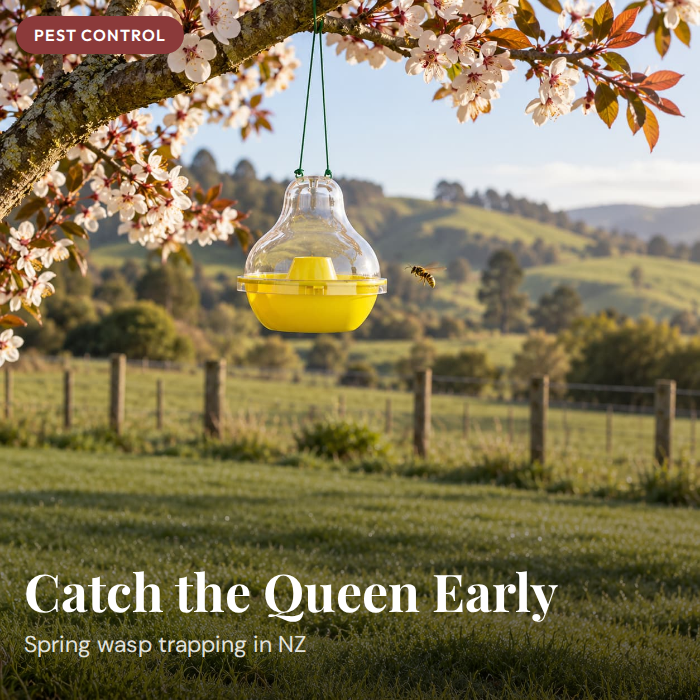
Spring is the only time of year a wasp queen is on her own. She's out of hibernation, building a small nest by herself and feeding her first larvae with no workers to back her up. Catch her now and that nest never forms, which means no colony of thousands and no new queens next autumn.
✓Queens are active from early spring, roughly September to..
Leave a Comment