
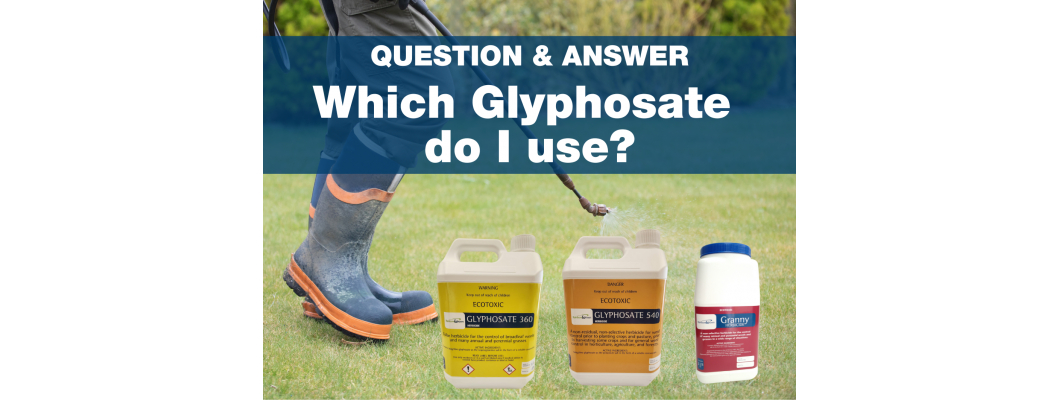
Nothing much separates our three glyphosate products except strength: G-360 Glyphosate, G-540 Glyphosate and Granny Herbicide all give you the same weed control, just at different concentrations, application rates and prices per 100L.
- ✓G-360, G-540 and Granny all do the same job, just at different strengths
- ✓Granny works out cheapest per 100L at current pricing
- ✓G-540 shows brown-off fastest, in 7-10 days on actively growing weeds
- ✓All three give you at least 4 hours of rain fastness
On this page
We get asked this a lot: what's the difference between our glyphosate products? The short answer is not much. The main thing that changes is the strength, and that flows through to how much you use and what it costs per 100L. Here's how G-360 Glyphosate, G-540 Glyphosate and Granny Herbicide stack up, so you can pick the right one for the job.
G-360 Glyphosate
G-360 Glyphosate is our standard-strength liquid option, and a straightforward choice for general spraying. It's 360g/L glyphosate as an isopropylamine salt, soluble concentrate, applied at 1L per 100L for general spraying, or 3-6L per hectare for pasture renovation. As a liquid, it's simple to measure and mix straight into the tank.
G-540 Glyphosate
G-540 Glyphosate is our highest-strength liquid, and the quickest of the three to show results. It's 540g/L glyphosate as a potassium salt, soluble concentrate, applied at 660ml per 100L for general spraying, or 2-3.5L per hectare for pasture spraying. Customers report brown-off in 7-10 days on actively growing weeds, making it a good fit when you want to see progress fast.
Granny Herbicide
Granny Herbicide is our highest-strength option overall and the one we reach for ourselves. It's 800g/kg glyphosate as water-soluble granules, applied at 425g per 100L for general spraying, 1.4-2.2kg per hectare for pasture spray out, or 65g per 15L for a knapsack. Granules need a bit more care dissolving than a liquid, but they store well and won't freeze over winter.
Cost per 100L compared
Once you factor in strength and application rate, the cost per 100L is close across all three, with Granny working out cheapest at current pricing.
| Product | Application rate | Cost per 100L |
|---|---|---|
| G-360 Glyphosate | 1L / 100L | $11.65 |
| G-540 Glyphosate | 660ml / 100L | $12.05 |
| Granny Herbicide | 425g / 100L | $8.21 |
Pricing based on 1 October 2026, for 5L purchases (2.25kg for Granny Herbicide), excl. GST.
Other things to weigh up
Price per 100L isn't the only thing that should drive your choice. A few other factors are worth thinking about too.
- Ease of use: liquids are simple to measure and mix, while granules need a little more care dissolving but store well and don't freeze in winter
- Speed: G-540 Glyphosate is the quickest to show brown-off, generally 7-10 days on actively growing weeds
- Rain fastness: all three give you at least 4 hours before rain washes them off
- Pack size: buying in bulk brings the cost per 100L down further on all three
FAQs
Which glyphosate should I use?
It depends on what matters most to you. If cost per 100L is the priority, Granny Herbicide currently comes out cheapest. If speed matters most, G-540 Glyphosate shows brown-off fastest. If you'd rather stick with a standard-strength liquid, G-360 Glyphosate is the simplest option. Contact us if you want advice specific to your situation.
Is granular glyphosate as effective as liquid?
Granny Herbicide is our highest-strength glyphosate product and works well in most conditions. The main differences from a liquid are in handling: granules need dissolving before use, but they store well and don't freeze over winter, which suits some setups better than others.
How long before rain can I spray glyphosate?
All three of our glyphosate products give you at least 4 hours before rain will wash them off. Always check current weather conditions before spraying, and follow the product label for full directions.
Can I mix glyphosate products together?
G-360 Glyphosate, G-540 Glyphosate and Granny Herbicide are all glyphosate at different strengths, so there's generally no need to mix them together. Contact us for advice if you're planning a tank mix with another product.
Further reading:



Leave a Comment