
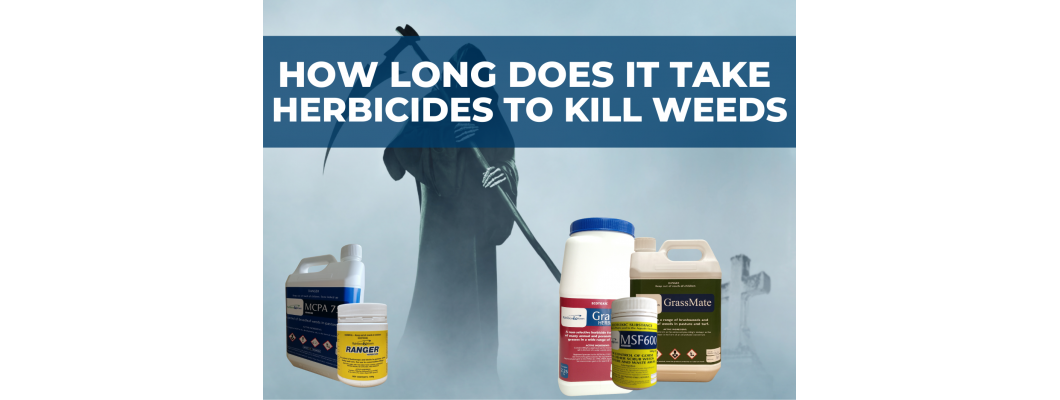
How long should it take stuff to die, after you’ve sprayed it?
It depends on three things.
First is the species, size and maturity of the weed involved.
Fast growing species, especially annuals, will die quickly because the herbicide is transported right through their smaller and simpler structures very quickly. Older, larger, and more mature weeds may take longer.
Second is the growing conditions.
The better a target weed is growing at application, the faster it will succumb to the herbicide. If the weed is near dormant, it can stave off the worst effects of the chemical for longer, and sometimes entirely. There are exceptions to this as sometimes the flow is away from the roots to feed the flowers or new growth.
Third is the herbicide and adjuvants used.
Herbicides have very different modes of action. Some simply work faster than others, as a necessary by-product of how they do their job. Although it goes without saying you need to select the correct herbicide for the weed you are trying to control. Some herbicides are very specific and will only kill a couple of weed varieties. Also, many are grass and clover friendly so no point in using these to kill grass as they just won’t work.
Some herbicides are available in different forms. 2,4-D for instance is available in a volatile ester form and a less volatile amine form and these will have slightly different kill times.
Here are a few examples.
Note: there are many variables in play and many exceptions so please do not flog us if the indicative times below are not 100% correct. This is a guideline only and more for comparison than the actual times.
Glyphosate
Glyphosate 360, Glyphosate 540, and Granny are fast acting, and are generally used against the faster-growing plants. Most grasses and broadleaf weed species will be looking crook within 3-5 days and will be dead within 5-10 days.
Glufosinate Ammonium
GA200 – a reasonably quick acting contact herbicide that kills by building up ammonia in the plant. Plants will stop growing within a day and death will occur anywhere from 2 days to 2 weeks, but normally within 3-5 days.
Triclopyr/Picloram
GrassMate and Triclo are a little slower acting and are often used against species that are slow growers such as brushweeds, and against the larger erect pasture weeds. Visible signs of distress usually take 7-14 days, and complete desiccation can take up to a month in some species.
Metsulfuron methyl
MSF600 has a very slow mode of action because all it does is prevent the plant from producing a substance that it requires for new growth. Many plants, especially slow growers, can tolerate that for quite a while before they become visibly distressed, and even then they can cling to life for a very long time. Gorse, for example, can take many weeks before the spine tips start to yellow, and many months – even as much as 18-24 months – before the plant fully dies off and disintegrates altogether.
WHACK – 2,4-D 800
WHACK – 2,4-D 800 – you will usually see signs that it is working after a few days and get full results after a few weeks.
MCPA750
MCPA750 – although often used in the same situations as 2,4-D, MCPA750 can take a bit longer and you may not see visible signs for a week or two and complete results for 3-4 weeks.
Picloram
Buckshot – can be a few weeks and longer if no rain to dissolve the granules.
Flumetsulam
Decision – on buttercup. Absorbed quickly where it stops cell division but after 30 days expect only around 20% death rate but by the 90-day mark you should be close to 100%.
Thifensulfuron
Ranger – on buttercup. After 30 days expect 30% death rate but again at the 90-day mark you should be near 100%.


Leave a Comment