
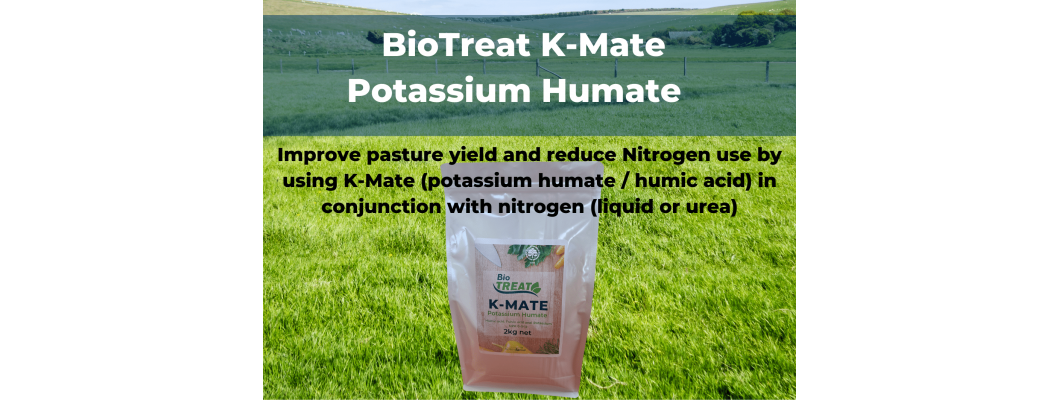
On the back of many international and successful trials, there had been little done in New Zealand on the benefits of humic acid and fulvic acid, especially when used in conjunction with Nitrogen. NZ trials were done back in 2012 by Phillip Schofi eld, Nicky Watt and Max Schofield testing the benefits of using humic acid granules (potassium humate/humic acid/fulvic acid) in conjunction with Urea to improve pasture growth.
IMPROVE PASTURE YIELD
 The results of their trials were conclusive and consistent with work done
overseas. Their trial results have been published and are available if anyone
wants to view these.
They did a wide range of trials over 4 years varying the usage rates of Urea,
using liquid urea, blends with humic acid (potassium humate) and in all cases,
the kg/DM/Ha were improved quite significantly.
For instance, their first trial was 6 applications of Urea at 65kg/ha with 3kg humic acid granules. The control was just 65kg/ha of Urea. Dry matter increased by 9% and over the 12 months produced an additional 1,680 kg/ha of dry matter. Do the maths!!! While this doesn’t sound like a lot, the cost implications are quite high as the dosage rate of the humic acid granules was only 3kg/ha and in many cases, they were able to reduce the Urea usage and still improved yield increases. Not only saving money and increasing yield but reducing their overall N inputs.
Other trials used liquid urea and humic and the total yields were even higher and the blend in this form yielded around 14% more kg DM/ha. This is to be expected as Urea applied in liquid form is known to be more effective than solid urea and better still would be to use our Nitrogen Boost as the source of the Nitrogen is from the amino acids so bioavailability is even better.
REDUCING NITROGEN INPUTS
You are all aware that using Gibber900 with Nitrogen Boost, Nitrosol Oceanic or even solid Urea will allow you to reduce your N inputs but normally you would only use Gibber900 during the autumn and spring. With K-Mate Potassium Humate (humic/fulvic acid) you can maintain pasture growth, or even slightly improve it while cutting back your Nitrogen usage by up to 70%.
The work done by the Schofields and Watts showed that the farms where the trials were carried out were
leeching around 18kg N/ha with pasture production over 21mt DM/ha. Over a four-year period, the Nitrogen
requirements reduced from 250kg N/ha to around 80-100kg N/ha and pasture production increased from
15.25 mt up to 17mt harvested per ha.
OTHER BENEFITS
Reducing nitrogen fertiliser inputs means reducing the amount of nitrates consumed by stock. There is
anecdotal evidence that this aids in reducing lameness, reducing somatic cell counts and improving
conception rates.



Leave a Comment