
SUCKLING-CLOVER
Trifolium dubium
Download the PDF

DESCRIPTION
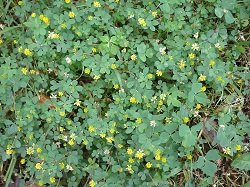
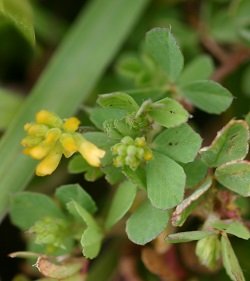
Suckling Clover: Trifolium dubium is generally smaller than most of the other New Zealand clover species and an almost hairless annual growing up to 5cm tall. Its’ wiry, thin stems either lying flat or curved slightly upwards. Yellow flowers in small heads span about 7cm across and sit on think stalks.
A single seed of about 1.5mm sits inside each seed pods which are normally around 2-3mm long.
It has trifoliate leaves which means each leaf has three leaflets.
Being a winter annual it mainly germinates in autumn, grows in winter and flowers in spring where it produces its seeds and then dies off as the soils dries out in summers.
Often found as a contaminant in white clover seed it is not generally considered a major problem for farmers and being a clover can be somewhat beneficial although being smaller its nutritional value is not as good as white clover. It is though a problem in turf and lawn where it produces mats of vegetation that detract from the overall appearance. It thrives under low mowing heights and because it fixes its own nitrogen it can thrive without the addition of nitrogen fertlisers.
Unlike the perennial white clover (Trifolium repens), which has a creeping stem with roots holding it to the soil, suckling clover stems do not have these roots and the stems are sometimes a reddish colour. Suckling clover can also be difficult to distinguish between the medick species.
HABITAT
Very common and found in pasture, lawns, gardens, cultivated and cropping land and waste places throughout New Zealand.
HERBICIDES TO CONTROL SUCKLING CLOVER
There are a number of herbicide control options that won’t damage your turf or pasture (other than clover), and of course being an annual it will die off naturally once flowering has finished in early summer. Keeping the turf dense and providing strong competition during the autumn will help stop the new seedlings from getting established. A few herbicides like ioxynil + bromoxynil + mecoprop will work when suckling clover is a seedling, but this weed is surprisingly hard to control once it is mature so our recommendations are:
- GrassMate – 2ml/10 square metres of lawn or turf, applied using a knapsack, handgun or if appropriate a small boom spray apparatus (such as a specialised greens/turf sprayer or a quad mounted system).
- TRICLO Herbicide – 2ml/10 square metres of lawn or turf, applied using a knapsack, handgun or if appropriate a small boom spray apparatus (such as a specialised greens/turf sprayer or a quad mounted system).
- GrassMate or TRICLO Herbicide are a better option (and they take out many of these also). The usage rates would be 2ml/10 square meters of turf, applied the same way.
- Dicamba 500 Select is also known to be effective against suckling clover.
- Ralid can be used under certain circumstances quite effectively but Ralid which contains clopyralid is not to be used for treating turf that will be mown and the clippings used for making compost; or made available for collection for, or deposited at, a municipal green waste recycling centre. It is also not to be used for lawns or home gardens. Add to that the requirement that it can only be used under the personal control of a suitably qualified handler during mixing, loading and application.
In all cases the addition of a wetter/ penetrant is not strictly necessary, but if one is available then add it at 0.1% of spray volume to get the best possible result, and to minimise the rain risk time.
Non-Selective Herbicides to Kill Suckling Clover in non-cropland areas
- TerbGuard 500 – Broadcast application at 15 – 19L/ha in 150 – 300L water. Add G-360 GLYPHOSATE, G-540 GLYPHOSATE or Granny Herbicide at the recommended label rates. TerbGuard 500 IS NOT SUITABLE FOR PASTURE OR CROPLANDS.