ONEHUNGA WEED
Soliva sessilis
Download the PDF

DESCRIPTION
Onehunga weed hardly needs to be introduced to anyone in New Zealand, especially anyone who goes barefoot on the grass. Its nasty prickles are familiar to pretty much everybody.
Originating in South America, including at latitudes similar to New Zealand, Onehunga weed is so-called here after the Auckland suburb where it was first reported.
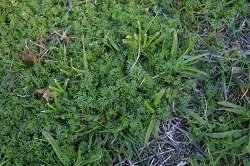
It is a very low-growing, creeping annual weed that forms expanding patches in lawns, turf and sports fields.
The plant is generally a winter annual, so it germinates in the autumn, grows through the winter, flowers Oct-Dec, and produces fresh seeds (fruits) that are then spread by the feet and jandals of every innocent bystander who walks across the plant. But occasionally, as if its prickles were not irritation enough, Onehunga weed will instead germinate in spring, presumably in order to spread the joy more evenly over the year.
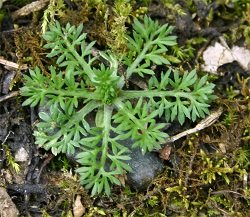
The leaves are 15-50mm long and finely divided, as well as being arrayed in branching segments so that they have a feathered overall appearance.
Flowers are green and very small, and effectively inconspicuous within the leaf axils.
The fruit is not so inconspicuous, due to it being the source of the painful foot prickles that this weed is so well known for. The individual fruits, also known as the prickles, are small and oval-shaped, about 3-4mm long and each with a sharp 2.5mm spine on one end.
The root system is fibrous and shallow, but the above-ground stems are creeping and readily take root at the nodes, resulting in the spread of the individual plants to patches about 40cm across. The plant grows very low and is usually beneath the cutting height of a mower blade.
HABITAT
Onehunga weed is common throughout the North Island, in particular the upper half. It does also occur, but to a much lesser extent, in scattered places in the upper and central South Island. The preferred habitat is of course lawns, as well as playing fields, parks, golf courses and sparse, stony pastures and waste areas.
HERBICIDES TO CONTROL ONEHUNGA WEED
Spray Herbicides to Kill Onehunga Weed in Lawns
Most lawn and turf care herbicides do not work well against Onehunga weed. The usual phenoxy herbicides like Rainbow & Brown MCPA750 and WHACK – 2,4-D 800 are ineffective unless boosted by the addition of other specialist actives like Dicamba 500 Select.
When to spray these herbicides: Apply during the optimal timing windows outlined above (May-July for best results) when plants are young and actively growing.
These are our recommended herbicides that are very effective:
- GrassMate – 2ml/10 square metres is a more suitable option for smaller-scale use, and does not involve any grass clipping disposal or composting issues. Best applied May-July when seedlings are small.
- Ralid – 100ml/100L water for high volume spot spraying, or 1L/ha for boom spraying. For knapsack sprayers use 25ml/10L water. Note: Ralid herbicide is not for use in home gardens. Treated plants or clippings must not be composted for at least 6 months after spraying. To be used only by a qualified handler.
- Dicamba 500 Select – 800ml plus 1.5L of Rainbow & Brown MCPA750 in 150-200L water per hectare.
- LawnMate – 75-100ml in 10L water over 250m2. NOT APPROVED FO USE ON PASTURE OR CROPLAND.
RESISTANCE
There have been some instances of strains of Onehunga weed becoming resistant to the actives in both Ralid and GrassMate (picloram/triclopyr). If you experience a poor result with either of these products or if the level of control over the years appears to be waning, alternate with an Rainbow & Brown MCPA750 / mecoprop / Dicamba 500 Select mix to regain the upper hand. The resistant strain is much less common and appears noticeably sparser and more slender in the leaf than the ‘normal’ Onehunga weed.
WHEN TO SPRAY ONEHUNGA WEED
The timing of herbicide application is crucial for effective Onehunga weed control. Here's when to spray for maximum results:
Best Time: Late Autumn (May-July)
- Apply herbicides when seedlings are small and actively growing
- Young plants (2-8 weeks after germination) are most susceptible to treatment
- Cooler, moist conditions improve herbicide uptake
- Spray before plants establish extensive root systems
Secondary Window: Early Spring (August-September)
- Target any spring-germinating plants before they mature
- Effective for plants that escaped autumn treatment
- Must spray before flowering begins (October)
Avoid These Times:
- Summer (December-February): Plants are dormant or dead
- Peak flowering (October-December): Mature plants are resistant to herbicides
- During seed dispersal: Risk of spreading viable seeds
Seasonal Spray Calendar:
- May-June: Primary spray window - target autumn seedlings
- July: Extended window for late-germinating plants
- August-September: Secondary window for spring germinators
- October onwards: Too late - plants are mature and setting seed