
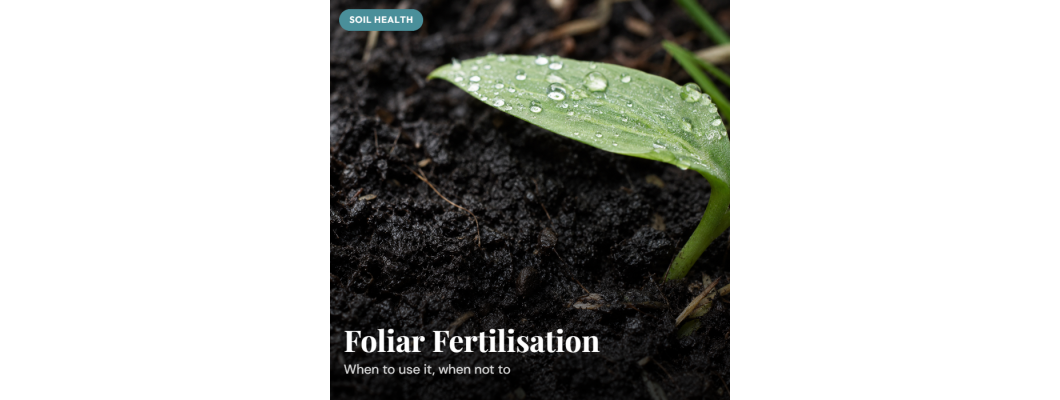
Foliar fertilisation means spraying dissolved nutrients directly onto plant leaves, where they're absorbed through the leaf surface and bypass the soil entirely. It's most useful for correcting mid-season deficiencies quickly, delivering micronutrients that soil chemistry is locking up, and supporting plants at critical growth stages when you can't wait weeks for soil-applied nutrients to work. It works best as a complement to a solid soil programme, not a replacement for one.
- Foliar feeding delivers nutrients directly through the leaf, producing a visible response within days
- Most effective for micronutrients (iron, zinc, boron, manganese) that soil chemistry often locks up
- Works independently of soil moisture, useful when dry conditions slow root uptake
- Can't replace soil fertilisation for bulk macronutrient demand or long-term fertility building
On this page:
Foliar fertilisation gets mentioned in farming circles fairly often without anyone stopping to explain what's actually happening at the leaf surface. This guide covers the what, the why, where it helps, and just as importantly where it doesn't. Useful reading for NZ farmers, horticulturalists, lifestyle block owners, and contractors.
What is foliar fertilisation?
Foliar fertilisation means dissolving nutrients in water, spraying them onto plant leaves, and letting the plant absorb them directly through the leaf surface rather than through the roots.
The nutrients bypass the soil and go straight into the plant's vascular system. Leaves take things in mainly through their stomata (the tiny pores that open and close to manage gas exchange and water loss). Nutrients can also move through micropores in the cuticle (the waxy coating on the leaf surface) and occasionally through small cracks in the epidermis. Once inside, the plant's own plumbing distributes those nutrients to wherever they're needed.
There's also a secondary effect worth knowing: whatever drips off the leaf hits the soil, and roots can pick that up too. So there's a degree of soil uptake happening alongside the foliar uptake.
This isn't a new idea. Foliar feeding started gaining serious scientific attention in the 1950s, when researcher Dr H.B. Tukey at Michigan State University began investigating how leaves absorb substances. Until then, most people assumed leaves were passive surfaces. Tukey's work established that they're actually quite effective at taking things in, which changed how the agricultural industry thought about nutrient delivery. It's now standard practice in horticulture, viticulture, orchards, arable cropping, and increasingly in pasture systems.
Why does it matter in New Zealand?
NZ's variable soils, dry summers, and intensive farming systems create conditions where foliar feeding can fill gaps that soil fertilisation alone sometimes can't.
- NZ soils lock up micronutrients more than many farmers realise. High-pH soils (common in parts of the South Island and some North Island volcanic soils) lock up iron, manganese, and zinc. Soils with high allophane content (widespread in volcanic regions including Waikato, Bay of Plenty, and Taranaki) have a high phosphorus-fixing capacity, holding phosphorus in forms plants can't access. Foliar application bypasses that chemistry entirely.
- Dry summers regularly compromise root uptake. Root uptake depends on water moving through the soil toward the root surface. When soil dries out (as it does across much of NZ from January through March) that process slows significantly even when nutrients are present. Foliar feeding operates independently of soil moisture.
- NZ's intensive farming systems create high-pressure growth windows. Dairy pasture, horticulture, and viticulture all involve critical growth stages where a fast nutrient response has real economic value. When a deficiency shows up mid-season, waiting weeks for a soil-applied correction isn't always an option.
How does foliar fertilisation work?
Nutrients enter through the leaf surface, move into the plant's vascular system, and are distributed to where the plant needs them. The whole process can produce a visible response within days.
-
Mix and apply at the right time. Nutrients are dissolved in water at the correct concentration and applied as a fine spray. For best uptake, apply when stomata are open (typically early morning or late afternoon, under moderate humidity). Avoid application in high heat or direct sun, which can close stomata and cause rapid evaporation before uptake occurs.
-
Nutrients enter through the leaf. Most entry happens through the stomata, but micropores in the waxy cuticle also allow movement. Cuticle thickness varies significantly between plant species; thin-leaved plants with minimal wax absorb foliar nutrients more readily than thick, waxy-leaved ones.
-
The plant distributes nutrients internally. Once inside the leaf, nutrients move through the phloem (the plant's internal transport system) to wherever demand is highest: actively growing tips, developing fruit, or deficient areas of the plant.
-
Residue reaches the soil. Whatever drips off or doesn't absorb hits the soil and becomes available to roots. This secondary uptake adds to the overall effect.
Always follow product label and local regulations. Concentration and timing requirements vary by product and crop type.
Foliar vs soil: where each has the edge
Both approaches have a clear role. The table below shows where each one earns its place and where it falls short.
| Where foliar has the edge | Where soil fertilisation wins |
|---|---|
| Speed. Produces a visible response within days. Useful when deficiency symptoms appear mid-season and you can't wait weeks for a soil-applied fix. | Bulk macronutrients. Plants need far more nitrogen, phosphorus, and potassium than leaves can safely absorb. Foliar can't carry the full macronutrient load without risking leaf burn. |
| Locked-up micronutrients. High pH, allophane soils, and compacted ground all prevent root uptake. Foliar bypasses that chemistry entirely and delivers straight to the plant. | Long-term fertility. Soil fertilisers (especially slow-release and organic types) build reserves that carry over season to season. You can't build organic matter or lasting fertility by spraying leaves. |
| Dry conditions. Root uptake slows when soil dries out, even if nutrients are present. Foliar feeding operates independently of soil moisture. | Soil biology. Fertilising the soil feeds microbial communities that cycle nutrients, fix nitrogen, and break down organic matter. Foliar feeding doesn't support that ecosystem. |
| Critical growth windows. Flowering, fruit set, heading: fast nutrient delivery at the right moment has real economic value. Foliar can hit those windows precisely. | Practicality at scale. Broadcasting or incorporating soil fertiliser across many hectares is simply more manageable than timing foliar applications to the right conditions across large areas. |
Rainbow & Brown foliar products
If you're looking for a starting point, our most used foliar options are BioTreat Amino-80 (BioGro certified, plant-based nitrogen and amino acids), Seaweed Treat Micro-Gran (trace elements and growth stimulation), and the Nitrosol range (liquid nitrogen, suited to pasture and horticulture). Not sure which fits your situation? Contact us and we can talk it through.
Practical tips for getting it right
Timing, concentration, and weather conditions determine whether foliar feeding works well or wastes time and money.
- Tip: Apply early morning or late afternoon. Stomata are open and conditions are cooler. Midday application in warm weather risks rapid evaporation before absorption, and high temperatures can cause stomata to close as a water-conservation response.
- Tip: Check the weather before you spray. Rain within a few hours of application washes nutrients off before they're absorbed. You need a dry window of at least 4-6 hours after application for meaningful uptake.
- Tip: Match the product to the actual deficiency. Foliar feeding works best when you know what's limiting plant performance. A soil test or tissue test before committing to a foliar programme tells you whether the problem is in the soil or whether soil chemistry is locking something up.
- Tip: Start with a trial area on unfamiliar crops or products. Species with thick, waxy cuticles absorb foliar nutrients less readily. What works well on one crop may be less effective on another.
- Tip: Think of foliar as the precision tool, soil as the foundation. The farmers and horticulturalists who get consistent results use both; soil fertilisation does the heavy lifting across the season, foliar applications fill specific gaps at specific times.
Common mistakes
Mistake: Applying in the middle of a hot, sunny day. Apply early morning or late afternoon when stomata are open and temperatures are moderate. Midday application in summer often produces poor uptake and risks leaf burn at higher concentrations.
Mistake: Using foliar as a substitute for a soil programme. Foliar is a complement, not a replacement. If your soil is depleted, poorly structured, or biologically flat, no amount of leaf spraying will address that. Sort the soil first, then use foliar for precision correction.
Mistake: Applying before rain without checking the forecast. Rain within 4-6 hours washes off nutrients before they're absorbed. You've spent money on product and time on application for minimal return.
Mistake: Applying the same foliar programme to every block without testing. Soil and tissue testing before you start tells you what's actually limiting. Applying broad-spectrum foliar products when you don't know what's deficient is an expensive guess.
Quick checklist
- Soil test or tissue test done: you know what's deficient or unavailable
- Identified whether the issue is true deficiency or soil chemistry locking nutrients up
- Weather suitable: moderate temperature, no rain forecast for 4-6 hours
- Applying early morning or late afternoon when stomata are open
- Concentration correct for the crop and product
- Trialled on a small area before full application on an unfamiliar crop
- Soil programme already in place, with foliar as the supplement, not the main event
Next step: If you're considering foliar feeding for the first time, start with a soil test. That tells you whether foliar is the right tool for your situation, or whether a soil programme adjustment is the better first move. Contact us and we can talk it through.
FAQs
Is foliar fertilisation better than soil fertilisation?
Neither is categorically better; they serve different purposes. Soil fertilisation does the heavy lifting: bulk macronutrient supply, long-term fertility building, and soil biology support. Foliar is the precision tool for fast corrections, micronutrient deficiencies, and situations where soil chemistry or dry conditions are blocking normal root uptake. The best results generally come from using both: soil as the foundation, foliar as the targeted supplement.
When is foliar fertilisation most effective in NZ conditions?
Most effective during dry summers when soil moisture is low and root uptake slows, mid-season when a deficiency symptom appears and you can't wait weeks for a soil-applied correction, and at critical growth stages like flowering or fruit set where a fast nutrient response has real value. Less effective when soil is wet and roots are actively feeding well, or when the real problem is a depleted soil biology rather than a nutrient availability issue.
Can foliar fertilisation damage plants?
Yes, if applied incorrectly. Too high a concentration, or application during hot conditions with direct sun, can cause leaf burn: damage to the leaf tissue you're trying to help. Application timing and concentration aren't details you can ignore. Always check product guidance for rate recommendations, and trial on a small area first when using a product or crop combination you haven't worked with before.
Which foliar products does Rainbow & Brown stock?
Rainbow & Brown carries a range suited to different situations, including BioTreat Amino-80 (plant-based nitrogen and amino acids, BioGro certified organic), BioTreat K-Mate (potassium humate with humic and fulvic acid, good for combining potassium delivery with soil-conditioning benefits), Seaweed Treat Micro-Gran (concentrated soluble seaweed for trace elements and growth stimulation), and the Nitrosol range (Oceanic, Original, Nitrogen Boost, and others). If you're not sure which fits your situation, contact us and we can talk it through.
Further reading
- Fulvic Acid Explained: How Fulvex 9500 Unlocks Nutrients Plants Can Actually Use — how fulvic acid acts as a natural chelator to improve nutrient availability, relevant to anyone looking at soil chemistry and uptake
- BioTreat range — soil health and plant nutrition — Rainbow & Brown's foliar and soil health range including Amino-80, K-Mate, and Seaweed Treat
- Nitrosol fertiliser range — liquid fertiliser options including Nitrogen Boost and Oceanic, suited to foliar application across pasture and horticulture
References: Tukey, H.B. and Wittwer, S.H. (1956). The entry of nutrients into plants through stem, leaf and fruit. Progress in Nuclear Energy Biological Sciences, Series Six, pp. 106-114. McGraw-Hill, New York. Ferrari, M. et al. (2021). Comparing Soil vs. Foliar Nitrogen Supply of the Whole Fertilizer Dose in Common Wheat. Agronomy, 11(11), 2138.



Leave a Comment