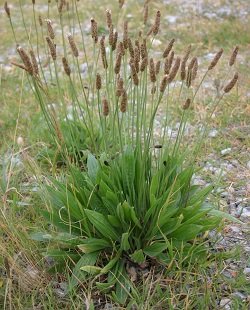
PLANTAIN (Narrow-leaved)
Plantago lanceolata

DESCRIPTION
This is a perennial flat weed, very common in pastures and in lawns and recreational areas.
It grows from a rosette with slender leaves, pointed at the ends. The flower stalks are tall (30-40cm) and unjointed, with a small cylindrical flower spike at the top. It flowers from July to August.
There is a related species called the broad-leaved plantain, and the differences between the two are fairly predictable from their respective names … narrow leaves versus broad leaves. The broad-leaved version also has a longer (i.e. deeper) flower spike.
The presence of plantains in pasture has traditionally been viewed as an indicator that the pasture is getting run down and is due for replacement. Also, that soil fertility levels may be low.
However, plantains are palatable to stock and are readily eaten. The narrow-leaved plantain is also quite tolerant of low fertility and has in more recent times has been included in pasture mixes, especially for organic and low-input farming systems.
Additionally, research in NZ has demonstrated that plantains have a higher content of certain minerals (copper, zinc) than ryegrass/clover pastures.
So, in pastures where the maximum possible production capacity is required, it’s probably justifiable to eradicate plantains, increase fertiliser applications and perhaps even replace the pasture entirely. But in more relaxed grazing systems the presence of plantains is not necessarily a bad thing at all, and their popularity as a desirable – or at least tolerable – pasture component is growing. If you’re spraying just for plantain control, it’s probably not worth the time and expense.
In lawns and recreational turf, however, the removal of plantains is almost always desirable to maintain a pleasing appearance.

HABITAT
Narrow-leaved plantain is common throughout New Zealand, below altitudes of about 100M above sea level. It thrives in low-fertility conditions, and can be found in pastures, waste areas, roadsides, sports grounds and lawns.
PHYSICAL CONTROL
In lawns and sports grounds, individual plants (rosettes) are easily lifted and removed. The patches of exposed ground after rosette removal should be fertilised and reseeded.
HERBICIDE CONTROL OF PLANTAIN (Narrow-leaved)
Selective removal from grass and turf is fairly easy, especially if clover damage is not a concern. Almost any broadleaf weed herbicide will control plantains well, especially when the plantains are at the seedling or small rosette stage.
In all cases add SprayWetter at 100ML per 100L water, for optimum penetration and to reduce rain risk period.
Selective Herbicide Sprays to Kill Plantain
- Rainbow & Brown MCPA750 – 2-3L/Ha in 200-300L water. Works best on smaller plants.
- WHACK – 2,4-D 800 – 2-2.5kg/Ha, in 100-300L water ground spraying. Seedlings and small rosette sage.
- GrassMate – 2L/Ha in 200L water. Effective against plantains at all growth stages.
- Ralid – 100ml/100L water for high volume spot spraying, or 1L/Ha for boom spraying. For knapsack sprayers use 25ml/10L water. Apply to actively growing plants. Note: Ralid herbicide is not for use in home gardens. Treated plants or clippings must not be composted for at least 6 months after spraying. To be used only by a qualified handler.
Herbicide Sprays to Kill Plantain in Pasture
If pasture is being sprayed out for renewal or cropping, then G-360 GLYPHOSATE, G-540 GLYPHOSATE or Granny Herbicide will also take out all the plantains. As plantains are often used as stock feed it would be unusual to want to selectively control plantain in pasture but if selective control in pasture is required, smaller plantains can be controlled as follows:
- Rainbow & Brown MCPA750 – 2-3L/Ha in 200-300L water.
- WHACK – 2,4-D 800 – 2-2.5kg/Ha, in 100-300L water ground spraying. Seedlings and small rosette sage.
- GrassMate – 2L/Ha in 200L water. Effective against plantains at all growth stages.
- PastureMate – 4L/ha in 200L water – clover friendly.
Spot control weedkillers to control plantain
- Use Cut'n'Paste Original Gel applied on the underside of the leaves. Use a gloved hand to support the leaves when applying the paste.