PERIWINKLE
Vinca major
Download the PDF

DESCRIPTION
Periwinkle is a ‘ground cover’ style plant, and in NZ originally escaped from gardens. It originates from the Mediterranean region.
The plant is a low, scrambling evergreen perennial. It forms dense mats of vegetation on long-running stems. The ground cover is so dense that it smothers out native plants and prevents regeneration of those species.
Periwinkle is subject to Pest Plant Management Strategies in some regions, which means that you are required to control it and in some cases to report it. Check with your local authority.
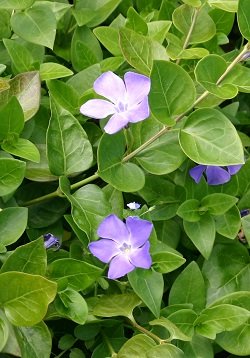
The plant can reach to 50cm height. The leaves are dark glossy green, leathery to the touch, and are up to 10cm long by 7cm wide. Leaves grow in opposite pairs on short stalks off the main stems, which can be 2 metres in length.
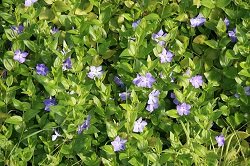
Flowers are distinctive, with five petals that fuse together near the tubular centre. They’re blue-violet in colour, white at the centre, and about 5cm in diameter. Periwinkle generally flowers in summer.
The root system consists of short shallow rhizomes at the nodes of the running stems. This root system allows the plant to spread quickly and aggressively.
Periwinkle is common throughout NZ. It will tolerate full sun or semi-shade, most soil types, salt, wet or drought conditions, heat or cold, and can survive heavy damage or grazing. It most frequently appears in waste areas, roadsides, disturbed bush, streamsides, and in gardens.
GENERAL CONTROL OF PERIWINKLE
Periwinkle is very difficult to eradicate once established, and any control method will require patience and repeat control efforts over 2-3 years.
PHYSICAL CONTROL OF PERIWINKLE
Very small infestation sites can be dug out. All plant material must be removed from the site and disposed of in a refuse transfer station, or burnt. Check for regrowth!
Mowing with a lawnmower on a very low setting can work on suitable sites. Mow 3-4 times a year, and grub out all regrowth after each mowing. This will take 2+ years of attentive work.
On small sites where spraying is not desirable, smothering with weed mat or black plastic can be effective. Cover for 6-12 months, then hand remove any surviving plants.
HERBICIDES TO CONTROL PERIWINKLE
Spray Herbicides to Kill Periwinkle
- Spray year-round with 1g MSF600 + 200ml G-360 GLYPHOSATE (or 130ml G-540 GLYPHOSATE or 90g Granny Herbicide) plus 5ml SuperWetter per 10L water, avoiding overspray into the drip line of adjacent desirable plants. Respray 2-3 times a year, for three years. This is not pasture or clover friendly
- Spray spring and autumn with 20ml G-360 GLYPHOSATE + 1ml SuperWetter per litre of water (or 13ml G-540 GLYPHOSATE, or 9g Granny Herbicide /L. In both cases + 1ml SuperWetter). Follow up each treatment on re-sprouting survivors with G-360 GLYPHOSATE at 30ml/L (or 20ml G-540 GLYPHOSATE or Granny Herbicide at 14g/L) plus the SuperWetter. This option allows closer spraying to the dripline of desirable plants. Repeat for 3 years. Again none of these options are selective so will kill pasture and clover sprayed.
Weed Wiping Herbicides to Kill Periwinkle
- Weed Wipe where practical using 500ml G-360 GLYPHOSATE (or 225g Granny Herbicide) + 2ml SuperWetter per litre of water. Repeat as regrowth dictates. Even though using non-selective herbicides the fact the weed wiper is appliing to the plant above the level of grazed pasture means that only the taller weeds are contacted so this method become selective control of periwinkle
Cut' stem Herbicide Control of Periwinkle
- Cut the weed down to about 2cm above a node and dispose of cuttings appropriately.
- Take your bottle of Cut'n'Paste Bamboo Buster, hold it upside down and gently squeeze a layer of Bamboo Buster glyphosate gel onto the whole surface of the cut stem from the edge to the centre.
- Leave it to die off.
- For the best effects paste the Bamboo Buster herbicide gel onto the Bamboo immediately after cutting