MANUKA
Leptospermum scoparium
Download the PDF

DESCRIPTION
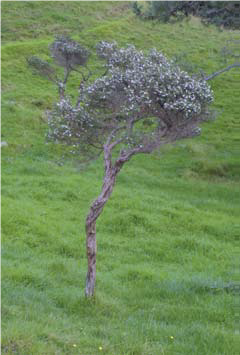
Manuka is a perennial scrub native to New Zealand and to parts of south-eastern Australia. It is a member of the myrtle family, and is often called tea-tree, apparently because Captain Cook used its fragrant leaves to make tea. There is a similar, related species (L. laevigatum) found in many coastal areas of NZ that has a clearer claim to the name tea-tree, but the name is widely used for both.
Manuka is a shrub or small tree with very attractive flowers, generally white or pink, growing in dense masses of separate individual blooms directly on the stems of the plant (i.e. without stalks). The flowers have no smell and generally appear from September to March.
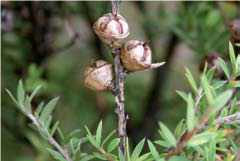
The fruit of the manuka takes the form of small woody five-celled capsules of about 7mm diameter. These split to release large numbers of very small and slender orange-red seeds which are spread mainly by the wind.
Leaves are small, up to about 10-12mm in length with pointed tips, and have a pleasant and strong myrtle fragrance when crushed.
Manuka oil, extracted from the crushed leaves, is highly prized for various health and medicinal properties, probably at least partly derived from a natural antibiotic substance (leptospermone) found in the oil.
Honey made from manuka flowers is also much sought after, both for its taste and its claimed medicinal benefits, and a significant industry in manuka honey exists in NZ.
Manuka is common (sometimes all too common) throughout NZ, and tends to do best in marginal areas and on incompletely developed land. It is a strong competitor as a seedling, and will often become established in serious numbers on hill country that has been cleared as a preliminary step to pasture improvement. While generally appearing as a shrub, manuka is capable of growing to 3 or 4 metres in height, and can form very dense thickets if not checked by early eradication.
Manuka can be confused with tauhini and kanuka. Tauhini has leaves with more rounded tips, and with near-white undersides, while kanuka is a taller plant but with smaller, narrower leaves and smaller flowers growing in groups of 2 or 3 blooms.
PHYSICAL CONTROL
Manuka is a good candidate for physical control methods such as scrub-cutting, slashing, and grubbing-out. Stumps left after manual cutting or slashing will normally die, and regrowth of cut manuka is not usual.
HERBICIDES TO CONTROL MANUKA
Cut & paint or paste Herbicides to Kill Manuka
Cut and paint (or paste) the stump within 10-15 minutes of cutting with any of the following.
- TRICLO Herbicide - 100ml/L of water
- GrassMate - 200ml/L of water
- MSF600 - 5g/L of water
- Cut'n'Paste Glimax Professional - apply a 2-4mm thick layer of gel on the cut stump.
- Cut'n'Paste Picloram Gel - apply a 2-4mm thick layer of gel on the cut stump.
- Cut'n'Paste MetGel - apply a 2-4mm thick layer of gel on the cut stump.
Weedkiller Sprays to Kill Manuka
Spraying can be successfully done at any time of the year, as long as the manuka is actively growing at the time it is sprayed. Complete coverage, especially of large bushes, is essential to obtaining a good result.
- MSF600 sprayed by air at 300g/Ha plus 2L SuperWetter penetrant in 400L water.
- MSF600 sprayed by hand at 30g/100L water, plus 100ml SuperWetter penetrant.
- GLYPHOSATE sprayed by hand at 1L/100L water by hand, or 9L/Ha by boom, in both cases also using 100ml SuperWetter per 100L water.
Notes:
GLYPHOSATE is preferred if hand spraying of smaller manuka growing in close proximity to valuable trees including orchards, because it has no soil residual effect. Nevertheless, the spray must be shielded to prevent drift or overspray.
MSF600 will not kill most native grasses, providing some grazing incentive for stock to penetrate and smash down the dying manuka thickets. MSF600 is the most cost-effective choice for larger spraying jobs targeting manuka, but it can take 4-6 months for a complete kill.