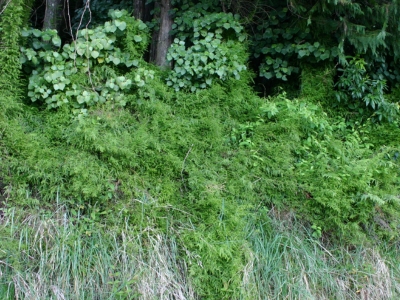
Climbing Asparagus
Asparagus Scandens
Download the PDF

DESCRIPTION
Climbing Asparagus, a vine native to southern Africa, was initially introduced to New Zealand as an ornamental garden plant. It has since become established and spread widely, becoming a significant invasive weed. This perennial, scrambling vine features thin, wiry green stems that can grow up to 6 metres long. Its fine, fern-like foliage includes small, delicate, lance-shaped leaves arranged in threes along the stem.
The plant's seeds germinate in autumn and early winter, growing slowly as the root system develops. It has tuberous roots that store energy and allow for easy resprouting.
Tiny white flowers appear on Climbing Asparagus from September to December, followed by green berries that ripen to red-orange from October to February. These berries, which are 8mm in diameter, contain 1-2 seeds each. It is worth noting that most plants do not flower until they are several years old and have developed substantial root systems, thus making them particularly resilient and challenging to control.
Additionally, this shade-tolerant, fast-growing vine can invade forest floors, preventing the regrowth of native seedlings. It can ringbark and kill soft-barked shrubs and trees, and it often invades areas typically occupied by epiphytes.
Similar species include Asparagus asparagoides, Asparagus setaceus, Asparagus densiflorus and even asparagus fern (Asparagus plumosa).
HABITAT
Climbing Asparagus is a weed that thrives in a variety of conditions, tolerating moderate to heavy shade, diverse soil types, and varying temperatures.
Particularly fond of disturbed and intact lowland and coastal forests, shrublands, mature broadleaf and/or podocarp forests, wasteland, scrub, epiphyte niches, and forest edges.
MANUAL REMOVAL
Manual control is very difficult on established infestations, but seedlings and juveniles can be pulled up successfully if the ground is loosened to ensure the rhizome is removed with the plants. Cut back the Climbing asparagus leaves and stems then dig out all roots and tubers. Tubers should be burned and destroyed.
Maintain rolling front of control, work outwards from inner bush.
HERBICIDES TO CONTROL CLIMBING ASPARAGUS
The best time to apply herbicides to Climbing asparagus is early spring, before flowering.
A combination of Cut Stump treatment and spraying can help tactic to target highly invaded areas. One or the other can also work.
Cut stem / wipe Treatment
Apply Cut’n’Paste Glimax Professional using plastic gloves. Wipe the gel on the underside of the growing leaders of the climbing asparagus. Hold the leaf with one hand and apply the gel with the other hand. Targeting the underside is effective as most stomata are located there, aiding in the absorption of the weed killer. Allow time for the weed to die, typically within a week or two. Follow-up treatment will be required every 6 months. Alternately apply 2-4mm of Cut’n’Paste Glimax Professional to the cut stem. The cut material will die without the need for treatment.
Spray Application
Glyphosate – Spot spray in autumn at the lower rates of G-360 GLYPHOSATE at 100ml/10L, G-540 GLYPHOSATE at 67ml/10L and Granny Herbicide at 45ml/10L. In Spring or early summer double these rates. Use Superwetter at 10ml/10L other than when spraying on tree trunks.
Work done in Australia would also show some other options. Both Triclo (triclopyr 600g/L) at 50ml/10L, which is pasture grass friendly and MSF600 (metsulfuron methyl 600g/kg) at 5g/10L will provide some control, although glyphosate is a better all around option. It is also likely that GA200 (glufosinate ammonium 200g/L) at 30ml/10L will work and is relatively safe around natives and trees but being a contact herbicide with little translocation the tubers are unlikely to be killed so regrowth is likely to occur.