
Bracken
Pteridium esculentum

DESCRIPTION
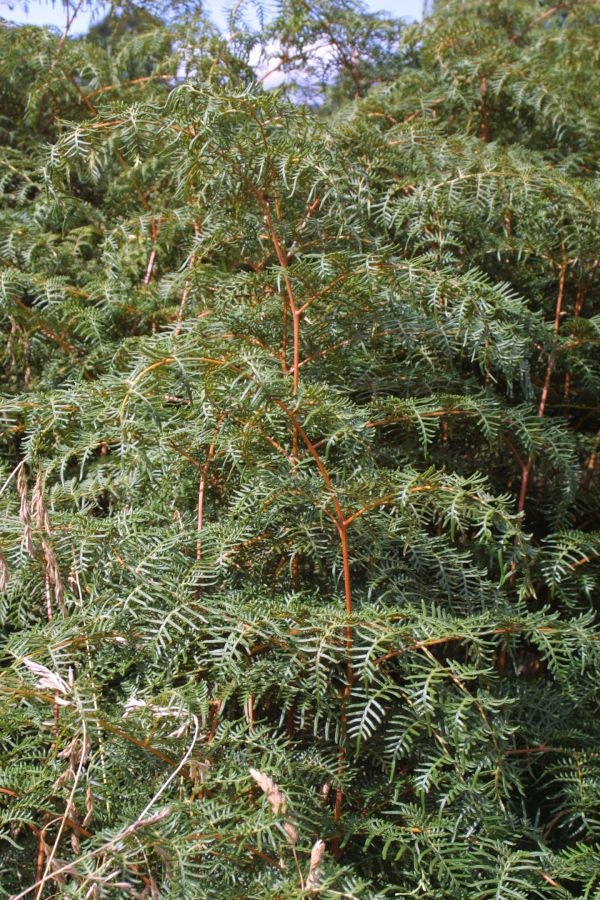
Bracken is a perennial fern with fronds up to 2 metres high and can form extremely dense stands. The fronds tend to die off in late autumn, although they often then remain standing for some years. New fronds emerge in the spring, so that established stands of bracken are a mix of old and new growth. Old frond litter forms a dense mat beneath the canopy and chokes out all other growth.
The fronds have the distinctive fern shape and structure, with narrow segments perpendicular to the rib from which they grow. The stems are typically erect at first, but as they become larger and heavier they will droop over and when established bracken is growing thickly it can force fences to the ground.
The plant has an extensive, spreading root system of thick, dark-colored rhizomes and fine roots. They form a thick network, usually in the top 15 to 20cm of the soil. This underground network is one of the reasons that bracken is hard to completely kill, at least in a single treatment.
The rhizomes have buds from which the new fronds emerge, and also give bracken good drought resistance as well as the means to regenerate efficiently after fire; this latter ability can be used against the plant, as is discussed below in the section on spraying.
Freshly opened fronds are bright, lighter green, but as they age through the year they become darker and harder.
The spread of bracken is achieved via spores that form on the underside of the fronds and can be windblown over a reasonable distance. These spores will normally germinate only in moist conditions.
Bracken is known to be toxic to animals, although the bracken type in New Zealand does not appear to be as toxic as is reported for some ecotypes from other countries. Stock in NZ will eat it in moderation, but this should be permitted only in spells to prevent the toxic effects that can result from prolonged exposure. Younger cattle are thought to be most at risk.
Bracken is also known to be carcinogenic and has been linked to cancers to people in constant proximity to large infestations in some other countries such as Wales. We’re not aware of any case of a carcinogenic link being established in New Zealand, however.
PHYSICAL CONTROL
Bracken is susceptible to cultivation, although it is generally growing in situations where cultivation is difficult or impractical. Repeated slashing and mowing is also effective in keeping the spread of bracken in check, and in allowing pasture species to compete. In light infestations, heavy treading by cattle will then minimise survival of freshly emergent fronds.
It is possible to eradicate bracken without chemicals over several years if it is progressively burnt and then extensively stocked with sheep in small blocks using a rotational grazing model to thoroughly control emerging regrowth. The system is reported to be effective but must be diligently followed for up to five years until 100% eradication is achieved.
HERBICIDE TO CONTROL BRACKEN
Spray Herbicides to Kill Bracken
The best time to spray bracken is from January to June when fronds are fully unfurled, but before the plant suffers frost browning (thus may be too late in some areas). Dense thickets with high trash content and low leaf-to-root ratio are best burned in spring, and the fresh regrowth sprayed in the autumn.
- MSF600 sprayed by air at 170g/Ha plus 1.5L SuperWetter penetrant in 300L water.
- MSF600 sprayed by hand at 35g/100L water, plus 100ml SuperWetter penetrant.
- G-360 GLYPHOSATE sprayed by hand at 1L/100L water by hand, or 9L/Ha by boom. in both cases also using 100ml SuperWetter per 100L water.
- G-540 GLYPHOSATE sprayed by hand at 700ml/100L water by hand, or 6L/Ha by boom. in both cases also using 100ml SuperWetter per 100L water.
- Granny Herbicide sprayed by hand at 450g/100L water by hand, or 2.7kg/Ha by boom. In both cases also using 100ml SuperWetter per 100L water.
Notes:
Glyphosate is preferred if hand spraying in close proximity to valuable trees including orchards because it has no soil residual effect. Nevertheless, the spray must be shielded to prevent drift or overspray.
MSF600 will not kill most native grasses, providing some incentive for stock to penetrate the dying thickets, which smashes down the bracken and minimizes regrowth. Overall, MSF600 is the most cost-effective spray to use on bracken.
Cut'n'Paste Gels To Kill Bracken
Cut the stem close to the ground and remove the cut foliage and stems for mulching. Using the convenient brush on squeeze pack apply a smear of any of the following Cut'n'Paste products onto the freshly cut stems.
