
WATTLE
Paraserianthes lophantha – Brush wattle
Racosperma mearnsii – Black wattle
Racosperma longifolia - Sydney golden wattle
Download the PDF

DESCRIPTION
All of these wattle species have similarities that allow us to consider them together here.
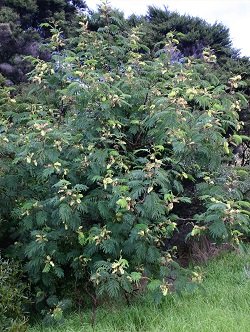
BRUSH WATTLE
A fast growing and prolifically-seedling evergreen tree. It can reach 5M in height. The flowers are green-yellow, and of a loose bottlebrush shape to about10cm long. Flowers appear from May-Aug. The leaves are dark green and twice-divided into many subdivisions. The fruit is a long green or brown pod containing the several hard, dark coloured seeds.
The brush wattle favours stream banks, steep ground, earth slips and coastal sites. It’s common through the North Island, and the coastal areas of the South Island, except on the western side. It’s the subject of Pest Plant Management Strategy in some regions.
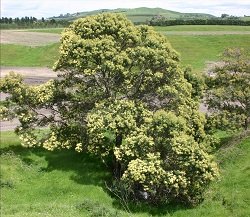
BLACK WATTLE
Ranges from a shrub to a large tree, and is distinguished by its abundant flowers, in rounded clusters of creamy yellow, appearing from Sep-Nov. Leaves are twice divided and dark green. Fruit is a pod sometimes slightly curved, and up to 9cm long.
Black wattle prefers waste areas, scrubland and stream banks, and often appears in pastures. It’s distributed pretty widely in the North Island, and the northern and eastern parts of the South Island. This species was planted extensively in the Waikato a hundred or so years ago, and the bark used in tanning processes.
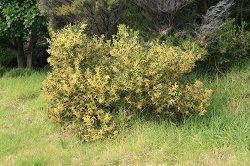
SYDNEY GOLDEN WATTLE
Similar to black wattle, but the flowers are pale golden coloured, and appear from Jul-Sep. The leaves differ in that they are long and flattened with two to four prominent veins.
Sydney golden wattle is distributed similarly to black wattle, at least down as far as Nelson, and is subject to a Pest Plant Management Strategy in some regions.
MANUAL REMOVAL
Smaller plants can readily be hand-pulled. Cutting down larger specimens will invariably result in regrowth from the stump, so is not a complete control solution.
HERBICIDES TO CONTROL WATTLE
There are several methods and herbicides to choose from, and the best solution will depend on factors including size and extent of the wattle infestation, proximity to valuable native species, and the time and chemicals you have available.
- Cut & squirt (year round): Make 1 cut every 100 mm around the trunk and saturate each cut with 10ml undiluted TRICLO Herbicide.
- Frilling: Cut downward to the sapwood to make an encircling frill, and apply;
- G-360 GLYPHOSATE – 250ml/L water, or
- G-540 GLYPHOSATE – 165ml/L water, or
- Granny Herbicide – 110g/L water.
- Injection (year round): drill holes sloping into the sapwood at regular intervals around the tree. As each hole is drilled saturate it with:
- G-360 GLYPHOSATE – 250ml/L water, or
- G-540 GLYPHOSATE – 165ml/L water, or
- Granny Herbicide – 110g/L water., or
- 3g/L MSF600 (usually the cheapest option but a slower kill time), or
- 10ml undiluted TRICLO Herbicide (triclopyr based herbicide).
- Stump swabbing (year round): 5g/L of MSF600 or 50ml/L of TRICLO Herbicide (triclopyr based) weed killer.
- Stump Swabbing GrassMate XTRA 1 part GrassMate XTRA with 20 parts of water or diesel.
- Spray (spring-summer):
- G-360 GLYPHOSATE – 10ml/L, or
- G-540 GLYPHOSATE – 7ml/L, or
- Granny Herbicide – 5g/L or TRICLO Herbicide – 30ml/L.
Cut'n'Paste Gel Herbicide Pastes to Kill Wattle
- Cut'n'Paste MetGel applied as a 4mm paste on the freshly cut stems is a simple and effective control although like all metsulfuron methyl based herbicides it is a long kill time.